Ninety thousand spectators filled Wembley Stadium for Wladimir Klitschko’s final fight. In the fifth round, Anthony Joshua knocked him down. In the sixth, Klitschko returned the favor with a straight right hand that left the younger champion on his back.
Joshua recovered and won, but that April 2017 contest offered a different ending from the one Klitschko’s critics might have expected. After years of methodical championship defenses, his farewell was an open, punishing heavyweight fight.
He retired with 64 wins, five defeats and 53 knockouts. The route to that record began with Olympic gold, passed through losses that threatened his career, and produced a championship reign lasting more than nine years.
A military childhood and an Olympic opening
Wladimir Klitschko was born on March 25, 1976, in Semipalatinsk, in the Soviet Union’s Kazakh republic. The city is now called Semey and lies in independent Kazakhstan. He represented Ukraine throughout his international boxing career.
His father’s work as a Soviet military officer meant the family moved during his childhood. His older brother, Vitali, became both a training companion and the other half of an unusually successful sporting family. Long before they held heavyweight belts simultaneously, the brothers were learning their trade in the Soviet and Ukrainian boxing systems.
Wladimir’s amateur results brought him steadily toward the international stage. He won the 1993 European junior heavyweight championship and took silver at the 1994 World Junior Championships. Military world championship gold followed in 1995, then super-heavyweight silver at the 1996 European Championships.
At the Atlanta Olympics that summer, he went one better. Klitschko defeated Tonga’s Paea Wolfgramm in the super-heavyweight final to win gold for Ukraine. His amateur record is generally listed as 134 wins and six losses.
An Olympic medal opened doors. Germany became the base for his professional career, giving the brothers a large television audience and a busy schedule of fights.
Fast progress, then a first warning
Klitschko made his professional debut in Hamburg on November 16, 1996, stopping Fabian Meza in the first round. He fought frequently, using quick combinations and considerable power to move through opponents.
The first serious interruption came in December 1998. Unbeaten in 24 professional contests, he faced Ross Puritty in Kyiv, tired badly and was stopped in the 11th round. It was an early lesson in the difference between winning exchanges and managing a long fight.
He rebuilt quickly enough to challenge Chris Byrd for the WBO heavyweight title on October 14, 2000. Byrd had taken that belt from Vitali earlier in the year. Wladimir won a unanimous decision, bringing the championship back into the family.
Five successful defenses followed. At 198 centimeters tall, with a reach commonly listed at 206 centimeters, he could hurt opponents before they reached him. His hand speed made those physical advantages more difficult to solve.
But his first reign ended abruptly. On March 8, 2003, South African southpaw Corrie Sanders repeatedly broke through his defense and stopped him in two rounds.
The losses that changed his boxing
Emanuel Steward began working with Klitschko in 2004, but their partnership did not deliver an immediate rescue. That April, Lamon Brewster survived an early assault and stopped him in the fifth round of a fight for the vacant WBO title.
Two damaging defeats in little more than a year left questions about his stamina, composure and ability to recover when hurt. The answer was not simply to punch harder.
Steward helped him build a more controlled system. The jab became a means of organizing the whole fight: setting distance, disrupting an opponent’s approach and preparing the straight right. When opponents got close, Klitschko increasingly tied them up rather than trading at their preferred range.
A September 2005 victory over Samuel Peter tested that approach under pressure. Klitschko was knocked down three times but won a unanimous decision. He had survived a difficult fight rather than allowing it to unravel.
On April 22, 2006, he faced Byrd again and stopped him in the seventh round to claim the IBF and IBO belts. His second championship reign had begun.
Nine years at the center of the division
This time, Klitschko stayed champion.
He defeated Brewster in their 2007 rematch, with Brewster’s corner ending the contest after six rounds. In February 2008, a points victory over Sultan Ibragimov added the WBO championship.
Not every performance pleased the audience. The Ibragimov fight was cautious, and Klitschko’s reliance on distance and clinching could make his contests repetitive. Yet opponents still had to find a way past the jab without walking onto the right hand.
Ruslan Chagaev could not manage it in June 2009. Klitschko stopped him after nine rounds and gained recognition as The Ring heavyweight champion.
David Haye brought speed, movement and a sustained promotional campaign to their July 2011 unification fight. Klitschko won a clear unanimous decision and added the WBA Super title. With Vitali holding the WBC championship, the brothers controlled the division’s major belts. They never fought each other.
Steward’s death in 2012 ended a partnership central to Wladimir’s development. Johnathon Banks, who had worked within Steward’s training setup, took over as his trainer.
The defenses continued. Klitschko beat Alexander Povetkin on points in 2013, stopped Kubrat Pulev in five rounds in 2014 and defeated Bryant Jennings in 2015. Across his second reign, he made 18 successful defenses. Between the Brewster loss and his next defeat, he won 22 consecutive fights.
Fury’s upset and the Wembley farewell
Tyson Fury disrupted that familiar pattern on November 28, 2015, in Düsseldorf. His movement, feints and changes of rhythm left Klitschko unusually hesitant. Fury won a unanimous decision, taking the WBA Super, IBF, WBO, IBO and Ring titles.
A planned rematch never happened. Instead, Klitschko returned after a 17-month absence to face Joshua at Wembley on April 29, 2017.
The IBF and vacant WBA Super and IBO titles were at stake. After their exchanged knockdowns in the fifth and sixth rounds, Klitschko had opportunities to press his advantage, but Joshua survived. In the 11th, the British fighter dropped him twice more before the referee stopped the contest.
Klitschko announced his retirement that August. His final record was 64-5, with no draws and 53 knockout victories. He was elected to the International Boxing Hall of Fame’s class of 2021 and inducted at the combined ceremony in 2022.
The method behind “Dr. Steelhammer”
The nickname emphasized his power, but patience became just as important to his success.
From an orthodox stance, Klitschko used the left jab to measure and control opponents. His straight right was the principal finishing weapon, while his left hook punished those anticipating another jab.
His feet were quicker than his size suggested. He could step away, reset and make an opponent start again. Clinching was the less attractive part of that system, frustrating both challengers and spectators, but it limited the exchanges in which he was most vulnerable.
The result was a fighter who took fewer risks without losing his ability to finish. Fifty-three knockouts in 64 victories underline that distinction.
Beyond the ropes
“Dr.” was not simply promotional decoration. Klitschko earned a doctorate in sports science in Ukraine in 2001, giving the nickname a basis beyond boxing.
His international upbringing and German-based career also made languages part of everyday working life. He speaks Ukrainian, Russian, German and English, moving between audiences without always needing an interpreter.
His relationship with American actress Hayden Panettiere brought attention from outside sport. The former couple became engaged and welcomed their daughter, Kaya, in December 2014. They separated in 2018. Beyond those publicly documented details, their family arrangements are private and should not be treated as permanent facts drawn from celebrity coverage.
The brothers’ public roles also diverged. Vitali entered politics and became mayor of Kyiv in 2014; Wladimir pursued business, speaking and educational projects after boxing.
Following Russia’s full-scale invasion of Ukraine in 2022, Wladimir publicly supported Ukraine’s defense and humanitarian efforts. He had enlisted in Kyiv’s territorial defense reserve shortly before the invasion. His subsequent public work has included fundraising and international advocacy, rather than a return to the ring.
FAQ
What is Wladimir Klitschko’s professional record?
He retired with 64 wins, five losses and no draws. Fifty-three victories came by knockout.
Where was he born?
He was born in Semipalatinsk, now Semey in Kazakhstan, on March 25, 1976. He is Ukrainian.
Did he win Olympic gold?
Yes. He won the super-heavyweight gold medal for Ukraine at the 1996 Atlanta Olympics.
Which heavyweight titles did he hold?
He held the WBA Super, IBF, WBO and IBO championships, along with recognition from The Ring. He never held the WBC title.
Who trained him?
Emanuel Steward trained him from 2004 until Steward’s death in 2012. Johnathon Banks then became his trainer.
When was his last fight?
His final bout was an 11th-round stoppage defeat to Anthony Joshua at Wembley Stadium on April 29, 2017.
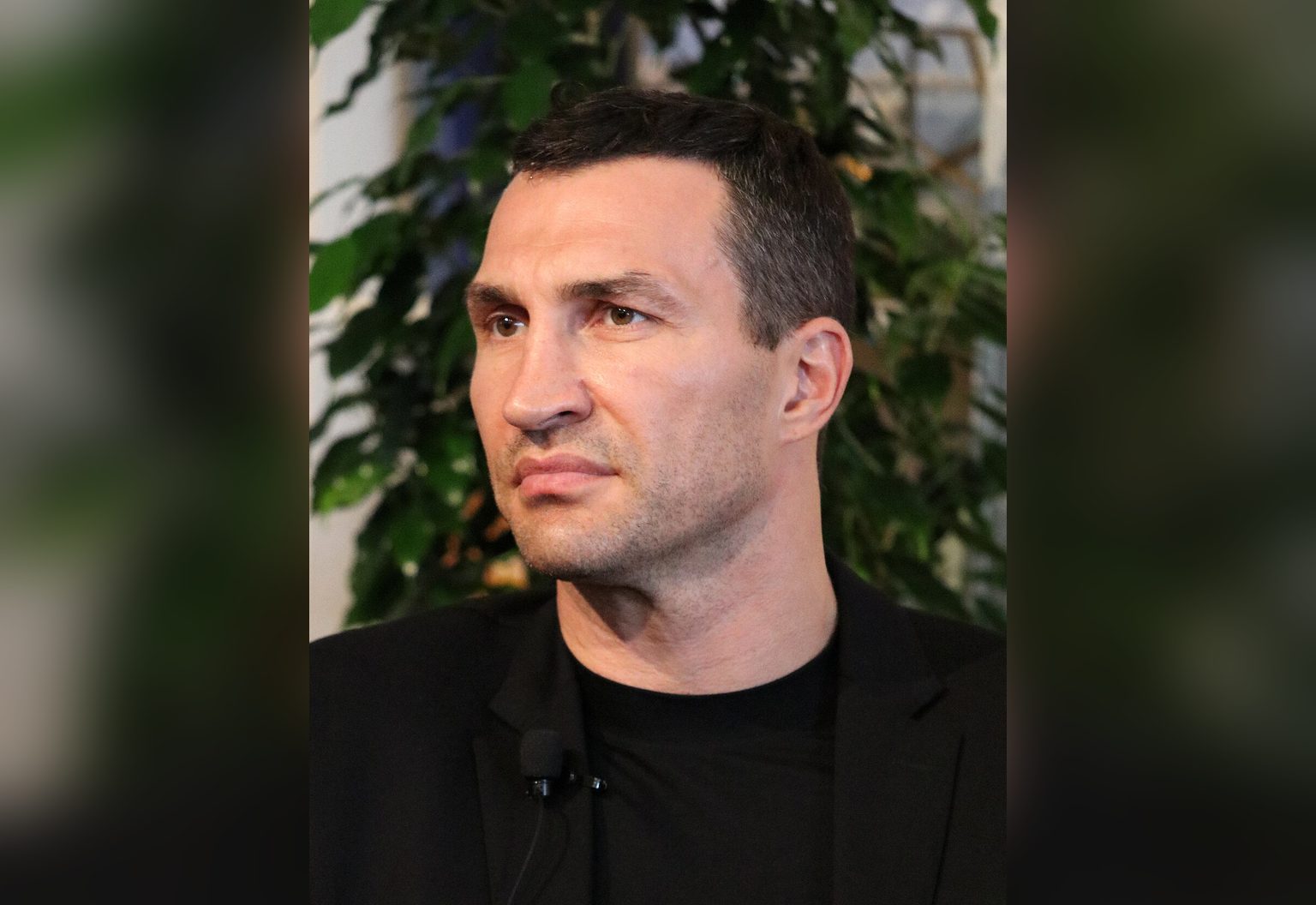
Photo: Fuzheado, CC BY-SA 4.0, via Wikimedia Commons