Larry Holmes went down in the seventh round, dropped by a right hand that briefly put the heavyweight championship within Earnie Shavers’ reach. Holmes got up, survived and eventually won. That September 1979 fight captured the central frustration of Shavers’ career: he could hurt the best heavyweights in the world without finding a way to beat them.
His reputation rested on more than that single punch. Muhammad Ali endured 15 rounds with him. Jimmy Ellis and Ken Norton did not make it through one. Although he never became world champion, Shavers remained a reference point whenever fighters discussed the hardest punchers they had faced.
From Alabama farm work to an amateur title
Born Earnie Dee Shaver on August 31, 1944, in Garland, Alabama, he spent his early childhood in a farming family. He later credited demanding physical work, including picking cotton, with helping build the strength that became his living.
The family moved to Ohio while he was still a child. In accounts of his upbringing, Shavers described racial threats as a reason for leaving Alabama. He grew up around Warren, far from the championship arenas where he would eventually fight.
Boxing arrived late. He was 22 when he took up the sport, an age at which many future contenders already had years of amateur competition behind them. Working with trainers including Pedro Tomez and Bob Saffold, he progressed quickly enough to win the National AAU heavyweight championship in 1969.
That title offered a practical reason to turn professional. His debut followed on November 6, 1969. There was little time to waste, and his early matchmaking reflected the busy schedules common to developing heavyweights of that period.
A puncher moves into contention
Shavers built his name by stopping opponents, often before a fight had settled into a rhythm. At 6 feet tall, with a listed 79-inch reach, he was not unusually large for a heavyweight. His threat came from the speed and force with which he could close the distance and land his right hand.
The early record was not spotless. Ron Stander stopped him in 1970, a warning that his own durability could not always support the risks he took. Nevertheless, a succession of knockout victories carried him toward better opposition.
On June 18, 1973, he knocked out former WBA champion Jimmy Ellis in the first round at Madison Square Garden. Ellis was an experienced, accomplished heavyweight, and the result gave Shavers something more substantial than an impressive knockout percentage: a quick victory over a recognized name.
Six months later, the same venue delivered the opposite experience. Jerry Quarry overwhelmed him in the opening round on December 14.
Another opportunity slipped away against Ron Lyle in Denver on September 13, 1975. Shavers knocked Lyle down but could not finish him. Lyle recovered and stopped him in the sixth round.
The pattern was becoming clear. Shavers could change a fight with one clean connection, but an opponent who weathered the danger could find openings of his own.
Fifteen rounds with Muhammad Ali
A 10th-round stoppage of Roy “Tiger” Williams in December 1976 helped move Shavers toward his first world-title opportunity. On September 29, 1977, he challenged Muhammad Ali for the WBA and WBC heavyweight championships at Madison Square Garden.
NBC carried the contest in prime time. For a fighter whose reputation had largely been built on abrupt finishes, this was a different examination: 15 rounds against a champion skilled at managing both the pace and the occasion.
Shavers hurt Ali, particularly with his right hand, but could not force a stoppage. Ali absorbed the punishment, answered with combinations and finished strongly enough to retain his titles by unanimous decision.
It was a clear defeat on the scorecards, though hardly a comfortable evening for the champion. Ali’s much-repeated description of the challenger’s power (“It shook my kinfolk back in Africa”) became attached to Shavers almost as firmly as either of his best-known nicknames, “The Acorn” and “The Black Destroyer.”
He had demonstrated that his power mattered at championship level. Turning it into a championship victory remained another task.
Norton falls, Holmes gets back up
Larry Holmes first faced Shavers on March 25, 1978, winning a 12-round unanimous decision in a WBC title eliminator. Holmes’ jab, movement and control of distance limited the openings available to the puncher.
Shavers earned another chance with one of his most decisive performances. On March 23, 1979, he stopped Ken Norton in the first round in Las Vegas, dropping the former WBC champion twice.
That victory brought a rematch with Holmes on September 28, this time for the WBC heavyweight title.
For much of the fight, Holmes again had the better of the boxing. Then, in the seventh round, Shavers landed the right hand that sent him heavily to the canvas. The champion rose and survived the follow-up attack.
Shavers had spent considerable energy trying to finish him. Holmes recovered, re-established control and won by an 11th-round stoppage, with the challenger cut and taking punishment.
Holmes later repeatedly identified Shavers as the hardest puncher he had faced. The distinction was striking given that his opponents also included Norton, Gerry Cooney and Mike Tyson. It did not change the result, but it explained why that seventh-round knockdown remained such an enduring part of both men’s stories.
Style, later fights and the record question
From an orthodox stance, Shavers looked for opportunities to drive his right hand through an opponent’s guard. He could jab and work to the body, but his most dangerous moments came when he planted his feet and committed fully.
The trade-off was visible against elite opposition. Missed punches cost energy; sustained exchanges exposed him to counters. Skilled opponents could make him reset, while durable ones sometimes outlasted his strongest attacks.
He continued fighting after the second Holmes defeat, losing to Bernardo Mercado and Randall “Tex” Cobb in 1980 and to James “Quick” Tillis in 1982. His career then became intermittent. A brief return in 1987 was followed by another in 1995, when Brian Yates stopped him in his final bout.
His career is commonly listed as 74 wins, 14 losses and one draw, with 68 knockout victories. Other published accounts credit him with 76 wins and 70 knockouts. These totals reflect differing historical bout listings due to the retroactive discovery of two early knockout wins.
Either accounting captures the same essential feature: the overwhelming majority of his victories came inside the distance. The Ring placed him 10th on its 2003 list of the 100 greatest punchers, an editorial assessment rather than a measurable claim to being boxing’s hardest hitter.
Family, faith and life beyond boxing
Retirement gave Shavers a public role very different from the one built around his fists. He became an ordained Christian minister and spoke about his faith in churches and at public engagements.
Published family accounts identify his wife as his high-school sweetheart, Laverne Payne, with whom he had five daughters. Obituaries also reported children from other relationships. The detailed family tallies vary between profiles, making them less dependable than the broad picture of a large family that remained important to him.
He lived in Phoenix and later spent substantial time in England, including Liverpool, where his work included security and public appearances. He also served as a patron of the Warrington-based Shannon Bradshaw Trust, which supports children with life-threatening conditions and their families.
Boxing audiences still wanted to meet him. Autograph appearances and speaking engagements allowed him to tell the stories behind the famous fights, while his autobiography, Welcome to the Big Time, appeared in 2001.
One story reached beyond boxing. Shavers said that, during a sparring session connected with Rocky III, Sylvester Stallone urged him to hit harder. According to Shavers’ account, a body punch quickly persuaded the actor otherwise. It belongs as a recollection, not a documented competitive result, but neatly illustrates how his punching reputation followed him into retirement.
He died on September 1, 2022, at his daughter’s home in Virginia, one day after his 78th birthday.
FAQ
What was Earnie Shavers’ professional record?
It is commonly listed as 74-14-1 with 68 knockouts. Some published sources instead credit him with 76-14-1 and 70 knockouts because historical bout listings differ.
Did he ever win a world heavyweight title?
No. He lost a unanimous decision to Muhammad Ali in 1977 and was stopped by Larry Holmes in their 1979 championship fight.
Did he knock Larry Holmes down?
Yes. He dropped Holmes with a right hand in the seventh round of their September 1979 rematch. Holmes recovered and won in the 11th.
Which notable opponents did he beat?
His best-known victories include first-round knockouts of former heavyweight champions Jimmy Ellis in 1973 and Ken Norton in 1979.
What did he do after boxing?
He became an ordained Christian minister, published an autobiography, made boxing-related appearances and supported charitable work, including the Shannon Bradshaw Trust.
When did he die?
He died on September 1, 2022, aged 78.
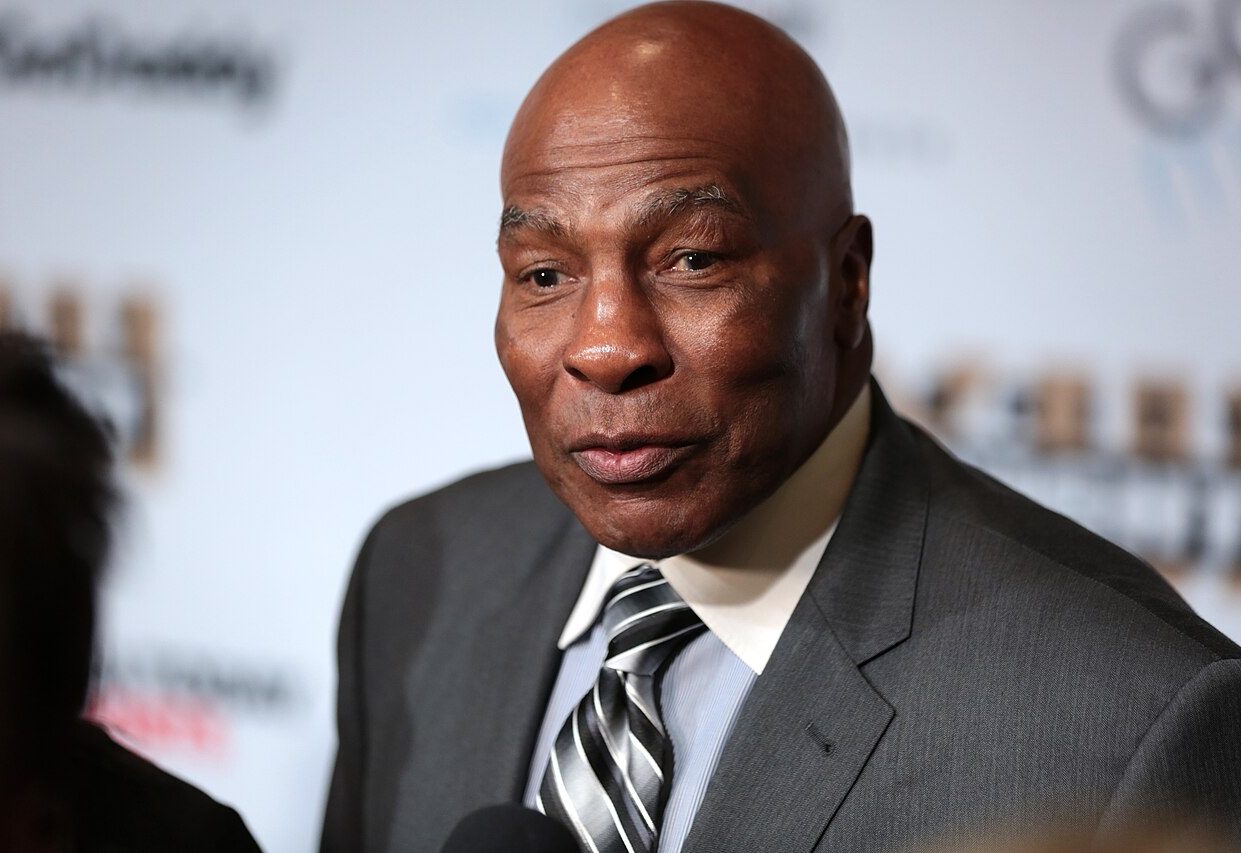
Photo: Gage Skidmore from Peoria, AZ, United States of America, CC BY-SA 2.0, via Wikimedia Commons