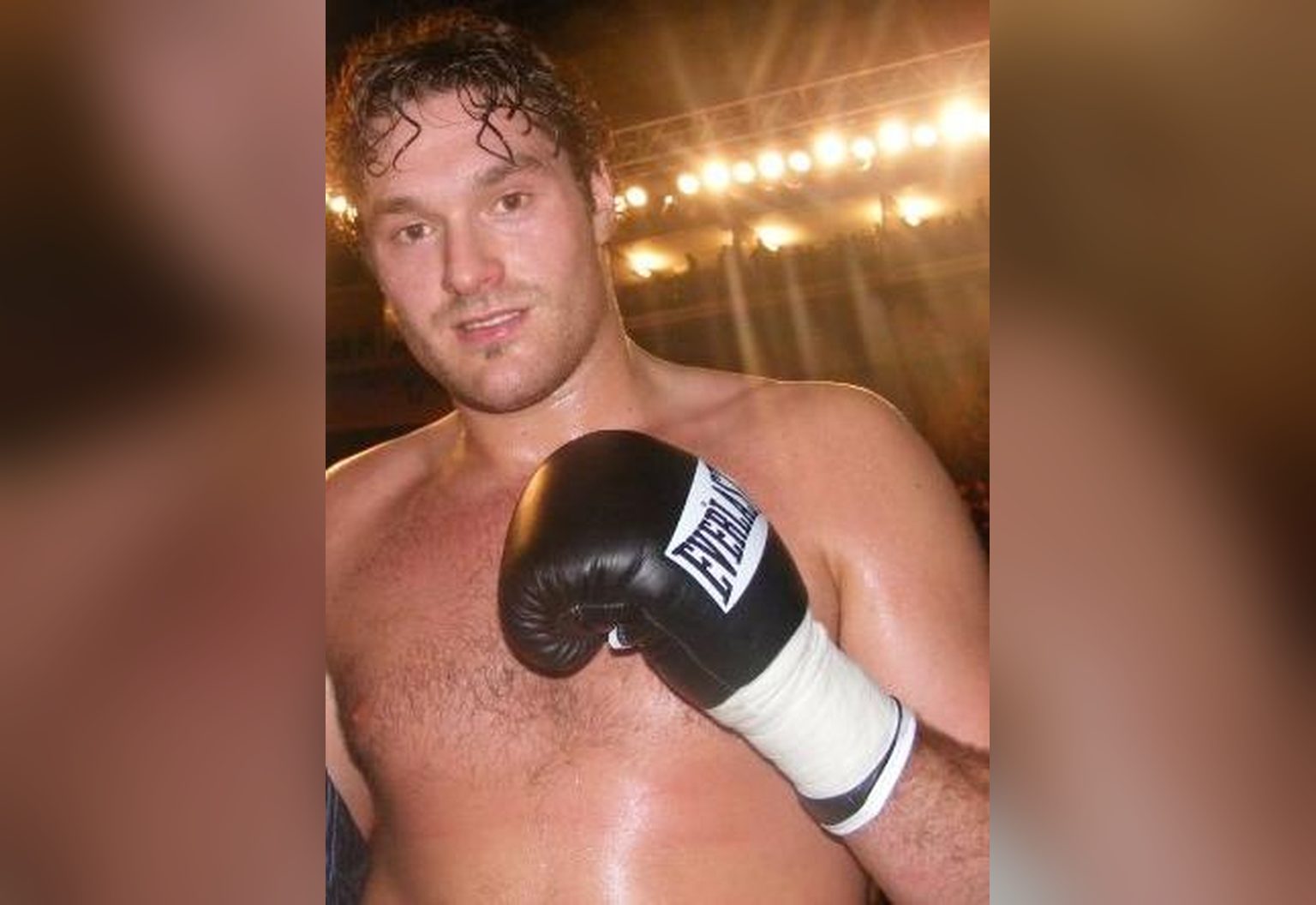
Three months early and weighing just 1 pound at birth, Tyson Fury did not arrive in the world looking like a future heavyweight champion. He grew into one of boxing’s most unusual top men instead: 6ft 9in tall, hard to hit, oddly nimble, and capable of turning the division’s biggest nights into awkward, tactical fights on his terms.
Born in Manchester as Tyson Luke Fury, he was raised in a fighting family. His father, John Fury, had boxed professionally and named him after Mike Tyson. The family’s Irish Traveller roots were always central to Fury’s public identity, even as he fought under the British flag. Boxing was around him early, and by about age ten he was training seriously under his father’s guidance. The sport was not a hobby in the Fury household. It was part of the family trade, later shared by relatives including Hughie Fury and half-brother Tommy Fury.
Early years and amateur grounding
Before the world-title nights and stadium crowds, Fury built himself in the amateur code. He finished with a reported amateur record of 31-4, with 26 stoppages, and his results showed he was more than a tall prospect with a famous surname.
He took bronze at the 2006 World Junior Championships in the super-heavyweight division, won gold at the 2007 EU Junior Championships, added silver at the 2007 European Junior Championships, and claimed the ABA super-heavyweight title in 2008. Those tournaments mattered. They gave him rounds, pressure, and the kind of ring education that later helped him solve elite heavyweights in very different ways.
Even then, the outline of the professional fighter was visible. Fury boxed from an orthodox stance, but he never moved like a conventional giant. He could jab and drift at range, spoil rhythm, lean in close, and make opponents fight at a pace they disliked.
Turning pro and collecting belts
His professional debut came on December 6, 2008, in Nottingham, where he stopped Béla Gyöngyösi. The early years were busy and productive. Fury moved through the domestic scene, then beyond it, collecting titles at English, British, Commonwealth, Irish and European level as he learned the longer distance and slower tempo of heavyweight boxing.
That rise was not just about size and punch resistance. He was developing a style that could be awkward without being passive. He feinted, switched speeds, tied up when needed and, for a man of his dimensions, moved with surprising ease. Opponents often looked uncomfortable before they looked beaten.
One detail from that stretch said something about how he saw himself. Fury vacated the British and Commonwealth titles to pursue an Irish title opportunity, a decision he said carried personal meaning. It fit the broader picture: a Manchester-born heavyweight whose identity in public life always blended British nationality with Irish heritage.
The night he dethroned Wladimir Klitschko
In November 2015, in Düsseldorf, Fury produced the performance that changed everything. Against Wladimir Klitschko, the long-reigning heavyweight ruler, he won a unanimous decision and took the WBA (Super), IBF, WBO, IBO, Ring and lineal heavyweight championships.
It was not a slugfest and did not need to be. Fury won with disruption. He broke Klitschko’s rhythm, gave him awkward angles, kept him guessing, and turned one of the division’s most disciplined champions into a hesitant fighter. For years, challengers had struggled to impose themselves on Klitschko. Fury did it by refusing to fight the expected fight.
That victory made him a unified world champion and remains the clearest statement of his pure boxing ability. Ring Magazine later recognized him as its Fighter of the Year, and the bout was widely treated as one of the sport’s major upsets of that period.
Some financial figures from the event have been widely reported, including claims of a multimillion-dollar purse and much larger total earnings once broadcast revenue was counted, though exact totals vary by source and should be treated as estimates rather than settled fact.
Titles lost outside the ring
The first championship reign did not unfold cleanly after Klitschko. Instead, Fury’s career stalled in public and in private.
He did not make a defense of the titles he won from Klitschko. The IBF belt was stripped soon after because of a contractual obligation to face a mandatory challenger. The rematch with Klitschko was then cancelled, and Fury later vacated his remaining major titles while dealing with mental health struggles, substance abuse issues and fitness problems that he has discussed openly himself.
His anti-doping case also became part of the record. Samples taken in February 2015 showed elevated nandrolone levels, and Fury later accepted a backdated two-year ban running from December 2015 to December 2017, while maintaining he had not knowingly committed a violation. Separately, his boxing licence was suspended by the British Boxing Board of Control in 2016 amid concerns relating to drug use and medical issues.
That period matters because it changed the shape of his career. Fury was no longer simply the man who beat Klitschko. He became a champion who disappeared from the ring, gained significant weight, and spoke publicly about depression, addiction and collapse. Those admissions were not polished retrospective storytelling. They were part of the story while it was happening.
The comeback and the Wilder trilogy
When Fury returned in 2018, the comeback itself became one of boxing’s biggest narratives. He took two tune-up fights, then went straight into a meeting with Deontay Wilder in Los Angeles in December of that year.
The first Wilder fight ended in a split draw, and it remains one of the defining heavyweight contests of its era. Fury boxed well for long stretches, using movement and craft to blunt Wilder’s right hand, but he was dropped twice, including dramatically in the 12th round. His recovery from that knockdown became one of the most replayed moments of his career.
If the Klitschko win showed his tactical discipline, the Wilder rivalry showed his range. In the rematch, in February 2020, Fury changed approach completely. He came forward, pressed Wilder, leaned on him, and won by seventh-round stoppage to claim the WBC heavyweight title. It was a forceful, physical performance and one of the best examples of his ability to reinvent himself for a specific opponent.
The trilogy ended in October 2021, with Fury stopping Wilder in the 11th round after another violent, momentum-swinging fight. By then, the rivalry had done more than settle a championship question. It had defined Fury’s second act.
WBC champion again
As WBC heavyweight champion, Fury became one of the division’s biggest attractions. He defended the title against Dillian Whyte in April 2022 at Wembley Stadium, winning by sixth-round stoppage in front of a huge crowd. It was a homecoming event and a reminder that his appeal was not limited to the hardcore boxing audience.
He later stopped Derek Chisora for a third time in December 2022, another successful defense, before taking on Francis Ngannou in October 2023. That fight, Ngannou’s professional boxing debut, ended with Fury winning a split decision after being knocked down. Officially it was a victory. In terms of impression, it was a more complicated night, and it raised questions about sharpness rather than adding much to his standing.
Reported purse figures for the Ngannou bout were enormous, but, as with many boxing paydays, exact numbers differ depending on the outlet. They are best treated as reported estimates.
Oleksandr Usyk and the first clear setbacks at the top
Fury’s long pursuit of the undisputed heavyweight championship finally led him to Oleksandr Usyk. Their first fight, in May 2024, ended with Usyk winning by split decision. Fury had moments, especially in the middle rounds, but Usyk’s pressure, accuracy and late surge decided the contest.
That defeat was significant on several levels. It handed Fury the second loss of his professional career, ended his WBC title reign, and denied him the chance to leave as the undisputed champion of the four-belt era.
The rematch, in December 2024, also went Usyk’s way, this time by unanimous decision. After years of surviving knockdowns, solving styles and returning from long absences, Fury had run into an opponent whose consistency and balance gave him repeated problems.
With those two defeats, his professional record stood at 34-2-1. Claims in the original version about later fights, including an April 2026 win over Arslanbek Makhmudov and a record of 36-2-1, are not established in the reliable public record and should not be presented as fact here.
How Tyson Fury fights
Heavyweights his size are often described first and understood second. Fury has always required the reverse. The measurements matter, 6ft 9in with an 85-inch reach, but they explain less than people assume.
At his best, he is a distance fighter with unusual feet, quick hands for his size, and a sharp sense of timing. He can lead with the jab, draw mistakes with feints, and win rounds by making opponents reset over and over again. Against Klitschko, that meant denying rhythm. Against Wilder, it meant first outboxing him, then walking him down. Against Whyte, it meant controlling space until the opening appeared.
He has also been willing to fight ugly. Clinches, leaning, mauling, talking, changing tempo, all of it has been part of the package. That blend of mobility and nuisance is what made him so difficult to prepare for. Tyson Fury was never just a puncher and never just a mover. The best version of him could be either one.
Life outside the ring
Away from boxing, family has remained the centre of Fury’s public image. He is married to Paris Fury; most published accounts place their marriage in 2008. They have a large family, and their home life has become part of his celebrity beyond sport.
That domestic side reached a wider audience through the Netflix series At Home with the Furys, released in 2023. The show leaned into the contrast that has long made him marketable: the heavyweight champion who can fill a stadium one week and be back in the middle of noisy family life the next.
His business interests and endorsements have expanded with fame, though sponsorship portfolios can change quickly and are best treated as time-specific. Fury has also spoken often about mental health, linking that advocacy to his own experiences with depression and addiction.
Not every outside-the-ring story has been straightforward. John Fury served a prison sentence after a 2011 incident in which he gouged out another man’s eye. And in relation to Tyson Fury’s anti-doping case, the Mail on Sunday reported in 2020 allegations of attempted interference in the original UK Anti-Doping investigation, including an alleged payment offer to a farmer connected to the “wild boar” explanation. Those claims were reported allegations, not established findings, and should be labeled that way.
FAQ
What is Tyson Fury’s boxing record?
His verified professional record after the second Oleksandr Usyk defeat is 34-2-1, with 24 knockouts.
Who is Tyson Fury’s wife?
He is married to Paris Fury.
How tall is Tyson Fury?
Tyson Fury is 6ft 9in tall, or 206 cm.
Did Tyson Fury fail a drug test?
He accepted a backdated two-year ban after nandrolone was found in 2015 samples, while denying that he had knowingly committed a violation.
Where was Tyson Fury born?
He was born in Manchester, England.
What titles has Tyson Fury won?
He has held the WBA (Super), IBF, WBO, IBO, Ring, lineal and WBC heavyweight titles.
Photo: Adamj1987 at English Wikipedia, Public domain, via Wikimedia Commons