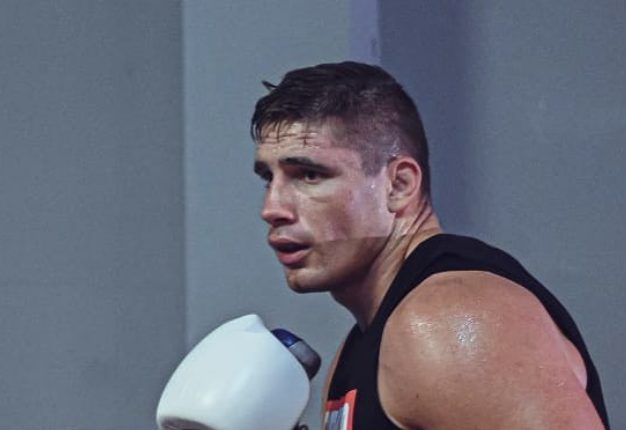
A heavyweight title run that began in 2013 turned Rico Verhoeven into the fixed point of modern kickboxing. For years, challengers changed, rivals came and went, and the Dutchman stayed where he was: at the top of GLORY’s heavyweight division, winning with a style built more on control and consistency than chaos.
Early years in Bergen op Zoom
Ricardo Verhoeven was born on April 10, 1989, in Bergen op Zoom, in the south of the Netherlands. Fighting was part of the household early. His father, Jos Verhoeven, worked with him in martial arts from childhood, and Rico has often spoken about growing up around training rather than discovering it later as a hobby.
Some accounts say he started Kyokushin karate at a very young age, even as a toddler; others place that beginning later in childhood. The firmer point is that he moved into kickboxing when he was still young and developed fast enough to stand out early. By his mid-teens, he was already fighting adults, a useful clue to the calm, practical style he would later bring to heavyweight title fights.
His parents, Jos Verhoeven and Jacqueline Deurloo, separated when he was a child. That family story has long been part of the public record, mainly because his father remained such an important figure in his development as a fighter.
Learning on the job as a young heavyweight
Verhoeven made his professional kickboxing debut in 2004, still only a teenager. The early years were busy rather than glamorous. He fought across several organizations, including K-1, It’s Showtime and SUPERKOMBAT, taking on experienced heavyweights while still building his own identity in the sport.
That period matters because it explains the version of Verhoeven that later became champion. He was not introduced to the elite with a carefully protected record. He took losses, learned pacing, and figured out how to win rounds against bigger punchers and more seasoned opponents. By the time he reached the top level, he already looked like a fighter who understood how heavyweight bouts change from minute to minute.
A key early setback came in 2011, when Jamal Ben Saddik stopped him. It would not be the last chapter in that rivalry, but it was one of the results that sharpened his career rather than derailing it.
Arrival in GLORY and the title breakthrough
When GLORY began to establish itself as kickboxing’s leading international promotion, Verhoeven arrived at the right moment. He debuted for the organization in 2012. One year later, he put together the run that changed his standing in the sport.
In 2013, he beat Errol Zimmerman by unanimous decision in the GLORY 11 heavyweight tournament and then defeated Gökhan Saki by majority decision in the final. That tournament win made him GLORY Heavyweight World Champion. It was not a flashy coronation. It was a hard night’s work against two established names, and it set the tone for what followed.
He backed it up in 2014 with a unanimous decision win over Daniel Ghita, another important result against a proven heavyweight. By then, Rico Verhoeven was no longer just a promising Dutch contender. He was the man holding the division together.
The long GLORY reign
Championship reigns often look tidy in retrospect. Verhoeven’s was long, but it was not simple. It stretched across different eras of the heavyweight class and included a mix of tactical fights, rivalries, rematches and injury-interrupted nights.
He defended the GLORY heavyweight title a record 13 times, the most in the promotion’s history at that weight. Among the notable defenses were wins over Benjamin Adegbuyi, Mladen Brestovac, Anderson “Braddock” Silva, Jamal Ben Saddik and Badr Hari.
The Hari fights brought the widest attention. Their first meeting, at GLORY: Collision in 2016, ended in the second round when Hari could not continue after suffering an arm injury. Verhoeven was awarded a TKO win. The rematch, at Collision 2 in 2019, also ended in his favor, this time in round three after Hari suffered a leg injury. Both contests were major events commercially, even if neither produced the clean, uninterrupted finish that settles every sporting argument.
The Ben Saddik rivalry told a slightly different story. Verhoeven had lost the first meeting in 2011. In 2017, he avenged that defeat with a fifth-round TKO, and in 2021 he beat Ben Saddik again, this time by unanimous decision. Those wins mattered because they showed more than title retention. They showed adjustment over time.
For much of this stretch, he was widely regarded as the leading heavyweight in kickboxing. Combat Press ranked him at or near the top of the division for years, reflecting how thoroughly he had separated himself from the field.
How Rico Verhoeven fights
At 1.96 meters tall and fighting from an orthodox stance, Verhoeven never depended on a single dramatic weapon. His game was built around a disciplined jab, sharp combination punching, low kicks, ring awareness and conditioning that held up deep into fights.
That is one reason his record does not read like that of a one-punch knockout artist. His kickboxing record stands at 66 wins and 10 losses, with 21 knockouts. The numbers fit the eye test. He could stop opponents, but much of his best work came through accumulation and control. He set tempo, managed distance and forced heavyweights to fight at his pace.
In a division where one exchange can wipe out a good game plan, that kind of structure is a skill in itself. Verhoeven’s best nights often looked methodical rather than explosive. He made opponents work to get close, then made them work again once they got there.
Beyond kickboxing: boxing and MMA
Unlike many heavyweight specialists, Verhoeven also tested himself outside kickboxing. He made his professional boxing debut in 2014 and later stepped into mixed martial arts as well.
His MMA record is 1-0, with a TKO win in his lone bout. His professional boxing record is 1-1, with one knockout.
The kickboxer’s boxing career has drawn attention largely because of crossover curiosity rather than a long résumé in the ring. Claims in the original version about a WBC heavyweight title fight with Oleksandr Usyk in May 2026, rankings after that bout, a reported $15 million purse, and an appeal of the decision are not supported by the established public record and should not be stated as fact. For the same reason, any net worth figure tied directly to that alleged fight is too uncertain to present as verified.
What can be said safely is that Verhoeven has shown interest in broadening his combat-sports profile. That fits the way he has managed his public career: not only as a champion kickboxer, but as a crossover athlete with reach beyond one rule set.
Closing a championship chapter
Verhoeven’s reign as GLORY champion lasted more than a decade from the night he won the belt in 2013. The original text states that he vacated the title in November 2025. If that is retained, it should be understood as the endpoint of the championship chapter rather than a change to the achievements that defined it: a long hold on the belt, 13 successful defenses, and a period in which the division was measured against him.
Whether fans preferred his precision or wanted more risk, the sporting case is straightforward. For a long stretch, anyone who wanted to be recognized as the best heavyweight in kickboxing had to go through Rico Verhoeven.
Outside the ring
Away from competition, Verhoeven has built a public profile that goes well beyond fight posters. He has lived in the Netherlands and has regularly shared parts of his training and family life through media appearances and social platforms.
He has children, and family has often appeared as part of his public image, though private-life details should be handled carefully unless he has confirmed them himself in reliable interviews or official channels. The same caution applies to relationship status and home-building stories: such details may circulate widely, but they should not be treated as hard fact without solid sourcing.
Business has also become part of the Rico Verhoeven story. He has been involved in gyms, media projects and commercial partnerships, the sort of portfolio that often follows a long title reign. Brand work and crossover visibility helped make him one of the few kickboxers recognizable outside the sport’s core audience.
In 2017, his biography RICO was published. That release fit the broader shape of his career: not just a fighter defending a belt, but a public figure trying to define his own image while still active.
One final note on rumor control: the claim that he “lost his mother during a training camp,” sourced only to a YouTube video in the draft, is not strong enough to include as fact. Without reliable published confirmation, it is better left out.
FAQ
How old is Rico Verhoeven?
He was born on April 10, 1989.
What is Rico Verhoeven’s kickboxing record?
His kickboxing record is 66 wins and 10 losses, with 21 knockouts.
When did Rico Verhoeven become GLORY heavyweight champion?
He won the GLORY Heavyweight World Championship in 2013.
How many times did he defend the GLORY title?
He defended the belt 13 times, a record for GLORY’s heavyweight division.
Has Rico Verhoeven fought in boxing and MMA?
Yes. He has competed in both professional boxing and mixed martial arts in addition to kickboxing.
Where is Rico Verhoeven from?
He was born in Bergen op Zoom, Netherlands.
Photo: Ah.kakar, CC BY-SA 4.0, via Wikimedia Commons