A left hook changed his life twice. First, it carried Alex Pereira out of a late start in kickboxing and into world titles. Later, it followed him into the UFC, where the Brazilian turned a specialist’s weapon into championship leverage at middleweight and light heavyweight.
From São Bernardo do Campo to the gym
Alex Sandro Silva Pereira was born on July 7, 1987, in São Bernardo do Campo, in the state of São Paulo, Brazil. He has spoken about a hard upbringing and about leaving school early, then working from a young age, including at a tire shop. Fighting did not arrive as a childhood plan or a carefully managed amateur path. It came later, when he needed direction.
He began training in kickboxing at 21, a remarkably late start for someone who would go on to reach the top of multiple combat sports. Pereira has said the sport helped him step away from alcoholism, a part of his story that remains central to understanding his rise. Most elite fighters build their base as teenagers. He was starting from scratch as an adult and trying to rebuild his life at the same time.
That background helps explain both the urgency in his style and the public image that formed around him. His nickname, Poatan, is commonly translated as “Stone Hands,” a reference tied to his Indigenous roots and his reputation as a puncher.
Learning fast, hitting harder
Before he became a UFC champion, Pereira made his name in striking. He built his early reputation in kickboxing, where his size, timing and power quickly stood out. He fought from an orthodox stance, but what opponents tended to remember was the left hook: short, sharp and often thrown after he had already backed them into a bad exchange.
His amateur records are often listed as 25-3 in boxing and 25-3 in kickboxing, though those figures are repeated across profiles more often than they are documented in full detail. What is clear is the broader point: he developed a reputation as a finisher long before MMA fans knew his name.
By the time he reached Glory, he was no longer just a dangerous newcomer. He was one of the promotion’s elite middleweights, and eventually more than that.
The Glory years and the Adesanya rivalry
Pereira fought in Glory during the period that first brought him international recognition. He won the Glory middleweight title and later added the Glory light heavyweight belt, becoming the first fighter in the promotion to hold titles in two weight classes at the same time.
That matters because it framed him not simply as a knockout artist, but as a proven championship-level kickboxer with staying power. His run at middleweight included multiple title defenses, and his professional kickboxing record is widely listed as 33-7 with 21 knockouts.
One rivalry from those years would shape the next phase of his career. Pereira beat Israel Adesanya twice in kickboxing. The first win came by decision. The second, in 2017, came by knockout and became one of the most replayed finishes attached to his name. When both men later landed in the UFC, those results gave the matchup a built-in history that few title fights can claim.
Early MMA: promise, then questions
He first stepped into MMA in 2015. The debut, at Jungle Fight 82, ended with a submission loss to Quemuel Ottoni. It was an immediate reminder that elite striking alone does not solve everything in mixed martial arts.
Pereira’s early MMA career unfolded in short bursts rather than one smooth climb. He fought in Jungle Fight, added experience, and kept developing while still carrying a serious kickboxing schedule. There was also a 2020 appearance in LFA before the move to the UFC.
The central question never changed: could he round out his game enough to let his striking matter against complete MMA fighters? He did not answer that by becoming a grappling specialist. He answered it by improving his takedown defense, learning how to manage range under MMA rules, and making opponents pay heavily for every mistake on the feet.
Fast-tracked in the UFC
His UFC debut came on November 6, 2021, when he stopped Andreas Michailidis in the second round. It was a measured start, but the matchmaking that followed made the plan obvious. The promotion saw a dangerous striker with a history against the reigning middleweight champion.
That path accelerated in July 2022. Pereira knocked out Sean Strickland in the first round at UFC 276, a result that pushed him straight into title contention. It was one of those wins that changed his place in the division overnight. Strickland had been a proven contender. Pereira needed only one clean opening.
Some reported purse figures circulated around that fight and others that followed, but exact payouts in MMA are often estimates unless officially disclosed. Where money is concerned, it is safer to say he quickly moved into the class of UFC headliners.
UFC 281 and the middleweight title
The rivalry with Adesanya reached its MMA peak at UFC 281 on November 12, 2022. Pereira won by fifth-round TKO and captured the UFC middleweight title.
It was the biggest moment of his career to that point, and it fit the pattern that had followed him from kickboxing: patient pressure, dangerous counters, and the sense that if he kept touching the target, the fight could turn suddenly. Adesanya had controlled stretches of the bout, but Pereira’s pressure late in the fight forced the finish and delivered the belt.
For a fighter who had started kickboxing at 21 and MMA even later, the speed of that rise was extraordinary. Within a short UFC run, he had gone from debutant to champion.
The title reign, however, did not last long. On April 8, 2023, at UFC 287, Adesanya knocked him out in the second round to reclaim the belt. That split in the MMA series left them 1-1 in the UFC, while Pereira still held the two kickboxing wins that gave the rivalry its unusual depth.
A move up, and a second UFC belt
Instead of rebuilding at middleweight, Pereira moved to light heavyweight. It looked like a practical decision as much as a competitive one. The cut to 185 pounds had always appeared demanding, and his frame suggested he could carry power comfortably in the higher division.
His first fight there came on July 29, 2023, against former champion Jan Błachowicz. Pereira won a split decision. It was not his flashiest performance, but it may have been one of his more useful ones. He showed he could handle a hard, physical fight against an experienced opponent without needing an early knockout.
Then came another title shot. On November 11, 2023, he stopped Jiří Procházka in the second round to win the vacant UFC light heavyweight championship. With that victory, Pereira became a two-division UFC champion.
That achievement placed him in rare company. More importantly, it confirmed that his success in MMA was no longer just a middleweight storyline built around Adesanya. He had become a champion in a second division on his own terms.
A busy title run at 205
As light heavyweight champion, Pereira stayed active. On April 13, 2024, at UFC 300, he knocked out Jamahal Hill in the first round. It was a quick, violent defense on one of the promotion’s biggest stages.
He followed it on June 29, 2024, by stopping Procházka again, this time in the second round at UFC 303. Then, on October 5, 2024, he beat Khalil Rountree Jr. by TKO in the fourth round at UFC 307.
Those wins gave him three successful defenses of the light heavyweight title. They also reinforced what had become the defining truth of his MMA career: even at championship level, his power remained the fight’s biggest variable. Opponents could compete with him, trouble him, even win rounds against him. But they had to navigate danger every second.
Style: kickboxing translated to MMA
Pereira is listed at 6-foot-4 with a long reach, and he uses that frame well. He is not a volume striker in the usual sense. Much of his game is built on posture, range, feints and pressure. He can look calm to the point of stillness, then suddenly fire a hook, a straight right or a low kick with fight-changing force.
The left hook gets the headlines, and for good reason, but his success in MMA has depended on more than one punch. He learned how to stand where takedowns are harder to finish, how to punish level changes with knees and uppercuts, and how to make opponents hesitate before entering. That hesitation is often all he needs.
His professional boxing record is commonly listed as 1-0 with one knockout. In MMA, his record through his title-winning run established the same pattern seen in kickboxing: most of his wins came by knockout or technical knockout.
Life outside the cage
Away from competition, Pereira’s story stays closely tied to family, identity and the life he came from. He has two sons with his former wife. His sister, Aline Pereira, is also a combat sports athlete and has built her own career in striking.
He has lived and trained in Connecticut, working out of Teixeira MMA & Fitness under the broader guidance of Glover Teixeira’s team. That move helped sharpen the wrestling and cage craft he needed for MMA, while also giving him a stable base in the United States.
Some of the details around his public image are easy to spot. He has embraced the Poatan nickname, and fans also associate him with the phrase “Chama,” which became part of his persona. He has spoken about his Indigenous ancestry, and that identity has remained visible in how he presents himself.
There are also repeated reports about business ventures, sponsorships and charitable work, including the Instituto Poatan project in Brazil. Those accounts generally describe a gym and community effort connected to his old neighborhood, though the exact scope of the project is not always detailed the same way across sources. Reported estimates of his net worth and career earnings vary widely, so those figures are best treated as rough media estimates rather than established fact.
Claims about luxury purchases and gifts for family have circulated in interviews and online coverage as well, but unless Pereira or a primary source confirms a detail directly, they belong in the category of reported anecdotes, not hard biography.
What is firmly established is the larger arc. He started late. He came from difficult circumstances. He built himself first into a top kickboxer, then into a UFC champion in two divisions. That is rare enough on its own. Doing it with such a distinct style made him impossible to mistake for anyone else.
FAQ
What is Alex Pereira’s nickname?
Poatan. It is commonly translated as “Stone Hands.”
Where is Alex Pereira from?
He was born in São Bernardo do Campo, São Paulo, Brazil.
When did Alex Pereira start fighting?
He began training in kickboxing at 21.
How many times has Alex Pereira fought Israel Adesanya?
Four times in total: twice in kickboxing and twice in MMA.
What titles has Alex Pereira won?
He won titles in Glory at middleweight and light heavyweight, then captured UFC belts at middleweight and light heavyweight.
Where does Alex Pereira train?
He has trained in Connecticut at Teixeira MMA & Fitness.
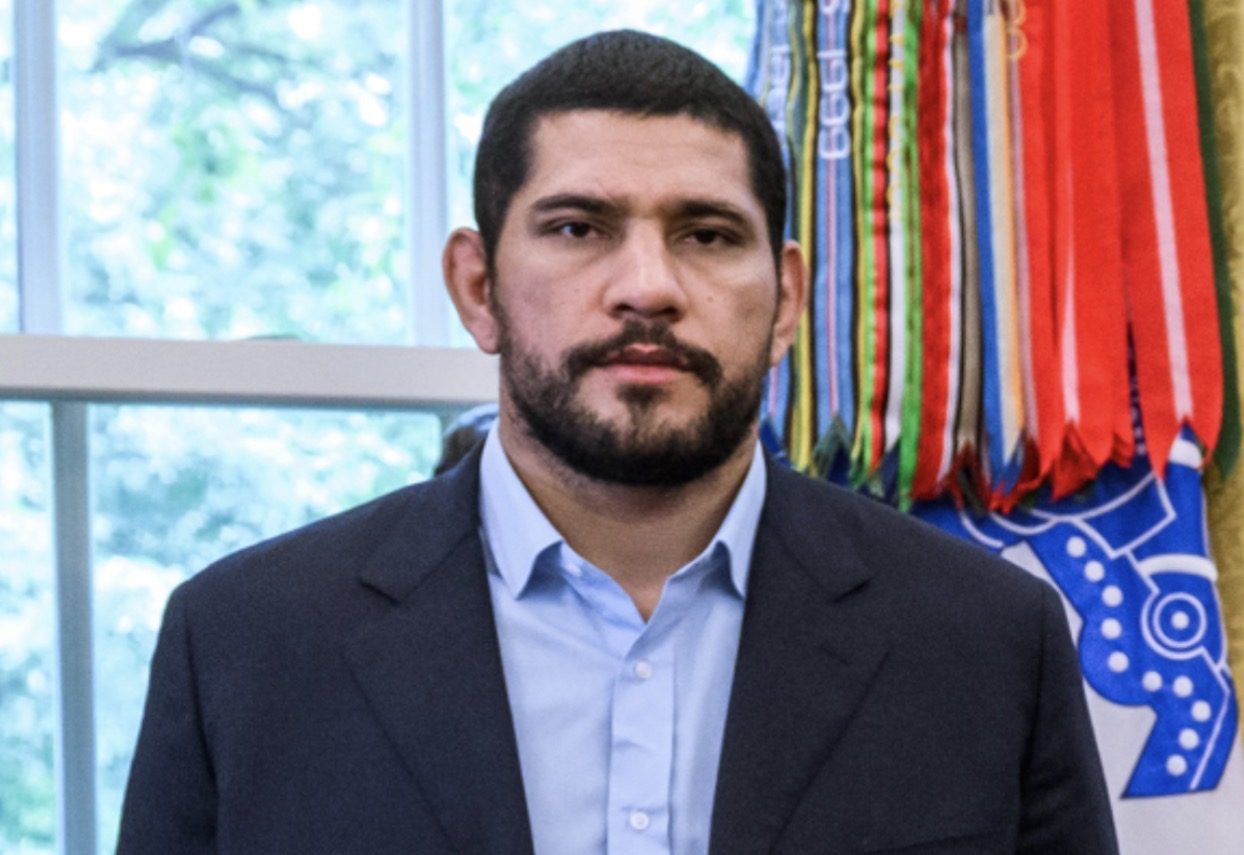
Photo: The White House, Public domain, via Wikimedia Commons