
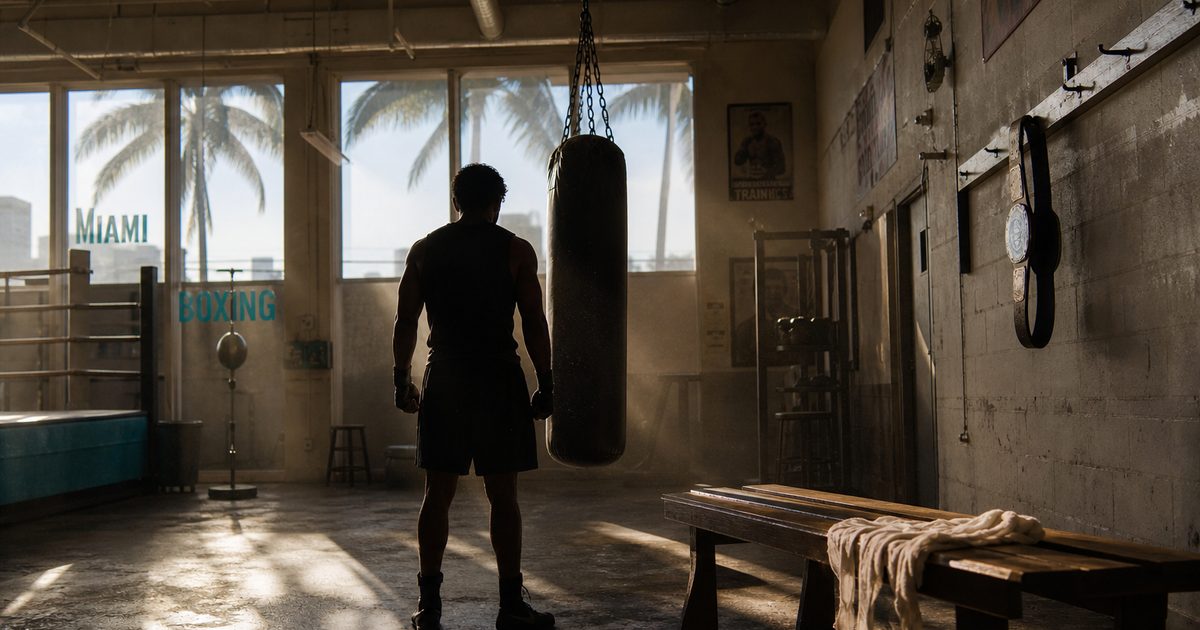
Twenty years old, a green belt around his waist, and barely out of his teens: that was the night David Benavidez forced his way into the super middleweight title picture for good. When he outpointed Ronald Gavril in 2017, he became the youngest WBC super middleweight champion in boxing history. The rest of his career has followed that same pattern, fast rises, hard resets, and a style built on pressure that rarely gives opponents a quiet round.
David Benavidez grew up in a boxing household
Anthony David Benavidez was born in Phoenix, Arizona, on December 17, 1996. Boxing was not a hobby in the family; it was the family business. His father, Jose Benavidez Sr., trained him from childhood and remained the central voice in his corner as he climbed the sport. His older brother, Jose Benavidez Jr., also became a professional fighter, which made the gym a natural extension of home life.
Benavidez is widely identified as Mexican-American, with Ecuadorian heritage through his mother’s side. Accounts of his mother’s background vary in detail across outlets, so the broad description is the safest one to use.
He started boxing very young, often described as age 3, and his father pushed him toward a professional style early. That mattered. Instead of building a long amateur résumé full of point-scoring habits, Benavidez was taught to sit down on punches, work in combinations, and stay comfortable in physical exchanges. His amateur record is commonly listed as 15-0, brief by elite standards but enough to show his talent.
There is another part of the early story that helps explain the fighter he became. As a teenager, he struggled badly with weight and has said he was around 250 pounds at one point. He later dropped more than 100 pounds. That transformation became part of his image: a naturally big man with heavy hands, but also someone whose career would repeatedly circle back to conditioning and the scales.
A quick start in the pro ranks
Benavidez turned professional on August 17, 2013, stopping Erasmo Moreno in Puerto Peñasco, Mexico. He was still a teenager, but the matchmaking already reflected what his team believed he was: not a long-term project, but a prospect meant to move quickly.
From 2013 through 2015, he fought regularly in Mexico and the United States, piling up rounds and stoppages. Those early fights sharpened the traits that still define him now. He jabbed, but not to coast. He threw combinations in bursts, walked opponents back, and kept his hands active enough to make even solid defensive fighters work every second.
In April 2015, he beat Rollin Williams for the vacant NABF junior light heavyweight title. Later that year, he signed with Sampson Boxing, a move that helped set up his push toward world level.
Ronald Gavril and a title at 20
The breakthrough came in September 2017. Benavidez faced Ronald Gavril for the vacant WBC super middleweight title and won by split decision. It was not a flawless performance, Gavril had his moments, and the fight was competitive, but the result stood, and it mattered. At 20, Benavidez became the youngest super middleweight world champion in boxing history.
He defended the belt in the rematch with Gavril in February 2018, this time winning more clearly by unanimous decision. By then, the outline of his championship identity was easy to see. He was not a one-punch artist in the traditional sense. He overwhelmed people with accumulation, pace, and the kind of sustained offense that makes a fight feel longer than it is.
The first setback came outside the ring
Momentum stopped abruptly later in 2018. Benavidez tested positive for cocaine in a VADA test and was stripped of the WBC super middleweight title. The result did not come from a performance-enhancing drug case, but it was still a major professional setback. He lost the belt without losing it in the ring, and the interruption stalled a title run that had only just started.
That period also included promotional turbulence. Published reports, including ESPN’s coverage at the time, described a dispute involving Top Rank and Sampson Lewkowicz before Benavidez returned to the Sampson Boxing side. The details were messy, but the larger point is simple: his career had become unstable at the same time his talent was becoming impossible to ignore.
Back to the top, then back to the scales
Benavidez fought his way back into position and reclaimed the WBC super middleweight title in September 2019, stopping Anthony Dirrell in the ninth round. It was one of his best performances to that point. Dirrell was experienced, clever, and durable, and Benavidez broke him down with pressure and volume.
Then came another self-inflicted detour. In August 2020, before his fight with Roamer Alexis Angulo, Benavidez missed weight and was stripped of the WBC title again. He went on to stop Angulo, but the belt was gone. For a fighter who had already spent years answering questions about discipline and size, it reinforced a theme that would follow him for much of his super middleweight run.
Rebuilding at super middleweight
The road back began with the kind of performance that tends to erase doubt quickly. In May 2022, Benavidez stopped former middleweight champion David Lemieux in three rounds to win the interim WBC super middleweight title. Lemieux had long been dangerous, especially early, but Benavidez’s size, pace, and punch volume were too much.
That win set up one of the biggest rivalries of his career.
In March 2023, he met Caleb Plant in Las Vegas and won a unanimous decision in a fight that carried genuine edge long before the opening bell. Plant boxed well in stretches, especially early, but Benavidez gradually dragged the fight into his preferred rhythm. The second half belonged to him. He pressed, he let his hands go, and he made Plant fight at a pace that was hard to sustain.
Later that year, in November 2023, he defended the interim belt against Demetrius Andrade and stopped him after six rounds. Andrade entered unbeaten and awkward, the kind of opponent who can make a fight ugly. Benavidez did not let that happen. He forced exchanges, found openings, and turned a high-level matchup into a statement win.
The move to light heavyweight
After years of talk about whether he was simply too big for 168 pounds, the move to light heavyweight finally came. In June 2024, Benavidez faced former WBC champion Oleksandr Gvozdyk and won by unanimous decision to claim the interim WBC light heavyweight title.
The fight was useful for more than the belt. It showed that his pressure style could carry up in weight against a proven boxer with pedigree and composure. Gvozdyk had the technique to punish mistakes, but Benavidez’s output and physicality won rounds. Reports around that camp linked him to BOXR gym in Miami, where he has spent part of his training time.
He took the next step in February 2025, beating David Morrell by unanimous decision to win a version of the WBA light heavyweight title. The fight had real tension late: Benavidez was ruled down in the 11th round, and Morrell was docked a point for hitting after the bell. Benavidez stayed composed and closed the fight out on the cards.
When the WBC later elevated him from interim status to full light heavyweight champion, it formalized what the division had already learned: he was not just visiting the weight class. He was a titleholder there too.
In November 2025, he defended his light heavyweight belts against Anthony Yarde and won by seventh-round TKO. The fight was rough in spots, including a point deduction against Benavidez for hitting while Yarde was down, but the result fit the usual pattern. Once he established his tempo, the fight tilted hard in his favor.
A third division and a bigger frame
Benavidez’s next jump took him to cruiserweight. In May 2026, he stopped Gilberto Ramirez in the sixth round to win the WBO and WBA cruiserweight titles, giving him recognized world titles in a third weight class.
That result marked one of the clearest shifts of his career. For years, much of the discussion around him centered on whether he could keep making weight. By the time he reached cruiserweight, the question had changed. Now it was about how far his pressure game, hand speed, and durability could travel as the opponents got larger.
His listed professional record stands at 32-0 with 26 knockouts. Because boxing records and title designations can change as sanctioning bodies update them, readers should always check the latest official listings for belt status. But the broad shape of the career is clear: champion at super middleweight, champion again at light heavyweight, and then a titleholder at cruiserweight.
Why his style works
Benavidez fights out of an orthodox stance, but the stance itself is only the starting point. What separates him is the volume. He throws in combinations, often up and down, and he keeps enough pressure on opponents that even defensive success comes at a cost. A blocked punch is often followed by three more.
That is why the nickname “The Mexican Monster,” widely associated with him after Mike Tyson used it, stuck so easily. Not because Benavidez fights wildly, he usually does not, but because he can make elite opponents feel crowded, hurried, and worn down.
His knockout total, 26 stoppages in 32 wins, underlines the point. He is dangerous with single shots, but his real strength is cumulative damage. He breaks rhythm, then posture, then resistance.
Life outside the ring
Away from boxing, family remains central to the David Benavidez story. Jose Benavidez Sr. is still the key trainer in his career, and Jose Benavidez Jr. remains the best-known name beside him in the household. Benavidez has also been linked to Miami, Florida, as a home base.
He has had business and sponsorship ties outside the ring as well. Public reports have connected him to the clothing brand El Bandera Roja, and he has been announced in sponsorship arrangements with SNAC System and Agua Plus.
There is also a documented charitable side. In 2021, reports noted that he donated part of a fight purse to the Boys & Girls Clubs of the Valley sports program. He has also been mentioned in local community support efforts, including backing a basketball team.
More personal claims should be treated carefully. Reports from social media and YouTube sources have described Karina Silva as David Benavidez wife and have attached business ventures and luxury assets to the couple. Those claims are not firmly established by reliable mainstream reporting and should be treated as rumor, not fact. The same goes for widely varying estimates of David Benavidez net worth. Public figures on boxer finances are often speculative unless tied to disclosed purses, court filings, or named financial reporting.
FAQ
What is David Benavidez record?
David Benavidez record is 32-0 with 26 knockouts.
How old is David Benavidez?
He was born on December 17, 1996.
Who trains David Benavidez?
His longtime trainer is his father, Jose Benavidez Sr.
Is David Benavidez related to Jose Benavidez Jr.?
Yes. Jose Benavidez Jr. is his older brother.
Why was David Benavidez stripped of his title?
He lost the WBC super middleweight title once after a positive cocaine test in 2018 and again after missing weight in 2020.
What weight classes has David Benavidez fought in?
He has competed at super middleweight, light heavyweight, and cruiserweight.