Thirty-two fights, thirty-two stoppages-and then Deontay Wilder had to win the hard way. When he challenged Bermane Stiverne for the WBC heavyweight title in January 2015, the knockout artist from Alabama went all 12 rounds for the first time. He left with a unanimous decision and the belt.
That night revealed something his early record could not: the right hand was his biggest weapon, but it was not his only route to victory. Over the next five years, Wilder made 10 successful title defenses, survived difficult rounds against Luis Ortiz and began a three-fight rivalry with Tyson Fury that eventually cost him the championship.
Tuscaloosa came before the titles
Born on October 22, 1985, in Tuscaloosa, Alabama, Deontay Leshun Wilder initially pictured his sporting future on a basketball court or football field. Boxing arrived later, alongside responsibilities that made earning a living more urgent than pursuing an athletic dream.
His daughter Naieya was born with spina bifida. Wilder has repeatedly described supporting her as the motivation behind his decision to fight. Before boxing paid the bills, he worked restaurant and delivery jobs, including a stint delivering Budweiser.
He began training at Skyy Boxing Gym in nearby Northport in October 2005, working with Jay Deas. He was approaching his 20th birthday, a late arrival compared with opponents who had been learning the sport since childhood.
What he lacked in experience, he compensated for with reach, athleticism and unusually heavy punching. His progress was quick enough to turn a practical decision into an international sporting career.
A short amateur apprenticeship, then Beijing
In 2007, Wilder won the National Golden Gloves and U.S. national championships at heavyweight. Within two years of entering a gym, he had moved into contention for an Olympic place.
At the 2008 Beijing Games, he reached the semifinals before losing to Italy’s Clemente Russo. He returned with a bronze medal, the only boxing medal won by the United States at those Olympics.
His amateur career is commonly recorded as 30 wins and five losses. It was a brief education for someone about to enter professional heavyweight boxing, but it supplied both a platform and a nickname.
“The Bronze Bomber” combined his Olympic medal with a nod to Joe Louis, the former heavyweight champion known as “The Brown Bomber.”
Building the knockout streak
Wilder turned professional on November 15, 2008, stopping Ethan Cox in the second round in Nashville, Tennessee.
The early matchmaking gave him room to develop, although the short fights also limited his opportunities to learn under pressure. Opponents kept falling before they could make him work through the problems that emerge over a long contest.
By the time he stopped Malik Scott in the first round in March 2014, his record stood at 31-0. A first-round finish against Jason Gavern that August made it 32 wins, all inside the distance.
The power was established. His championship credentials were not.
Stiverne provided that examination on January 17, 2015, in Las Vegas. Rather than forcing an early finish, the challenger used his jab and reach, controlled stretches of the fight and won clearly on the scorecards. He became the first American to hold a major heavyweight world title since Shannon Briggs lost his WBO belt in 2007.
Ten defenses, with danger along the way
The championship years were not an uninterrupted procession of easy knockouts. Eric Molina hurt Wilder before being stopped in the ninth round in June 2015. Artur Szpilka presented awkward movement before a right hand ended their January 2016 contest in round nine.
A rematch with Stiverne in November 2017 was much shorter than their first meeting: three knockdowns and a first-round knockout.
Luis Ortiz posed a more sustained threat in March 2018. The Cuban southpaw was experienced, technically skilled and capable of punishing mistakes. He badly troubled the champion in the seventh round, but Wilder recovered and stopped him in the 10th.
That escape mattered. His reign depended not simply on landing first, but sometimes on staying in the fight long enough to land at all.
Fury changes the story
The first Tyson Fury fight, on December 1, 2018, brought those qualities into sharp focus. Fury’s movement and feints disrupted Wilder’s offense, but the American scored knockdowns in the ninth and 12th rounds. Fury rose from both, including a dramatic final-round knockdown, and the contest ended in a split draw.
Wilder retained his title, then delivered two emphatic finishes in 2019. Dominic Breazeale lasted less than a round in May. In November’s Ortiz rematch, the challenger built a lead before a seventh-round right hand ended the fight.
That was Wilder’s 10th successful defense. There would not be an 11th.
Fury approached their February 22, 2020 rematch more aggressively, forcing the champion backward and stopping him in the seventh round when his corner threw in the towel.
Their third meeting, on October 9, 2021, was a punishing exchange of knockdowns. Wilder went down in the third, dropped Fury twice in the fourth and was eventually knocked out in the 11th. The trilogy finished with a draw and two Fury victories.
Returns, setbacks and a changing record
An October 2022 comeback against Robert Helenius lasted less than three minutes. A short right hand produced another first-round knockout and briefly restored a familiar picture.
The next two opponents denied him that finish. Joseph Parker controlled their December 2023 contest and won a wide unanimous decision. In June 2024, Zhilei Zhang stopped Wilder in the fifth round.
He returned against Tyrrell Anthony Herndon in June 2025, winning by seventh-round TKO. A split-decision victory over Derek Chisora in April 2026 took his record to 45 wins, four losses and one draw, with 43 knockouts.
Those numbers describe a career built overwhelmingly on stoppages, but its two decision victories carry their own significance: the first secured a world championship; the second came after a difficult run of defeats.
How the right hand worked
Listed at 6 ft 7 in, with an 83-inch reach, Wilder had the dimensions to threaten opponents from outside their preferred range. From an orthodox stance, he could use his left hand to measure distance before releasing the right.
The punch did not always require a long setup. Sometimes it came straight down the middle; sometimes it travelled over a guard. His ability to generate force quickly made even apparently quiet stretches dangerous.
There were trade-offs. He could become off-balance when chasing a finish, and opponents who disrupted his positioning could reduce his output. Fury and Parker exposed different versions of that problem.
Calling him merely a slugger misses the timing behind many of his knockouts. Calling him technically complete overlooks the weaknesses better opponents exploited.
Family, money and life beyond boxing
The distance between delivery work in Alabama and heavyweight championship purses was substantial. Forbes reported a $25 million purse for the second Fury fight. Such figures are reported earnings, however-not proof of personal wealth after taxes, expenses and other obligations. Online net-worth estimates offer much less certainty.
His public identity has remained closely tied to Tuscaloosa and fatherhood. Wilder has spoken publicly about having eight children, and Naieya’s place in his boxing story has remained central: the sport began as a way to provide for her, not as a childhood plan.
There have also been outlets beyond fighting. He released the single “Everytime” with his brother Marsellos in 2022, stepping into music after years of being known chiefly for what happened when his right glove landed.
The contrast is part of his profile: a late-starting boxer whose working life once revolved around ordinary shifts, and whose professional life became defined by brief, violent finishes.
FAQ
What is Deontay Wilder’s boxing record?
Following his April 2026 victory over Derek Chisora, his record was 45-4-1, with 43 knockout wins.
When did he become heavyweight champion?
He won the WBC heavyweight title on January 17, 2015, defeating Bermane Stiverne by unanimous decision.
How many successful title defenses did he make?
He made 10 successful WBC title defenses before losing the championship to Tyson Fury in February 2020.
Why did Wilder start boxing?
He has said he began boxing to help support his daughter Naieya, who was born with spina bifida.
What happened in the Tyson Fury trilogy?
Their first fight ended in a split draw in 2018. Fury won the rematch by seventh-round TKO in 2020 and the third fight by 11th-round knockout in 2021.
Why is he called “The Bronze Bomber”?
The nickname references his bronze medal at the 2008 Beijing Olympics and pays tribute to Joe Louis, “The Brown Bomber.”
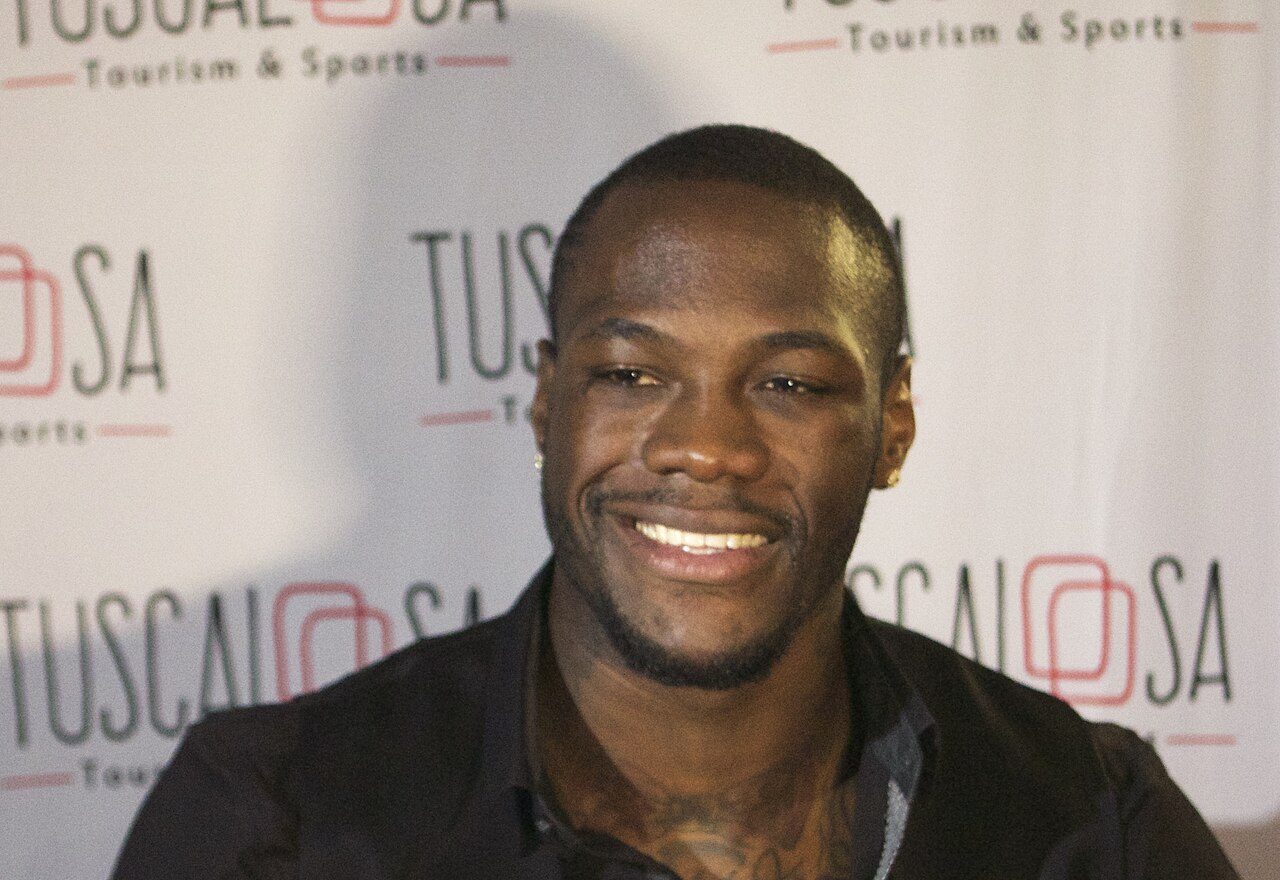
Photo: Layton Dudley – http://www.laytondudley.com/, CC BY-SA 2.0, via Wikimedia Commons