Twelve rounds with Canelo Alvarez changed the scale of Dmitry Bivol’s career, but they did not change the way he boxed. He still fought behind the same hard jab, the same measured feet, the same refusal to give an opponent the kind of opening that turns a fight chaotic. That steadiness is the thread that runs through his story: from a boy in Tokmok training in borrowed circumstances to a light-heavyweight champion who built his reputation on control rather than noise.
From Tokmok to St. Petersburg
Dmitry Yuryevich Bivol was born on December 18, 1990, in Tokmok, then part of the Kirghiz SSR in the Soviet Union, now in Kyrgyzstan. His background reflects several places at once. His father is Moldovan, his mother is ethnically Korean, and Bivol later built his life and boxing career in Russia.
He has spoken about a modest upbringing. As a child, he helped on the family farm, where onions and wheat were part of daily life. Boxing arrived early, at around six years old, and one of the enduring details from those first steps is almost too odd to invent: he trained in ballet shoes. He also began without his parents initially knowing, which says something about the pull the sport already had on him.
At 11, he moved from Kyrgyzstan to St. Petersburg. That relocation mattered. It placed him in a stronger boxing environment and gave structure to a talent that was already taking shape. What had started as childhood curiosity became routine, then discipline, then a serious competitive path.
A deep amateur education
Before he became a titleholder in the paid ranks, Bivol had already logged the kind of amateur volume that explains his polish. His reported amateur record was 268 wins against 15 losses, a huge body of work that helped form the style he would later carry into world-level fights.
He won world cadet titles at under-17 level, took bronze at the 2008 AIBA Youth World Championships, and won gold at the 2013 World Combat Games at 81 kilograms. In Russia, he claimed national titles at light-heavyweight in 2012 and 2014.
One thing missing from the résumé is the Olympics. Bivol did not make it to the Games; in his division, Russia selected Egor Mekhontsev. That can look like a gap when listed on paper, but in practical terms it did little to slow him. By the time he turned professional, he had already had the rounds, the travel and the education.
Turning professional and moving quickly
His professional debut came in November 2014 in Moscow, where he stopped Jorge Rodriguez. From the start, the team around him was stable. Trainer Gennady Mashianov became a key figure in his development, while Vadim Kornilov managed his career and Andrey Ryabinsky promoted him in the early years.
Bivol entered the pro game as a light-heavyweight with an amateur’s habits and a professional’s patience. He stood around 6 feet tall, fought from an orthodox stance, and did not rely on a single dramatic trait. Instead, he built advantages piece by piece: front-foot positioning, a compact guard, clean balance after punching, and combinations that landed without leaving him exposed.
That translated quickly. In May 2016, he won the interim WBA light-heavyweight title by stopping Felix Valera. Less than a year later, in February 2017, he was elevated to full WBA champion when Badou Jack vacated the belt. It was a fast rise, but not a surprising one. Bivol looked like a fighter whose style would age well because it was based on repeatable decisions rather than athletic gambling.
The long title run
Champions often become known by one or two big nights. Bivol’s standing was built differently. He spent years defending his place, often against good contenders who found the same problem: they could not make him fight at the wrong distance for long enough.
He defended his WBA title repeatedly against opponents including Cedric Agnew, Samuel Clarkson, Trent Broadhurst, Isaac Chilemba, Sullivan Barrera, Jean Pascal, Joe Smith Jr., Lenin Castillo, Umar Salamov, Craig Richards and Lyndon Arthur. Some wins were more emphatic than others, but the pattern stayed familiar. He controlled range, piled up rounds, and rarely looked hurried.
By the time he reached the broader public, hardcore boxing followers already knew what he was: one of the division’s most reliable champions, difficult to pressure and even harder to outscore cleanly.
The night Canelo picked him
On May 7, 2022, Bivol defended his title against Canelo Alvarez and produced the most visible win of his career. Alvarez came in as the sport’s biggest commercial star and an undisputed champion at super-middleweight. Bivol met that occasion without changing his temperament.
He won a unanimous decision, though the fight often felt wider than the official scores suggested. His jab kept Alvarez from setting his feet, his combinations interrupted the Mexican star’s rhythm, and his discipline held for all 12 rounds. There was no need for drama. He simply boxed better.
That result pushed his name far beyond the light-heavyweight division. It also brought formal recognition: The Ring and the Boxing Writers Association of America named him Fighter of the Year for 2022.
Later that year, on November 5, he beat Gilberto Ramirez by unanimous decision in another strong defense. Ramirez came in unbeaten, bigger-framed and ambitious. Bivol made the fight look orderly, which is often his way of making difficult work seem simpler than it is.
Chasing the fight that defined the division
For years, the obvious matchup at 175 pounds was Bivol against Artur Beterbiev. One was the division’s sharp technician, the other its most feared pressure puncher. When they finally met, the fight carried the kind of weight that had been building for a long time.
Their first bout took place on October 12, 2024. Beterbiev won by majority decision, handing Bivol the first loss of his professional career. It was close, tense and competitive, exactly the kind of fight expected when two elite light-heavyweights share a ring. For Bivol, it was also a test of whether his style and temperament could absorb a setback without changing shape.
The answer came in the rematch on February 22, 2025. Bivol won by majority decision and, with that victory, became the undisputed light-heavyweight champion. He left the ring with the WBA, WBC, IBF and WBO titles unified at 175 pounds, along with The Ring championship. That is the key correction in his title picture: undisputed at light-heavyweight requires all four major belts, including the WBC.
The rematch was not a reinvention. He did not suddenly become a different fighter. He was simply a little cleaner, a little more consistent, and a little more successful at making the fight unfold on terms he preferred.
Record, milestones and where he stood
Bivol’s professional record stood at 25 wins and 1 loss, with 12 knockouts, after his May 2026 victory over Michael Eifert. Before the Beterbiev rematch, he had also stopped Malik Zinad on June 1, 2024, a useful stay-busy fight that ended inside the distance.
The broader shape of the record matters more than the raw numbers. He is not a knockout artist in the classic sense, and his KO percentage reflects that. But his fights tend to show a different kind of authority. He wins rounds clearly, makes opponents reset, and drains their options. That has long been the core of the Dmitry Bivol record: not spectacle for its own sake, but sustained command.
One factual note is important here. The original version described him as holding the Ring, IBF, WBO and WBA Super titles while also calling him undisputed after beating Beterbiev. If he was undisputed after that rematch, the WBC title belongs in that list as well unless later lost or vacated. Without a confirmed later change, the cleaner and more accurate description is that Bivol became the undisputed champion in February 2025.
How Dmitry Bivol fights
The easiest label is that he is an outside technician, but that only tells part of the story. Bivol’s style works because it is disciplined without being passive. He uses the jab constantly, not as decoration but as structure. It sets distance, blocks entries, scores points and opens the lane for short combinations.
His feet are just as important. He rarely oversteps, rarely squares himself badly, and usually finishes exchanges in balance. When opponents try to crowd him, he gives ground in controlled steps, then answers before they can settle. The high guard and slightly bladed stance help him stay compact, and his punches come in efficient bursts rather than long, risky flurries.
That is why he has been so hard to beat cleanly. He does not need to dominate every second. He just keeps forcing the same questions until opponents run out of good answers.
Life outside the ring
Away from boxing, Bivol has been associated with both Russia and the United States. He has lived in St. Petersburg and spent training time in Southern California, a setup that reflects the international nature of his career.
He married Ekaterina in July 2013, and the couple have two sons. Reports about his private life beyond that should be handled carefully. Some outlets have referred to marital strain or a separation, but unless Bivol has publicly confirmed those details, they remain reports rather than established fact.
The same caution applies to religion. EssentiallySports reported that Bivol had reportedly converted to Islam, but he has not publicly made his religious beliefs a central part of his public profile. That claim should therefore be treated as unconfirmed reporting, not stated as fact.
Financial figures around boxers are often approximate, and Bivol is no exception. Reported purse numbers have linked him to a guaranteed $5 million plus pay-per-view upside for the Alvarez fight, and larger earnings for the Beterbiev rematch. Estimates of Dmitry Bivol net worth vary widely depending on the source, so any firm total is best treated as an estimate rather than a verified number.
There are, however, a few personal details that feel solid because they fit the rest of the story. The farm work as a boy. The move from Tokmok to St. Petersburg. The early training in ballet shoes. They help explain why Bivol comes across as he does: understated, methodical, and more interested in craft than image.
FAQ
Where is Dmitry Bivol from?
He was born in Tokmok, now in Kyrgyzstan, and moved to St. Petersburg, Russia, when he was 11.
What is Dmitry Bivol’s record?
After his win over Michael Eifert, his professional record stood at 25-1 with 12 knockouts.
Who did Dmitry Bivol lose to?
His only professional defeat came against Artur Beterbiev, who beat him by majority decision in October 2024.
Did Dmitry Bivol become undisputed champion?
Yes. He became the undisputed light-heavyweight champion by beating Artur Beterbiev in their rematch in February 2025.
Did Dmitry Bivol fight Canelo Alvarez?
Yes. He beat Canelo Alvarez by unanimous decision in May 2022 in one of the biggest wins of his career.
What is Dmitry Bivol’s fighting style?
He is an orthodox boxer known for his jab, footwork, balance, defensive discipline and efficient combinations.
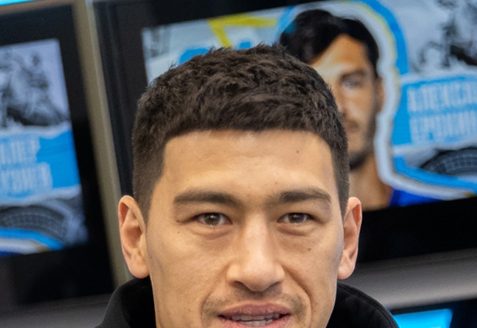
Photo: Вячеслав Евдокимов, CC BY-SA 3.0, via Wikimedia Commons