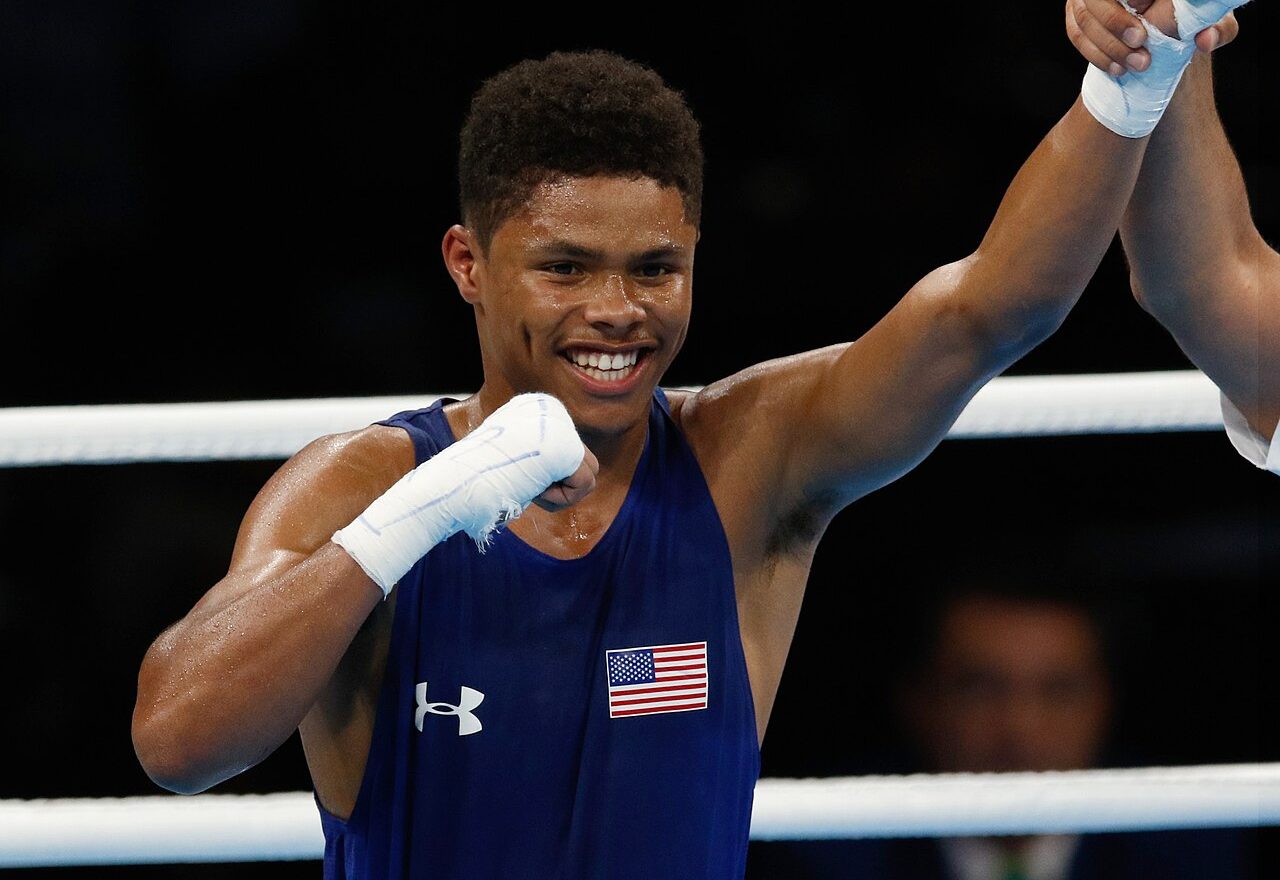
A split-decision loss to Robeisy Ramírez in Rio still ended with a silver medal around his neck. For most young fighters, that would have been the headline. For Shakur Stevenson, it became the launch point.
The Newark southpaw entered the professional game with the kind of amateur pedigree that brings expectations, but his rise has never been built on noise alone. It has been built on control: feet in the right place, shots picked with care, and long stretches where opponents simply cannot land cleanly. Over time, that style carried him from prospect to champion in three weight classes. Claims that he later won major titles at junior welterweight or signed with Zuffa Boxing are not supported by the established record and are best left out.
Newark roots and an early start
Ash-Shakur Nafi-Shahid Stevenson was born on June 28, 1997, in Newark, New Jersey. Boxing found him early. He started around age five, guided first by his grandfather Wali Moses, who was also his first trainer and one of the central figures in his development.
He grew up in a big family as the oldest of nine siblings. His mother is Malikah Stevenson. His biological father, Alfredo Rivera, was largely absent from his life and later died in 2019. Stevenson has said he was named after Tupac Shakur, and he has spoken openly about practicing Islam.
The picture that emerges from those early years is consistent: a gifted kid who was always boxing, always moving, always rehearsing the craft. He idolized Andre Ward, and that influence showed. Even before he turned pro, there was already a seriousness to the way he approached the sport.
A standout amateur career
Before he ever fought for a professional title, Stevenson had already built one of the strongest amateur résumés of his generation in the United States.
His tournament results came quickly. He won gold at the 2013 AIBA Youth World Championships? No, that needs correcting. Stevenson won the 2013 AIBA Junior World Championships, then added the 2014 AIBA Youth World Championships and a gold medal at the 2014 Summer Youth Olympics. He also won national titles on the junior and youth level and was named AIBA Junior Male Boxer of the Year in 2013.
That run mattered because it separated him from the usual prospect class. He became the first American male boxer to win junior and youth world titles and a Youth Olympic gold medal. By the time the 2016 Olympics arrived, he was no longer just a promising teenager from Newark. He was one of Team USA’s best medal hopes.
At the Rio Games, fighting at bantamweight, he reached the final and took silver after losing a split decision to Cuba’s Robeisy Ramírez. Even in defeat, the result carried weight. Stevenson became the highest-medaling American male boxer at the Olympics since Andre Ward won gold in 2004.
Turning pro and learning the long game
Stevenson made his professional debut on April 22, 2017, beating Edgar Brito by decision. He signed with Top Rank, and from the start his style was unmistakable.
He was not a seek-and-destroy puncher built around chaos. He was a southpaw who preferred to control range, draw mistakes and punish them with precise counters. He could lead when he wanted, but much of his best work came from making opponents hesitate. That approach won rounds, and it also started an argument that has followed him ever since: admirers saw elite defense and ring IQ; critics wanted more risk and more action.
In his early professional years, the results came steadily. Stevenson moved through the prospect stage without a loss, sharpening the same habits that had made him so difficult to hit as an amateur.
First world title at featherweight
His first major breakthrough came on October 26, 2019. Stevenson outboxed Joet Gonzalez over 12 rounds to win the vacant WBO featherweight title.
The fight had extra edge because of the personal tension around it, but inside the ring he stayed disciplined. He controlled distance, landed the cleaner shots and won by wide unanimous decision. It was the kind of performance that fit his career perfectly: emotionally charged occasion, cool technical answer.
That victory made him the first male boxer from the United States’ 2016 Olympic team to win a world title as a professional. More importantly, it marked the point where he stopped being discussed mainly as a prospect with pedigree and started being judged as a champion.
Moving up and taking over at 130
Stevenson did not stay at featherweight for long. After missing weight ahead of a planned title defense against Jeremiah Nakathila in 2021, he moved up to super featherweight. That detail matters because it changed the path of his title run: he did not simply collect belts in a straight line; he also had to navigate the consequences of outgrowing a division.
On October 23, 2021, he faced Jamel Herring for the WBO super featherweight title. Stevenson was sharp from the opening rounds and increasingly dominant as the fight wore on. He broke Herring down and forced a stoppage in the 10th round, one of the clearest statement wins of his career.
Then came the unification bout that remains one of his best nights as a professional. On April 30, 2022, he beat Oscar Valdez by unanimous decision to unify the WBC and WBO titles at 130 pounds, while also claiming The Ring championship. Stevenson dropped Valdez in the sixth round and controlled the fight with timing, accuracy and composure.
That win elevated him beyond the label of talented titleholder. He had become the man to beat in the division.
Setback outside the ropes, then a move to lightweight
His reign at super featherweight ended in an unusual way. Stevenson was stripped of his titles after coming in overweight before a scheduled defense against Robson Conceição in September 2022. He still won the fight by decision, but the belts were no longer on the line for him.
That was a turning point. Not because he lost in the ring, he did not, but because it forced the next move. Lightweight was now the natural home.
He debuted at 135 pounds in April 2023 with a decision win over Shuichiro Yoshino, stopping him in the sixth round. The performance was efficient and one-sided, and it set up a title opportunity later that year.
The WBC lightweight title and the De Los Santos reaction
On November 16, 2023, Stevenson faced Edwin De Los Santos for the vacant WBC lightweight title. He won by unanimous decision and became a three-division world champion.
The result was clear. The reaction was not.
The fight drew boos, and Stevenson himself later apologized for the lack of action. It quickly became the most cited exhibit in the debate over his style. To supporters, it showed how completely he can shut down danger. To detractors, it showed the limits of a safety-first approach when entertainment value drops too low.
Both readings contain some truth. Stevenson’s defense is real, measurable and rare. But boxing is also a performance business, and that night in Las Vegas sharpened the tension between effectiveness and excitement that has followed him throughout his career.
Title defenses and where the record stands
Stevenson returned in July 2024 and defended the WBC lightweight title with a unanimous-decision win over Artem Harutyunyan.
Beyond that point, the source text drifts into claims that do not line up with the verified record. There is no established basis here for listing wins over Josh Padley, William Zepeda or Teófimo López, nor for calling Stevenson a four-division champion at junior welterweight. The same caution applies to the stated 25-0 record and the references to rankings and titles tied to 140 pounds.
Based on the reliable, widely established record, Stevenson is an unbeaten professional and a world champion in three divisions: featherweight, super featherweight and lightweight.
Why his style stands out
Some fighters overwhelm opponents with volume. Some do it with power. Stevenson’s game is built on denial.
He is a southpaw counter-puncher with excellent balance, quick eyes and a feel for spacing that often makes opponents look hesitant. He takes away the first shot, then the second, and by the time a rival tries to force the issue, he is already gone or already answering with something cleaner.
That is why his defensive reputation has become such a large part of his identity. He does not just avoid punches; he disrupts rhythm. He makes exchanges die before they become dangerous.
The criticism, when it comes, usually centers on risk level and output. That is a fair debate in stylistic terms. But it should not obscure what he does well. Stevenson is one of the most difficult fighters in boxing to hit cleanly, and that is not an aesthetic opinion. It is the foundation of his success.
Life outside the ring
Away from boxing, Stevenson has remained closely associated with Newark even as his career has taken him elsewhere. Reports have placed him living in Houston, Texas, at points during his professional career, though residence details can change and should be treated as time-specific rather than permanent biography.
Family has stayed central to his story. So has the influence of Wali Moses, the grandfather who first put gloves on him and helped shape the fighter he became. Stevenson has also spoken about wanting to give back to his hometown and create something positive for the next generation.
Some of the smaller details tell you plenty. He was known for shadowboxing constantly as a kid. He committed fully to boxing rather than taking a college path. He has also said he would prefer that his younger siblings not follow him into the sport. That does not sound like a slogan. It sounds like someone who knows exactly what boxing has demanded of him.
FAQ
What is Shakur Stevenson’s full name?
His full name is Ash-Shakur Nafi-Shahid Stevenson.
Did Shakur Stevenson win an Olympic medal?
Yes. He won a silver medal at the 2016 Olympic Games in Rio de Janeiro.
How many weight classes has Shakur Stevenson won world titles in?
He has won recognized world titles in three divisions: featherweight, super featherweight and lightweight.
What is Shakur Stevenson’s fighting style?
He is a southpaw boxer known for defense, counter-punching, distance control and precise shot selection.
Where is Shakur Stevenson from?
He is from Newark, New Jersey, in the United States.
Is Shakur Stevenson related to Tupac Shakur?
No. He was named after Tupac Shakur, but they are not related.
Photo: Fernando Frazão/Agência Brasil, CC BY 3.0 br, via Wikimedia Commons