A sold-out Wembley, 90,000 voices, and a tired right hand that still had enough left to change everything. When Anthony Joshua stopped Wladimir Klitschko in the 11th round, he moved from Olympic gold medalist and rising heavyweight attraction to the center of British boxing.
That night did not come out of nowhere. Joshua’s career has been built in clear stages: a late start, a rapid amateur climb, an explosive professional rise, a painful upset, and then the harder work of rebuilding in public. Few heavyweights of his era have combined medals, titles and mainstream reach in quite the same way.
Early years: Watford, Finchley and a fast rise
Anthony Oluwafemi Olaseni Joshua was born on October 15, 1989, in Watford, Hertfordshire, England. He is of Nigerian heritage, with Yoruba family roots, and for years people around him knew him as Femi, taken from his middle name.
Before boxing became the focus, he was a strong all-around athlete. He played football, ran track, and reportedly clocked 11.6 seconds for 100 meters at school. His parents, Yeta Odusanya and Robert Joshua, separated when he was young, and Joshua’s early life moved between ordinary routines and the kind of restlessness that often shows up in young athletes before they find the right sport.
He did not grow up as a child boxing prodigy. He only took up the sport at 18, joining Finchley ABC in North London in 2007. That late start is one of the more striking parts of his story. Many elite amateurs have been in gyms since primary school; Joshua arrived much later and still moved quickly.
Some accounts of his younger years include a story that he once fought several men in the street and injured his knuckle. Because retellings vary and the details are not firmly documented, it is best treated as an anecdote rather than a settled fact.
Outside the gym, he also worked regular jobs before boxing paid well enough to become a full-time life.
Amateur breakthrough and Olympic gold
Once Joshua committed to boxing, the progress was fast. He won the Haringey Box Cup in 2009 and 2010, took ABA heavyweight titles, and developed into one of Britain’s leading super-heavyweights in a short span.
His amateur record is commonly listed at 40-3, though amateur totals can vary slightly depending on the source. What is beyond dispute is the speed of his rise. In 2011, he won silver at the World Championships in Baku, losing in the final to Magomedrasul Majidov. That result put him firmly on the international map.
Then came London 2012. Fighting in front of a home crowd, Joshua won Olympic gold in the super-heavyweight division. The final against Italy’s Roberto Cammarelle ended on countback after the scores were tied, and some observers also debated earlier decisions in the tournament, particularly his win over Erislandy Savón. Those arguments have followed the event ever since, but the official record is unchanged: Joshua left the London Olympics with a gold medal and a transformed public profile.
A destructive start in the professional ranks
Joshua turned professional on October 5, 2013, stopping Emanuele Leo in the first round at the O2 Arena. Matchroom promoted him carefully but not slowly. The formula was obvious from the beginning: a big heavyweight, an orthodox stance, a sharp jab, and finishing power that made even short appearances feel eventful.
He was named The Ring’s Prospect of the Year for 2014, recognition of how quickly he had become more than an Olympic name. Domestic titles followed. He won the vacant Commonwealth heavyweight title in 2015 by stopping Gary Cornish in one round, then added the British title later that year with a seventh-round stoppage of Dillian Whyte.
The Whyte fight mattered. Joshua had been hurt and tested before getting the finish, which made it more revealing than some of the quick knockouts that came around it. It showed both his vulnerabilities and his ability to regain control under pressure.
World champion, then unified champion
His first world title arrived in April 2016. Joshua knocked out Charles Martin in two rounds to win the IBF heavyweight title at the O2 Arena. Martin was unbeaten and a titleholder, but Joshua handled him with the kind of calm authority that suggested bigger nights were coming.
They arrived a year later.
In April 2017, Joshua faced former long-reigning champion Wladimir Klitschko at Wembley Stadium. It remains the defining win of his career. Joshua started well, was dropped in the sixth, looked close to unraveling, then recovered and finished Klitschko in the 11th. The victory gave him the WBA (Super) and IBO titles to go with his IBF belt, and the fight was widely honored as one of the year’s best.
It also established the version of Joshua that became most familiar to the wider public: dangerous, composed when he could be, vulnerable when pushed, and always watchable in big-fight settings.
He continued to collect titles and names. In March 2018, he outpointed Joseph Parker to add the WBO heavyweight title, becoming a unified champion with three of the four major belts. Later that year he stopped Alexander Povetkin in seven rounds at Wembley after a difficult start.
By then, Anthony Joshua had become one of boxing’s biggest live attractions. Stadium crowds were standard, not exceptional.
The Andy Ruiz Jr upset and the rematch
Every heavyweight reign eventually runs into chaos. Joshua’s came in June 2019 at Madison Square Garden, where he made his U.S. debut against Andy Ruiz Jr. Ruiz had stepped in on short notice, and the fight looked like a routine defense until it suddenly was not.
Joshua dropped Ruiz in the third round, then was badly hurt in return and never fully recovered. Ruiz stopped him in the seventh. It was Joshua’s first professional defeat and one of the division’s biggest upsets of the era.
The rematch, six months later in Saudi Arabia, told a different story. Joshua boxed with far more caution and discipline, using his jab, feet and range to win a clear unanimous decision over 12 rounds. He regained the WBA (Super), IBF and WBO titles and became a two-time unified heavyweight champion.
That second Ruiz fight changed how many people saw him. The early professional image had been built on knockouts and physical authority. The rematch showed a more tactical heavyweight, willing to win without drama if that was the safer route.
Oleksandr Usyk and the end of the title reign
Joshua’s second unified reign ended against a fighter with a very different style challenge. In September 2021, he defended his titles against Oleksandr Usyk at Tottenham Hotspur Stadium and lost a unanimous decision. Usyk’s movement, timing and accuracy repeatedly disrupted Joshua’s rhythm.
The rematch in August 2022 was more competitive, but the result was the same in practical terms: Usyk won again, this time by split decision. Joshua had moments, especially to the body, but not enough of them. With that, his second run as a unified heavyweight champion was over.
Those defeats did not erase what he had done before. They did, however, shift his place in the division. He was no longer the man holding the belts. He was the former champion trying to work his way back.
Rebuilding after Usyk
Joshua returned in 2023 with decision wins over Jermaine Franklin and Robert Helenius, then beat Otto Wallin when Wallin was retired after five rounds. In March 2024, he knocked out former UFC champion Francis Ngannou in the second round, a high-profile win even if Ngannou was still very new to professional boxing.
His next major outing brought another setback. In September 2024, Daniel Dubois stopped Joshua in the fifth round in a challenge for the IBF heavyweight title. It was a damaging loss and a reminder that, at the top of the division, Joshua’s margin for error had narrowed.
Because this profile aims to stay factual, it does not include unverified later results or scheduled future fights that are not firmly established in the record.
Fighting style: power first, then adjustment
At 6ft 6in with an 82-inch reach, Joshua looks like a modern heavyweight should look: tall, strong, upright, and built to control range. He boxes from an orthodox stance and, at his best, works behind a firm jab and straight right hand. Early in his career, the emphasis was on pressure and finishing. He often hurt opponents with compact combinations rather than wild swings.
As the opposition improved and the setbacks came, his style evolved. The Ruiz rematch was the clearest example of Joshua choosing caution over destruction. Against other opponents, especially elite movers, he has sometimes looked caught between versions of himself: the puncher who wants to impose and the technician trying to reduce risk.
His professional record stands at 28 wins and 4 losses, with 25 victories by knockout, following the loss to Dubois. That record includes world title wins over Charles Martin, Wladimir Klitschko and Joseph Parker, plus notable victories over Dillian Whyte, Alexander Povetkin and Andy Ruiz Jr in their rematch.
Business, profile and life outside the ring
Joshua’s commercial value grew almost as quickly as his boxing reputation. He became one of Britain’s most marketable athletes, with endorsement deals and partnerships that have included Under Armour, Beats, Jaguar Land Rover, Hugo Boss and Audemars Piguet. Reported purse figures for his biggest fights have varied by outlet, and exact guarantees are often difficult to verify, so broad estimates are safer than hard claims. What is clear is that he has been one of the sport’s top earners for much of his professional career.
Estimates of Anthony Joshua net worth also vary widely depending on the publication and what is being counted, including property, business interests and endorsement income. Any single figure should be treated as an estimate, not a fixed fact.
Away from boxing, Joshua has generally kept his private life guarded. He has a son, Joseph. Claims about his relationship status should be treated cautiously unless he has stated them publicly himself.
He has also been linked with charitable work and youth-focused causes. Joshua has supported initiatives connected to sport and community development, including work in Nigeria. As with many celebrity philanthropy stories, the exact structure and scale of individual projects can be reported differently across sources, so the safest point is that he has been publicly involved in charitable efforts rather than attaching too many hard claims to every initiative.
The personal details that feel most solid are often the simplest ones. He was known as Femi before the world called him AJ. He worked ordinary jobs before stadium nights became normal. And he came to boxing later than most champions, which remains one of the most unusual parts of his rise.
FAQ
What is Anthony Joshua’s full name?
Anthony Joshua’s full name is Anthony Oluwafemi Olaseni Joshua.
When was Anthony Joshua born?
He was born on October 15, 1989, in Watford, Hertfordshire, England.
What is Anthony Joshua’s boxing record?
After his loss to Daniel Dubois, his professional record stands at 28-4, with 25 knockouts.
Did Anthony Joshua win Olympic gold?
Yes. He won gold in the super-heavyweight division at the 2012 London Olympics.
What titles has Anthony Joshua held?
He has held the IBF, WBA (Super), WBO and IBO heavyweight titles, and he is a two-time unified heavyweight champion.
How tall is Anthony Joshua?
He is listed at 6ft 6in (198 cm), with an 82-inch reach.
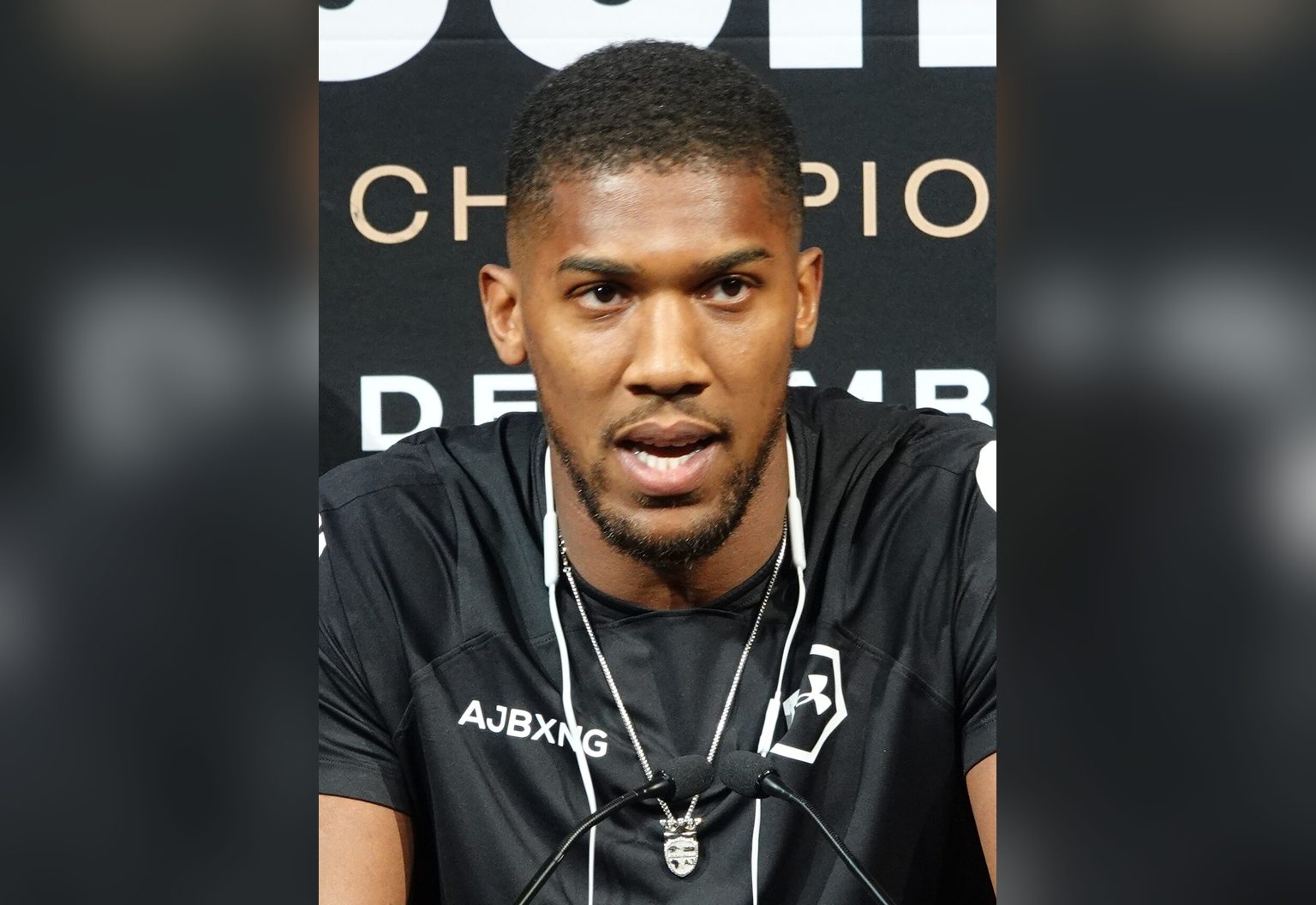
Photo: JazzyJoeyD, CC BY-SA 4.0, via Wikimedia Commons