Two clean knockouts changed the way Ilia Topuria was discussed. First came Alexander Volkanovski, then Max Holloway, two of the defining featherweights of their generation, both stopped. By the time Topuria moved up and took the UFC lightweight title as well, his rise no longer looked like a prospect story. It looked like a fighter forcing his way into the center of the sport.
Early years: from Halle to Georgia to Alicante
Ilia Topuria was born on January 21, 1997, in Halle, Germany, to Georgian parents. His family later spent time in Georgia, where he started Greco-Roman wrestling as a child, before settling in Alicante, Spain. That route, Germany to Georgia to Spain, helps explain why he has long been embraced by fans in more than one country.
The wrestling came first, and it mattered. Topuria began training young, building the kind of balance and body control that would stay visible once he moved into mixed martial arts. In Alicante, he added Brazilian jiu-jitsu at Climent Club, the gym that became the base of his development and, for years, the center of his professional life.
His rise was not especially glamorous at the start. Before fighting paid well, he worked retail, including a job as a cashier at Stradivarius. It is a small detail, but it gives the story some scale. Long before title belts and pay-per-view attention, there was ordinary work and a young fighter trying to make a career hold together.
Topuria’s progress on the mat was quick. He picked up strong youth results in grappling competition, including a silver medal at the 2014 IBJJF European Championship in the juniors. In 2018, he and his brother Aleksandre Topuria were widely described as the first Georgian black belts in Brazilian jiu-jitsu.
Building on the regional scene
Topuria made his professional MMA debut in 2015 and spent his early years fighting across the European circuit. Those bouts came in Spain and beyond, including appearances in promotions such as Cage MMA Finland and Cage Warriors. He also won the Mix Fight Events featherweight title, an early belt that helped mark him as more than just another unbeaten prospect.
Even then, the outline of his game was easy to spot. He liked to pressure opponents, but he was not a reckless swarmer. He moved forward behind sharp boxing, looked comfortable exchanging, and carried a real submission threat when fights hit the mat. The wrestling base gave him control; the jiu-jitsu gave him finishing options.
By the time he reached the UFC, he had already built a reputation as a dangerous all-around fighter rather than a specialist surviving in one phase.
The UFC arrival and a fast climb
Topuria joined the UFC in 2020 and won his debut against Youssef Zalal. The performance was not a title-night breakthrough, but it fit the pattern his career would keep following: calm pressure, clean technique, and the sense that he was difficult to push backward.
From there, the wins kept stacking up. He beat Damon Jackson, then handled Ryan Hall in a matchup that drew attention because Hall’s awkward grappling style had troubled other opponents. Topuria stopped him in the first round. He later moved up to lightweight on short notice and outpointed Jai Herbert, surviving an early scare before turning the fight around and finishing it. It was one of those nights that sharpened his image. He was not just talented when things went smoothly; he could also recover and take control.
Back at featherweight, he kept moving through ranked opposition. Victories over Bryce Mitchell and Josh Emmett pushed him into the title picture. The Mitchell fight ended with a second-round submission. Against Emmett, he showed another side of his game, winning a clear five-round decision and proving he could control a high-level bout over distance rather than simply hunt an early finish.
Volkanovski, Holloway, and the featherweight title
The biggest shift came at UFC 298 on February 17, 2024. Topuria challenged Alexander Volkanovski for the UFC featherweight championship and knocked him out in the second round.
That result did more than put a belt around his waist. Volkanovski had ruled the division for years and had beaten an elite level of opposition. Topuria did not edge him on the cards or steal a close round late. He stopped him cleanly. In one night, he became the first fighter to win a UFC championship while representing both Georgia and Spain.
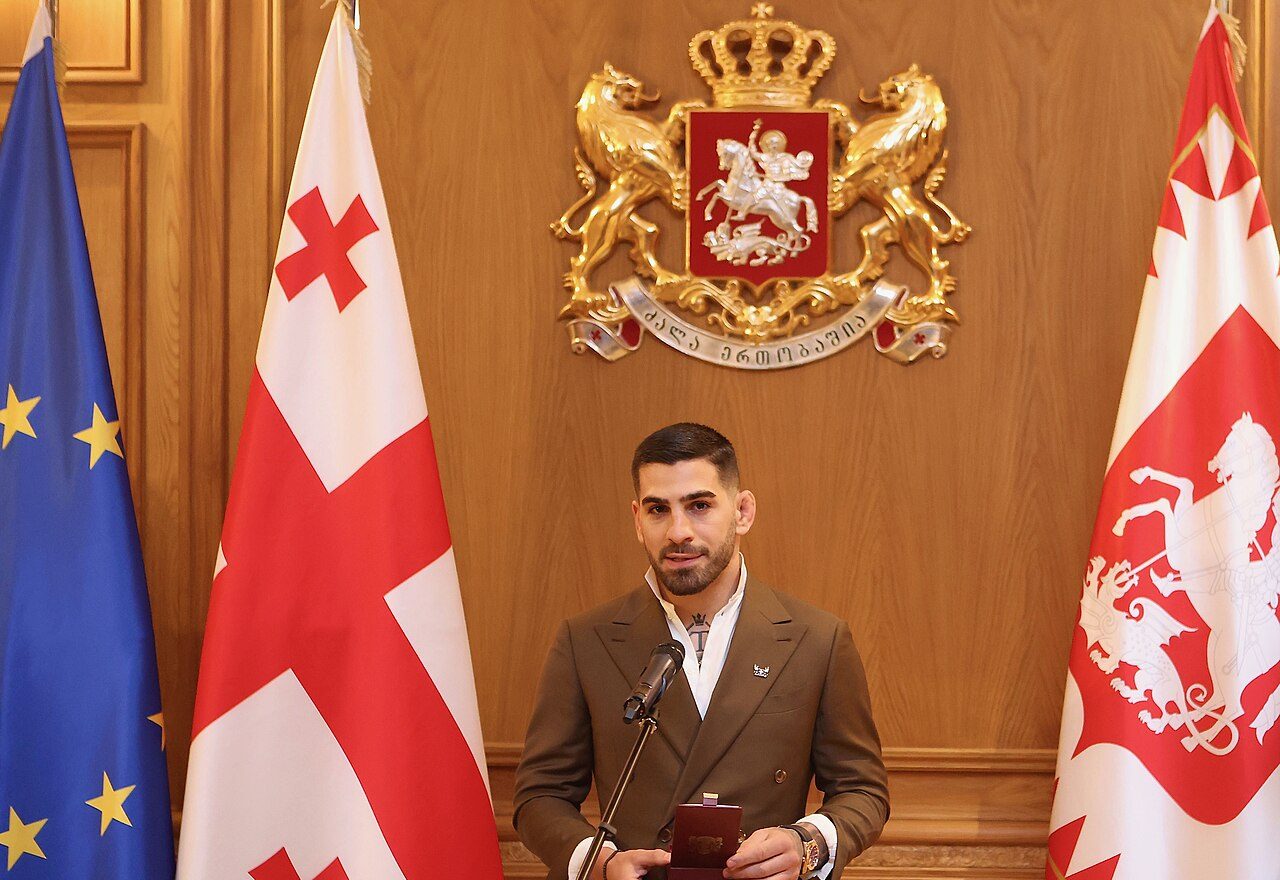
A few weeks later, his public profile grew again. He formally received Spanish citizenship in 2024, adding a legal milestone to an identity that had already been central to his story. Georgia also honored him after the title win, underlining how quickly the victory had become a national sporting moment.
Champions are measured by what comes next, and Topuria’s first defense was every bit as significant. At UFC 308 on October 26, 2024, he faced Max Holloway and stopped him in the third round. Holloway had long been one of the division’s standard-bearers, famous for his durability and volume. Beating him was one thing. Knocking him out was another.
That gave Topuria one successful defense of the UFC featherweight title and strengthened the sense that his run was not built on favorable timing. He was beating major names, and he was doing it emphatically.
A move to lightweight and a second UFC belt
The cut to 145 pounds had always been part of the conversation around him, so the move up did not come as a shock. Topuria eventually vacated the featherweight title and committed to lightweight, where the questions were obvious: would the pressure still carry up, and would the power come with him?
He answered quickly. In his lightweight title fight against Charles Oliveira, he won by first-round knockout to claim the UFC lightweight championship. It was another former champion, another high-stakes fight, and another finish.
That victory made him a two-division UFC champion, a rare distinction in the sport. It also completed a striking sequence on his record: Volkanovski, Holloway, and Oliveira, all former champions, all beaten by stoppage in consecutive fights.
Because the source text included later-career claims that cannot be verified here with confidence, it is better not to state exact purse figures, pound-for-pound placements, or “first ever” statistical distinctions unless tied to a clearly sourced record. What is beyond dispute is the broader point: Topuria won UFC titles at featherweight and lightweight and did it with unusual speed.
Style: pressure with choices
“El Matador” is an apt nickname, but not because he fights wildly. Topuria’s style works because it is layered. He pressures opponents, yet he does not need one specific route to win.
On the feet, he is an orthodox boxer with compact power and a sharp sense of timing. His jab helps him close distance, and he is comfortable throwing hard counters in the pocket. He can look patient for stretches, then suddenly accelerate with combinations that change a fight.
The grappling is what makes the striking more dangerous. Opponents cannot simply shell up and wait for the punches to pass, because he can wrestle, take the back, and finish on the mat. His Greco-Roman background shows in the clinch and in his balance. His jiu-jitsu shows in the control and the submissions.
That blend is the key to any useful Ilia Topuria analysis. He is not just a boxer with takedowns or a grappler who learned to punch. He is difficult because each part of the game supports the others.
Life outside the cage
Outside the UFC, Topuria’s story remains closely tied to family. His brother Aleksandre is also a professional fighter, and the two have often been mentioned together as part of the same martial arts journey from Georgia to Spain.
He has long been based in Alicante, and that city is more than a residence line on a fighter profile. It is where much of his development happened, where Climent Club helped shape him, and where his adult career took form. Later, his competitive base shifted toward Topuria Team.
Some business interests around him have been reported as his profile grew. Various outlets have linked him to investments and brand partnerships, but those details tend to move quickly and are not always documented with the same clarity as fight results. For that reason, it is safer to treat claims about net worth, shareholdings, or long-term wealth projections as reported estimates rather than settled fact.
The same caution applies to private life. Reports have linked Topuria to Giorgina Uzcátegui Badell, and Spanish-language coverage has discussed the couple expecting a child. Those details should be understood as publicly reported personal information, not something the fighter has always centered in his own sporting profile.
What is clear is the broader picture. Topuria’s public image has never been built only on knockouts. It also rests on family ties, his Georgian and Spanish identity, and the sense that his success was built over years rather than appearing overnight.
Why his rise landed so hard
Some champions arrive through close decisions and long promotional buildup. Topuria’s climb felt different. He came through the European scene, entered the UFC with a complete game, and then beat elite champions in a way that left little room for argument.
That is why interest in Ilia Topuria record details, Ilia Topuria nationality, or Ilia Topuria fighting style tends to lead back to the same conclusion. The numbers matter, but the impression matters too. He rose quickly because he looked complete early, and once he reached title level, he kept performing like he belonged there.
FAQ
Where was Ilia Topuria born?
He was born in Halle, Germany.
What is Ilia Topuria’s nationality?
He is Georgian and Spanish.
Which UFC titles has Ilia Topuria won?
He won the UFC featherweight title and the UFC lightweight title.
What is Ilia Topuria known for as a fighter?
He is known for pressure fighting, sharp boxing, and high-level grappling.
Did Ilia Topuria fight before joining the UFC?
Yes. He built his record on the European regional scene, including fights in Spain, Finland, and Cage Warriors.
Is Aleksandre Topuria related to Ilia Topuria?
Yes. Aleksandre Topuria is his brother, and he is also a professional MMA fighter.
Photo: საქართველოს პრეზიდენტის ადმინისტრაცია, CC BY 4.0, via Wikimedia Commons