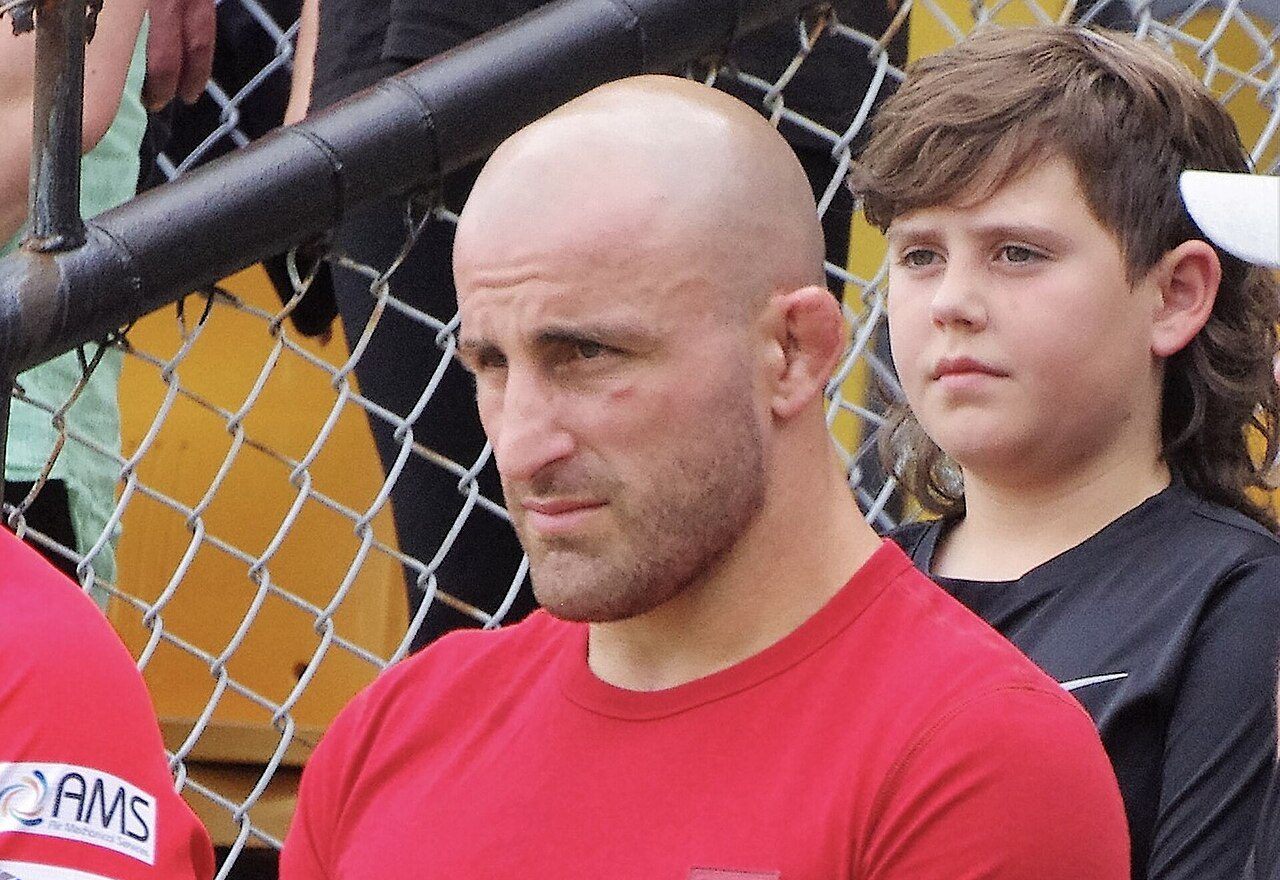
At 5-foot-6, Alexander Volkanovski never looked like the obvious man to rule a division built on length, speed and endless movement. Then he kept beating the best featherweights in the world anyway.
His career has never followed the standard path. Before the UFC title fights and sold-out arenas, Volkanovski was a stocky rugby league player from Wollongong, a talented junior wrestler and a concreter by trade. By the time he took the featherweight belt from Max Holloway in December 2019, he had already built a reputation for doing difficult things the hard way.
What followed turned him into one of the defining fighters of his era: a long first title reign, two ambitious moves up to lightweight against Islam Makhachev, a knockout loss that ended his run at 145 pounds, and then a return that brought the belt back around his waist. He is a two-time UFC Featherweight Champion and the first Australian-born fighter to win a UFC title.
Early life in Wollongong
Volkanovski was born on September 29, 1988, in Wollongong, New South Wales, Australia. He is of Macedonian and Greek heritage, and sport came early.
His first serious base was wrestling, specifically Greco-Roman. As a child, he won national titles, and that grounding never really left him. Even after he became known for pressure boxing, feints and pace, the balance and control from those early wrestling years remained part of his game.
As a teenager, though, rugby league took over. He played for the Warilla Gorillas and developed into a powerful, compact forward. In 2010, he won the Mick Cronin Medal as the best player in Group 7 Rugby League. In 2011, he was named man of the match in Warilla’s grand final win.
That chapter matters because it explains the version of Volkanovski that first caught attention in MMA: broad, strong, hard to move and used to collisions. He later left rugby league to pursue fighting full time, and the physical transformation became one of the most repeated details of his story. The former 200-plus-pound player would eventually make his name at featherweight.
Outside sport, he also worked as a concreter, a job that fits the image he has carried through his career. Nothing polished, nothing delicate, just steady work and repetition.
Amateur fights and the regional circuit
Before turning professional, Volkanovski went 4-0 as an amateur in MMA. He made his pro debut in 2012 and spent the next few years fighting across the Australian regional scene, where he built both experience and momentum.
He won titles in several promotions and across multiple weight classes, including stints at featherweight, lightweight and welterweight. That alone says something about the stage of his career: he was active, adaptable and willing to take fights where they came.
More importantly, he kept winning. By the time the UFC signed him in 2016, he had put together an 11-fight winning streak and owned a 13-1 professional record. He was not arriving as a novelty story or a late replacement from nowhere. He had already done the rounds, sharpened his style and learned how to fight different kinds of opponents.
He also boxed professionally in 2015, a small but relevant footnote in his broader combat sports profile.
UFC debut and the climb through featherweight
The UFC debut came in November 2016 against Yusuke Kasuya, and Volkanovski won by second-round TKO. Reported purse figures for early UFC fights vary by source and are not officially disclosed in full, but the bout marked the real start of his rise on the global stage.
He did not get pushed straight into title contention. Instead, he built his case the old-fashioned way. He beat Mizuto Hirota, Shane Young and Jeremy Kennedy, then stopped Darren Elkins in 2018 in a performance that announced him as more than a grinder with cardio. There was timing in his striking, confidence in his entries and a clear sense of how he wanted fights to unfold.
Victories over Chad Mendes and José Aldo followed in 2018 and 2019. Those were the wins that moved him from contender to unavoidable challenger. Mendes was still dangerous. Aldo was still Aldo. Volkanovski beat both and did it without much wasted motion.
By then, the shape of his game was clear. He pressured without rushing, mixed targets well, used feints constantly and made elite opponents work at a pace they did not enjoy.
Taking the belt from Max Holloway
December 2019 changed his career.
Max Holloway entered their first meeting as the UFC featherweight champion and one of the division’s great titleholders. Volkanovski beat him by unanimous decision over five rounds at UFC 245, using leg kicks, discipline and clean tactical adjustments to take the belt.
It was not a fluke result and it was not a one-off upset. He controlled long stretches of the fight and gave Holloway fewer openings than most opponents had managed.
The rematch came in July 2020. This time the fight was closer, and Volkanovski retained the title by split decision. The result was debated, but officially it was his first successful defense.
He then settled into the role of champion with more authority. In September 2021, he submitted Brian Ortega in the third round after surviving serious danger on the mat. In April 2022, he stopped Chan Sung Jung, the Korean Zombie, in the fourth. In July 2022, he beat Holloway for a third time, this one a clear unanimous decision that effectively closed the rivalry at the top level.
That third Holloway fight may have been the most important of the three for his legacy. The first won the belt. The third removed doubt.
Lightweight risks and the Islam Makhachev fights
Some of Volkanovski’s biggest nights came outside his home division.
In February 2023, he moved up to challenge Islam Makhachev for the UFC lightweight title at UFC 284 in Australia. He lost a unanimous decision, but the performance enhanced his standing rather than hurting it. Over five rounds, he matched Makhachev for stretches, rallied late and made the champion work under pressure.
Back at featherweight in July 2023, he defended his title against interim champion Yair Rodriguez and won by third-round TKO. It was one of the sharpest performances of his championship run, a reminder that the move to lightweight had not dulled him at 145.
Then came a second shot at Makhachev in October 2023, this time on short notice at UFC 294. The result was far harsher. Makhachev knocked him out in the first round.
Those two losses matter in any honest reading of his career. They showed ambition, but they also added damage. Volkanovski was not protecting a record. He was chasing the hardest fights available.
Losing the title and winning it back
The first featherweight reign ended in February 2024. At UFC 298, Ilia Topuria knocked Volkanovski out in the second round and took the belt.
For a champion who had ruled the division for years, it was a hard ending. It also raised the usual questions that follow a knockout loss: how much was left, how much had the lightweight detours cost, and whether the division had finally moved on.
Volkanovski answered in the cage.
After Topuria later vacated the title to move up in weight, Volkanovski fought Diego Lopes for the vacant UFC featherweight championship at UFC 314 in April 2025. He won by unanimous decision over five rounds to begin a second reign as champion.
That victory made him a two-time UFC Featherweight Champion. It also restored the central fact of his career: when the division has needed a standard-bearer, he has repeatedly put himself back in the frame.
His professional MMA record stands at 27-5, with 13 wins by knockout, three by submission and 11 by decision.
How Alexander Volkanovski fights
Volkanovski works from an orthodox stance, but that only tells part of the story. His style is built on layers.
He is short for the division, yet his 71.5-inch reach has always helped him bridge that gap. He feints constantly, changes rhythm, attacks the legs and body, and rarely gives opponents the same look for long. He can box in combination, but much of his best work comes from forcing reactions and then punishing them.
The wrestling base is just as important. Even when he is not chasing takedowns, it shapes the fight. He is difficult to control, strong in clinches and usually in command of where exchanges happen.
Cardio has been another constant. In title fights especially, he has often looked like the man better equipped for 25 minutes. That, more than any single punch or submission threat, helped make him such a reliable champion.
Life outside the cage
Wollongong has remained central to his life. Volkanovski is married to Emma Volkanovski, and the couple have children. Public interviews and his own social media have often shown a family-centered life away from fight week, though private details beyond that are best treated cautiously.
He has also leaned into a more personal public image than many champions do. His YouTube series, Cooking with Volk, showed a lighter side and fit neatly with the everyman persona that has followed him since his days working construction.
Business and sponsorship links have been widely reported as well, but exact ownership stakes and earnings are not always public. Reported net-worth figures for fighters are estimates, not verified disclosures, and should be treated that way. The same goes for many published purse numbers outside officially released bonus figures.
What is clear is that Volkanovski built a profile larger than the cage alone. In Australia, he became one of the sport’s most recognizable faces, not through noise or controversy, but through consistency, accessibility and years spent fighting at the top.
Legacy at featherweight
A lot of champions have a moment. Fewer have a body of work.
Volkanovski’s does. He beat Max Holloway three times. He defended the UFC featherweight title against Ortega, Jung and Rodriguez. He took on Islam Makhachev twice in pursuit of a second belt. He lost the championship and later won it back.
He is also tied with José Aldo for the most UFC featherweight title fight wins, with eight. That number, more than any slogan or nickname, explains where he belongs in the division’s history.
FAQ
How old is Alex Volkanovski?
He was born on September 29, 1988.
What is Alex Volkanovski’s record?
Alexander Volkanovski’s professional MMA record is 27-5.
Is Alex Volkanovski a UFC champion?
Yes. He is a two-time UFC Featherweight Champion.
Where is Alex Volkanovski from?
He is from Wollongong, New South Wales, Australia.
Who is Alex Volkanovski’s wife?
He is married to Emma Volkanovski.
What is Alex Volkanovski’s nickname?
His best-known nickname is “The Great.”
Photo: NAPARAZZI, CC BY-SA 2.0, via Wikimedia Commons