A five-round fight can turn into a numbers exercise when Max Holloway is involved. He has piled up more significant strikes in UFC history than anyone else, and he did it without changing the core of his game: pace, pressure and the kind of boxing rhythm that makes opponents work every second.
From Waiʻanae to the UFC
Jerome Max Keliʻi Holloway was born in Honolulu, Hawaii, and raised in Waiʻanae on Oʻahu’s west side. The setting matters in his story. Waiʻanae has long had a hard-edged fighting culture, and Holloway grew up in unstable circumstances. Published profiles have reported that both of his parents struggled with substance abuse, that his father left when he was young, and that his grandmother helped raise him. Holloway has also spoken publicly about parts of that upbringing and about his mother’s recovery.
He started training as a teenager, taking up kickboxing at 15. The beginning was quick and local, the kind of start that fits a Hawaiian prospect learning on the move rather than in a polished academy system. He has often been described as a natural competitor from the start, and early regional experience helped sharpen the style that would later define him: high output, clean combinations and unusual comfort in long exchanges.
Holloway turned professional in 2010. He made his debut on September 11 of that year at X-1: Heroes, fighting at lightweight. Within a short time he had built enough momentum on the Hawaii circuit to win the X-1 lightweight title, giving him a regional credential before he was old enough to have much of a résumé by UFC standards.
A young prospect thrown in deep
His UFC debut came fast. In February 2012, Holloway entered the promotion as one of its youngest fighters and drew Dustin Poirier in his first appearance. He lost by first-round submission, caught in a triangle armbar, but the matchup said plenty about how the UFC viewed him: raw, talented and worth testing immediately.
That first stretch in the promotion was uneven, as it often is for young fighters asked to learn on the biggest stage. He beat Pat Schilling and Justin Lawrence, then lost a decision to Dennis Bermudez. In August 2013, he dropped another decision to Conor McGregor. At the time, those defeats looked like reminders of how much work remained. In hindsight, they became early chapters in a much longer rise.
What stood out even then was not polish so much as temperament. Holloway kept fighting at a pace that suggested he trusted volume more than caution. He was willing to let rounds fill up with exchanges, and over time that became less a risk than a weapon.
The 12-fight run that changed everything
The real climb began after the McGregor loss. From 2014 into 2016, Holloway kept winning and kept adding layers. He beat Will Chope, Clay Collard, Cole Miller, Cub Swanson, Charles Oliveira and Jeremy Stephens, then kept the streak going against Ricardo Lamas. By then he was no longer just an entertaining action fighter. He was forcing his way into the center of the featherweight title picture.
In December 2016, he met Anthony Pettis for the interim UFC featherweight title. Holloway broke him down and finished him in the third round, a performance that captured the shape of his best work. He rarely looked rushed. He just kept adding pressure until the fight tilted.
That win set up the defining moment of his featherweight career. In June 2017, Holloway faced José Aldo in Rio de Janeiro for the undisputed UFC featherweight championship. Aldo had ruled the division for years and remained one of its central figures. Holloway weathered the early danger, found his rhythm and stopped him in the third round to unify the title.
The rematch six months later ended the same way. Holloway again stopped Aldo in the third round, this time in Detroit, confirming that the first result was no upset. By then, the 12-fight win streak had carried him from prospect to champion.
Champion at featherweight
A title reign can be measured in defenses, but Holloway’s was also about the way he fought. He defended the belt against Aldo in the rematch, then against Brian Ortega and Frankie Edgar. The Ortega bout, in December 2018, was especially punishing. Holloway’s jab, combinations and sustained pace built round after round until the cageside doctor stopped it after the fourth.
Against Edgar in July 2019, he was more measured but still in control, winning a unanimous decision. Those victories gave him three successful defenses of the undisputed UFC featherweight title. If the interim title win over Pettis is counted as a title-fight victory, the championship run looks even fuller, but his undisputed defenses stand at three.
By the end of his featherweight peak, Holloway had already carved out a place among the division’s most accomplished fighters. He became one of its most prolific winners and one of the UFC’s most reliable action headliners, not because he chased chaos, but because his style created it.
Volkanovski and a rivalry that reshaped the division
Every long run eventually meets resistance. For Holloway, that resistance came in the form of Alexander Volkanovski.
They first met in December 2019, when Holloway lost the featherweight title by unanimous decision. The rematch in July 2020 was much tighter and remains one of the most debated decisions of his career. Volkanovski won a split decision, but many media scorecards favored Holloway. Officially, though, the result stayed the same: another loss, and another missed chance to reclaim the belt.
Their third fight came in July 2022, with Holloway again challenging for the title. This time Volkanovski won a clear unanimous decision. That trilogy effectively closed Holloway’s featherweight championship chapter. He remained elite, but the division’s center had shifted.
Between those title losses, Holloway produced one of the signature performances of his career. In January 2021, he dominated Calvin Kattar over five rounds, putting on a striking clinic while talking to the commentary desk mid-fight and still landing at a historic rate. The bout reinforced what the statistics already showed: no one in UFC history had matched his sustained offensive output.
Records, style and the move up
For years, Holloway’s identity was tied to featherweight, but his frame and his mileage always made lightweight a natural option. He had fought above 145 pounds before, including an interim lightweight title loss to Poirier in 2019, yet the later move felt different. It looked less like a temporary jump and more like the next phase of his career.
Before that full shift, he produced one of the most memorable finishes of his career at UFC 300 in April 2024. Facing Justin Gaethje for the BMF title, Holloway spent much of the fight ahead on the scorecards, then chose not to coast. In the final seconds of round five, he pointed to the center, traded with Gaethje and knocked him out at 4:59. It was officially the latest knockout in UFC history.
That win added another line to his résumé: BMF champion. It also showed that even after years at the top, Holloway could still produce a moment that felt new.
Later that year, he challenged Ilia Topuria for the UFC featherweight title and lost by knockout. That result mattered beyond the defeat itself. It underscored that his future was likely above featherweight, where the weight cut had long been part of the conversation around him.
Holloway’s UFC records have shifted over time as the promotion keeps moving, but he has long sat at or near the top in total strikes landed and significant strikes landed. More important than the exact count is what those numbers say about him. He is not a one-shot finisher by nature. He wins by accumulation, by pressure, by taking away an opponent’s breathing room over 15 or 25 minutes.
Technically, he is an orthodox boxer-puncher with strong footwork, sharp reads in combination and a rare ability to maintain output deep into fights. He mixes straight punches well, attacks in layers and often looks strongest once the pace starts to drag others out of position. His game includes kicks and grappling experience, but the engine of it has always been his hands and his tempo.
Setbacks outside the results column
Not every interruption in Holloway’s career came from an opponent. During his championship years, several health-related issues disrupted his schedule.
He withdrew from UFC 222 because of a leg injury. Soon after, he was removed from a planned fight with Khabib Nurmagomedov at UFC 223 after a difficult weight cut, with the New York State Athletic Commission stepping in. Later that same year, he was pulled from UFC 226 with what were described publicly as concussion-like symptoms.
Those episodes complicated what might otherwise have been a smoother title reign. They also fed a broader discussion around weight management and durability in his career, especially as he moved deeper into his late-prime years.
Life outside the cage
Hawaii has never felt like a branding detail in Holloway’s story. It is central to how he presents himself and how he is understood. He has often spoken about representing the islands, and he has walked out under the Hawaiian flag as a visible sign of that connection.
His family life has also been partly public. Holloway was previously married to Kaimana Paʻaluhi, and they have a son, Rush. He later began a relationship with professional surfer Alessa Quizon; their relationship became public in 2020, and they married in 2022.
He has also spoken openly about mental health. In 2018, Holloway discussed struggles with depression, saying that seeing other athletes speak publicly helped him do the same. In a sport that often rewards silence, that candor became a meaningful part of his public image without needing to be overstated.
Away from fighting, he has been involved in charity and community work in Hawaii. Public reporting has linked him to efforts supporting the Hawaiʻi Foodbank, including merchandise initiatives and fundraising work, and he has taken part in other local causes connected to youth and families. He has also built a media presence beyond the cage, including online content under the BlessedMMA name.
As for finances, estimates of Max Holloway net worth vary widely by outlet and should be treated as estimates rather than confirmed fact. The same goes for many published figures about purses and sponsorship earnings. Reported totals can be useful for context, but they are not always officially disclosed by the UFC.
FAQ
What is Max Holloway’s real name?
Jerome Max Keliʻi Holloway.
Where is Max Holloway from?
He was born in Honolulu and raised in Waiʻanae, Hawaii.
What titles has Max Holloway won?
He won the UFC featherweight title, the interim UFC featherweight title and the UFC BMF title.
What is Max Holloway’s fighting style?
He is known as a high-volume pressure striker with strong boxing, steady footwork and elite pace over long fights.
Did Max Holloway fight Conor McGregor?
Yes. They fought in 2013, and McGregor won by unanimous decision.
What is Max Holloway’s professional record?
His record changes as his career continues, so it is best checked against the UFC’s official fighter page or a current bout database.
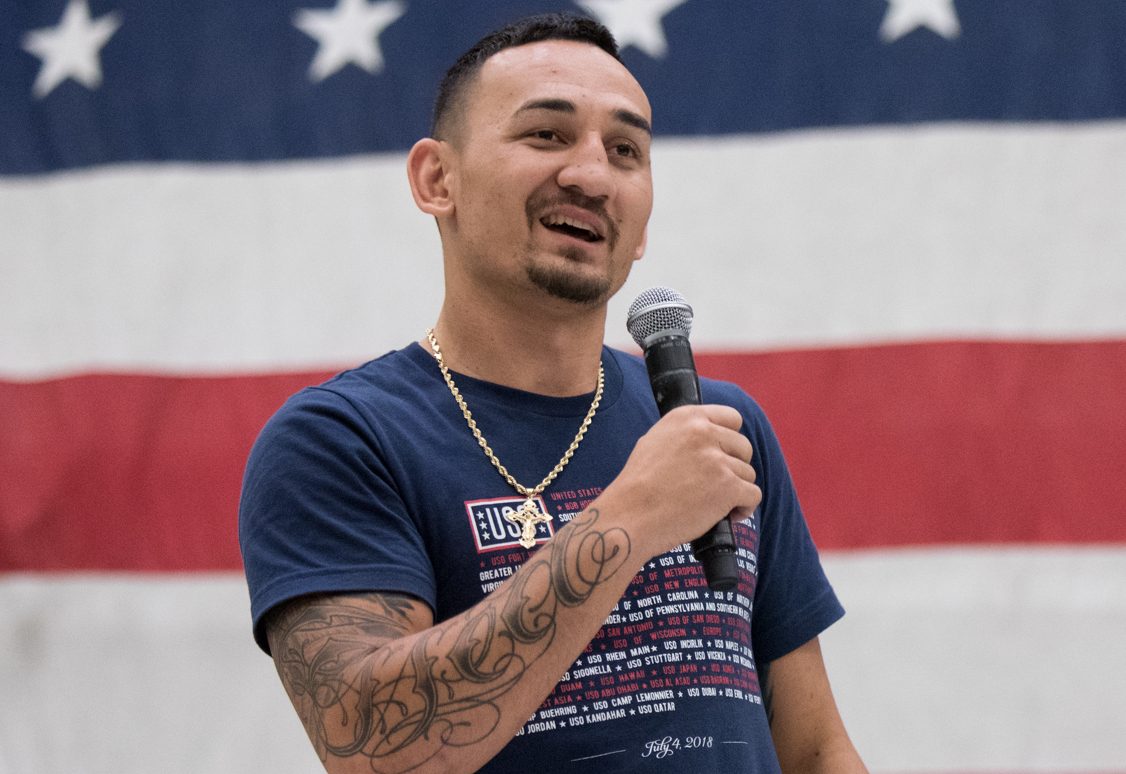
Photo: Chairman of the Joint Chiefs of Staff from Washington D.C,…, Public domain, via Wikimedia Commons