A featherweight standing 5ft 6in with a 71.5-inch reach should not look built for control at the highest level. Alexander Volkanovski made it work anyway, turning that compact frame, long arms and relentless pace into one of the strongest runs the division has seen.
Born on September 29, 1988, in Wollongong, New South Wales, Volkanovski grew up in the Shellharbour area and never really lost that local identity, even as his career became global. Long before the UFC, he was a wrestling kid. He competed in Greco-Roman wrestling from a young age and won national titles early, which helps explain a lot about the fighter he later became. Even when people talk about his pressure boxing or his ability to break rhythm on the feet, the roots are in balance, leverage and body control.
That athletic life did not stop at wrestling. He also played semi-professional rugby league for the Warilla Gorillas, a period that shaped both his toughness and his public image. In 2010 he won the Mick Cronin Medal, awarded as the club’s best and fairest player. Around the same time, he worked as a concreter. Mixed martial arts began as a practical addition, something to keep him fit in the rugby offseason. It did not stay a side project for long.
The early MMA years
Volkanovski turned professional in 2012 and built his name on the Australian regional scene. He fought mostly at welterweight and lightweight early on before settling lower, which makes his later success at featherweight even more striking. Those years were not glamorous, but they were important. He was learning how to turn raw physicality into a complete game.
He picked up experience in local promotions including Australian Fighting Championship, where he won the AFC featherweight title. The record from that stretch showed a fighter developing quickly: hard to hold down, hard to discourage, and increasingly polished in transitions between striking and wrestling.
There was also a brief detour into boxing. In 2015, he had one professional boxing match and won it, leaving him with a 1-0 record in that sport. It was a minor chapter, but it fit the broader pattern. Volkanovski was adding layers rather than starting over.
A fast climb in the UFC
The UFC signed him in 2016, and he made his debut that November at UFC Fight Night 101, beating Yusuke Kasuya by second-round TKO. At that stage he was not yet a headline name outside Australia, but the style was already there: pressure, feints, level changes and a willingness to make every exchange uncomfortable.
He followed that with wins over Mizuto Hirota, Shane Young and Jeremy Kennedy. Then came a fight that changed how he was viewed. In July 2018, he stopped Darren Elkins, a durable veteran who had made a career out of dragging opponents into ugly fights. Volkanovski did not just beat him; he controlled the terms.
The real statement arrived in December 2018 against Chad Mendes. Mendes had been one of the division’s measuring sticks for years, and Volkanovski knocked him out in the second round. Suddenly the climb was no longer quiet. It was obvious he belonged in the title picture.
A few months later, in May 2019, he beat José Aldo by unanimous decision in Brazil. The scorecards were debated in some corners, but the official result stood, and it secured what mattered most: a title shot.
Taking the belt from Max Holloway
In December 2019, Volkanovski met Max Holloway at UFC 245 and won a unanimous decision to claim the UFC featherweight title. It was a disciplined performance rather than a dramatic one. He attacked the legs, disrupted Holloway’s rhythm and stayed composed over five rounds. With that win, he became the first Australian-born UFC champion.
The rematch came in July 2020 at UFC 251. This time the fight was much tighter. Holloway started well, Volkanovski adjusted, and the champion retained his belt by split decision. It remains one of the most debated results on his record, but officially it was his first title defense.
Their trilogy was more decisive. At UFC 276 in July 2022, Volkanovski outclassed Holloway over five rounds and removed any doubt about the rivalry. Across three meetings, he went 3-0 against one of the best featherweights of his era.
Building a title reign
Between the Holloway fights, Volkanovski kept adding substance to his reign. In September 2021, he defended the belt against Brian Ortega in one of the most memorable performances of his career. He was badly threatened in guillotine and triangle choke attempts, escaped both, and went on to win by unanimous decision. That fight showed more than skill. It showed composure under real danger.
He followed with a fourth-round TKO of Chan Sung Jung, the Korean Zombie, in April 2022. Then, after the Holloway trilogy, he met interim champion Yair Rodriguez in July 2023 and stopped him in the third round to unify the titles.
That first reign gave him five successful UFC featherweight title defenses: Holloway, Holloway again, Ortega, Jung and Rodriguez. In total title-fight wins at featherweight, he moved into rare company alongside José Aldo. He also put together an 11-fight UFC winning streak, the longest in divisional history at the time.
Outside the cage, awards followed. He was named the World MMA Awards’ Charles “Mask” Lewis Fighter of the Year for 2022, and for a stretch he sat at the top of the UFC men’s pound-for-pound rankings.
The move up to lightweight
Volkanovski’s ambition was not limited to one division. In February 2023, he challenged Islam Makhachev for the UFC lightweight title at UFC 284 in Perth. He lost by unanimous decision, but the fight enhanced his standing rather than hurting it. He was competitive throughout, finished strongly, and showed he could trouble a larger champion with speed, footwork and urgency.
The rematch came together on short notice in October 2023 at UFC 294. This time Makhachev won by first-round knockout. It was a sharp setback, especially because Volkanovski had accepted the fight with limited preparation time. Still, it was part of the same pattern that had marked his career for years: he was willing to test himself against the hardest available challenge.
Losing the featherweight title
Back at featherweight, Volkanovski defended his belt against Ilia Topuria at UFC 298 in February 2024. Topuria knocked him out in the second round and ended the title reign.
For a champion who had built his reputation on consistency and adaptation, the loss was significant. It closed a chapter that had begun with Holloway and had turned Volkanovski into the central figure of the division. It also left him with a professional MMA record of 26-4 at that point, not the later figures sometimes repeated in speculative or outdated profiles.
How he fights
Volkanovski is often described as a pressure fighter, but that only tells part of the story. His best work comes from how many things he can threaten at once. He feints to draw reactions, changes levels to freeze opponents, and uses short combinations to enter range without giving away clean counters.
The wrestling base remains essential. Even in fights where he mostly boxes or kicks, the threat of the takedown shapes the exchanges. Opponents have to think about underhooks, stance and balance, which gives him more freedom on the feet. His long reach for the division helps too. He can touch taller featherweights from spots where they do not expect him to.
He is also a Brazilian jiu-jitsu black belt, and while that is not the first thing people mention about him, it matters in scrambles and defensive sequences. The Ortega fight is the clearest example. Volkanovski did not become elite by relying on one trait. He became elite by making every phase connect.
Life outside the cage
Away from fighting, his public image has usually been grounded and domestic rather than flashy. Volkanovski is married to Emma Volkanovski, and the couple have children together. Details about the exact number and names of their children are widely reported in media profiles and on social media, but family information should be treated as public only to the extent the family has chosen to share it.
He has long been associated with New South Wales and has trained with several respected camps, including City Kickboxing in New Zealand. He has also spent time working with Tiger Muay Thai and Bangtao in Thailand, reflecting the way modern top fighters build teams across countries rather than staying in one room forever.
On the business side, some outlets have linked him to ventures such as Volk’s Deli, while sponsorship reporting has connected him with brands including Prime Hydration, Hublot and Tyro Payments. As with most endorsement coverage, exact terms are rarely public, so those deals are best described as reported partnerships rather than fixed financial facts.
One detail that does feel true to character is his cooking content. Volkanovski launched “Cooking With Volk,” a YouTube series that plays neatly against the intensity of his fight persona. It is a small thing, but it rounds out the picture: a champion with a hard, technical style in the cage and a more relaxed, accessible presence outside it.
As for net worth figures, those vary widely across celebrity-finance sites and are not independently verified. Any estimate should be treated as speculative.
FAQ
What is Alexander Volkanovski’s nationality?
He is Australian.
Where is Alexander Volkanovski from?
He was born in Wollongong, New South Wales, and has strong ties to the Shellharbour area.
Was Alexander Volkanovski a wrestler before MMA?
Yes. He competed in Greco-Roman wrestling as a child and won national titles at a young age.
Did Alexander Volkanovski play rugby league?
Yes. Before focusing fully on MMA, he played semi-professional rugby league for the Warilla Gorillas.
How many times was Alexander Volkanovski UFC featherweight champion?
He has been UFC featherweight champion once. He won the belt in 2019 and lost it in 2024.
What is Alexander Volkanovski’s professional record?
Based on the results covered here through the loss to Ilia Topuria, his MMA record stood at 26-4. His professional boxing record is 1-0.
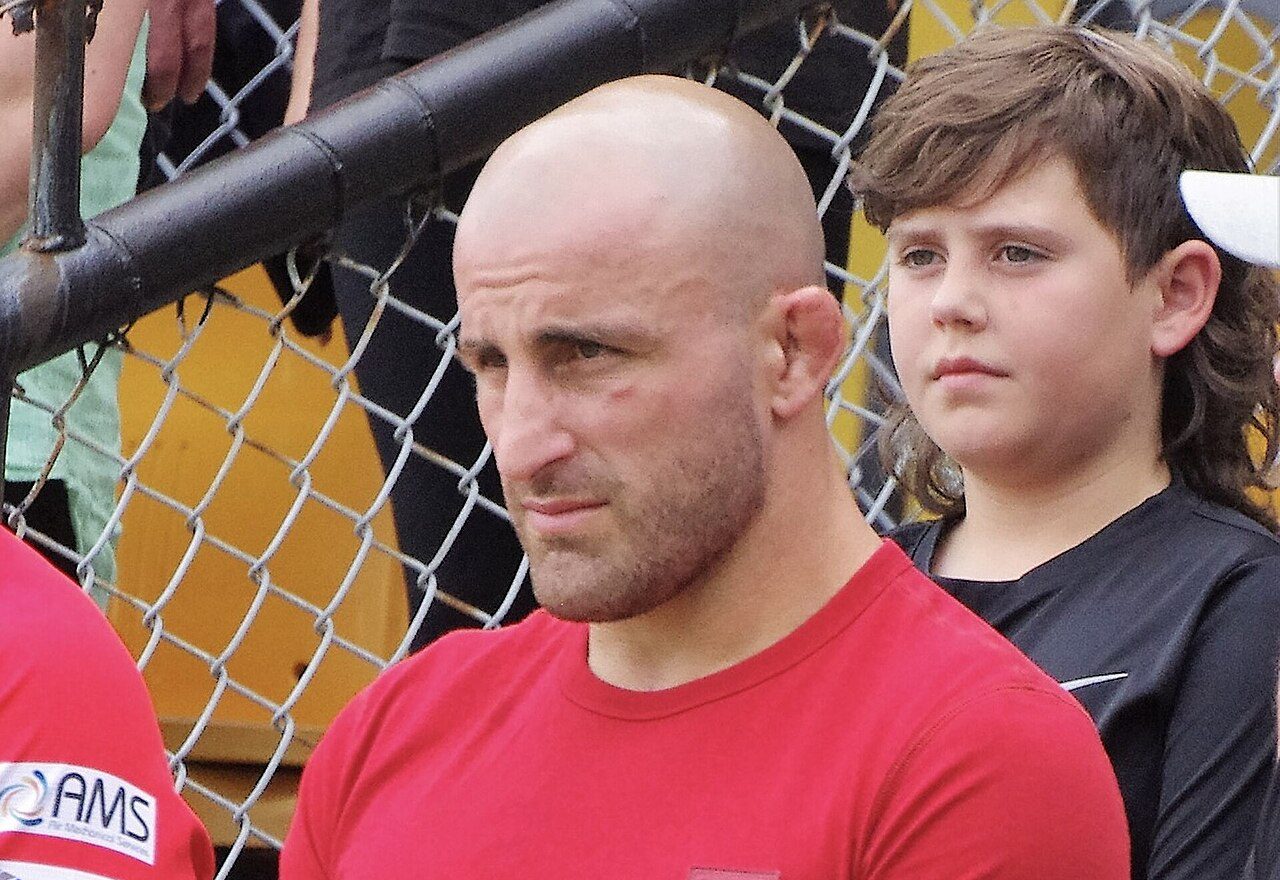
Photo: NAPARAZZI, CC BY-SA 2.0, via Wikimedia Commons