A first-round knockout loss is still the only mark against Islam Makhachev’s record. Everything that followed turned that early stumble into the starting point of a much bigger story: a climb from Dagestan’s combat-sambo circuit to the top of two UFC weight classes.
From Makhachkala to the mat
Islam Ramazanovich Makhachev was born on October 27, 1991, in Makhachkala, in Dagestan, and grew up in the hard-edged sporting culture that has produced so many elite wrestlers and fighters. He is of Lak heritage, one of the ethnic groups of the North Caucasus, and his upbringing was rooted in the routines of work, family and training rather than celebrity.
His athletic education started early and did not stay in one lane. He began with taekwondo as a child, then moved into sanda, wrestling, judo and sambo. That mix matters. It helps explain why his MMA game, though built on control and grappling, never developed as a one-note style.
Makhachev also came up alongside Khabib Nurmagomedov, not as a marketing footnote but as part of the same training world. They grew up in the same Dagestani fight culture, and the influence is obvious in the way Makhachev competes: pressure first, position before risk, and very little wasted motion.
Publicly available details about his family paint a modest background. His father worked as a driver and also grew tomatoes. His mother, according to widely repeated profiles, was a homemaker who also ran a small cafe. One story often told about those years is that his father allowed him time away from work to train and still paid him during camps, a small detail that says a lot about how seriously fighting was taken in the household.
The combat sambo years
Before the UFC knew his name, Makhachev had already built a serious résumé in combat sambo. He won Russian national titles at 74 kilograms and later captured the Combat Sambo World Championship in 2016. He also earned the rank of International Master of Sport in combat sambo.
That background is central to understanding his transition into MMA. He was not a prospect learning how to grapple after turning professional. He arrived with years of high-level experience in a discipline that rewards takedowns, balance, top control and composure under pressure. Those qualities would become the backbone of his work in the cage.
Building a record before the UFC
His professional MMA career began in 2010. Over the next several years he fought on the regional scene, including in M-1 Global, and steadily built himself into one of the more intriguing lightweights outside the UFC.
By the time he reached the promotion, he had already developed the outline of the fighter he would become: a southpaw, difficult to back up, hard to shake off in grappling exchanges, and increasingly comfortable dictating where a fight took place.
The UFC debut came in 2015, and so did the only defeat of his career. On October 3, 2015, at UFC 192, Adriano Martins knocked him out in the first round. It remains the lone loss on the Islam Makhachev record, and for a long time it was the clip critics returned to whenever they questioned his ceiling.
There was another setback the following year, though of a different kind. In 2016, Makhachev was flagged in an out-of-competition drug test for meldonium, leading to the cancellation of a scheduled bout. The case was later dismissed after it was determined he had ingested the substance before it was banned and the amount found was consistent with residual traces. That distinction matters, because the initial headline was damaging, but the final ruling cleared him of an anti-doping violation.
Once he was back in action, the momentum returned. He kept winning, and the conversation around him shifted from promising teammate of Nurmagomedov to a contender in his own right.
Islam Makhachev at lightweight: the title run
The breakthrough came at UFC 280 on October 22, 2022. Makhachev faced Charles Oliveira for the vacant UFC lightweight title and finished him with an arm-triangle choke in the second round. It was not just a championship win. It was the night he fully stepped out of the shadow of his gym and took control of the division himself.
A first defense against Alexander Volkanovski followed at UFC 284 on February 12, 2023. Volkanovski, moving up from featherweight, forced a more tactical fight than Oliveira had. Makhachev won by unanimous decision over five rounds, relying on control, timing and enough clean work to stay ahead on the cards. It was the kind of performance that showed he could manage a championship fight without needing a dramatic finish.
The rematch at UFC 294 on October 21, 2023 ended much faster. Makhachev knocked out Volkanovski in the first round with a head kick and follow-up strikes, one of the sharpest finishes of his career and one that strengthened his place near the top of the pound-for-pound discussion.
His next title defense came against Dustin Poirier at UFC 302 on June 1, 2024. Poirier had long served as one of the division’s measuring sticks, dangerous late and proven against elite competition. Makhachev submitted him with a D’Arce choke in the fifth round, a result that underlined both his patience and his ability to find control deep into a hard fight.
He made a fourth successful defense against Renato Moicano, submitting him in the first round with a brabo choke, a variation often grouped with the D’Arce family of chokes. By the time he left the division, his run at 155 pounds had become one of the strongest in UFC lightweight history.
He vacated the lightweight belt before moving up, closing that chapter with four successful title defenses and five lightweight title-fight wins in total, counting the victory over Oliveira. His winning streak inside the UFC reached 16, tying one of the longest runs in promotion history.
Moving up and winning a second UFC title
The shift to welterweight changed the scale of his career. Makhachev had spent his entire professional run competing as a lightweight, so the move to 170 pounds was more than a one-off challenge. It was a deliberate second act.
In his welterweight title fight, he defeated Jack Della Maddalena by unanimous decision over five rounds to win the UFC welterweight championship. That result made him a champion in a second division after first vacating his lightweight title, a rare sequence in UFC history and one that added a different kind of weight to his résumé.
At that point, his professional record stood at 28-1, with 5 wins by knockout, 13 by submission and 10 by decision. Those numbers tell a useful story. Makhachev is often introduced as a grappler first, and that is fair, but he is not a specialist who survives only in one phase. He has become an efficient all-around fighter whose striking works because it is built around threat, balance and control.
What makes his style work
The shorthand description is simple: southpaw, combat sambo base, elite wrestling. The fuller picture is more interesting.
Makhachev’s best work usually begins before the takedown. He pressures opponents into narrower choices, gets them reacting, then uses that hesitation to enter on the legs or force them to the fence. Once he gets on top, he is not especially flashy. He is methodical. He advances position, traps arms, flattens hips and waits for mistakes.
That patience is a major part of why he has been so effective. He does not chase finishes at the expense of control. If a submission opens, he takes it. If it does not, he is comfortable winning rounds and wearing opponents down.
His striking has also improved over time. For a fighter known mainly for grappling, his stand-up has become clean and economical, particularly from the left side. The knockout of Volkanovski was the most obvious example, but even in decision wins his striking tends to serve the larger structure of the fight rather than exist as a separate layer.
Life outside the cage
Away from competition, Makhachev has kept much of his private life private. He is publicly described as married, though he has not made his family life a major part of his public image. He also has an older brother, Kurbanismail, and is open about his Muslim faith.
His training base has long been split between Dagestan and American Kickboxing Academy in San Jose. Javier Mendez has been a key coach, while Khabib Nurmagomedov has remained an important figure in his corner and development. He has also been linked to teams and training groups including Eagles MMA and other Dagestani wrestling and fight clubs.
His ties to home remain strong. Makhachkala is central to his story, and reports have also linked him to life on a farm in the mountain village of Burshi. That image fits the public version of Makhachev: reserved, disciplined and still closely connected to the region that shaped him.
There are a few personal details that surface now and then. He has been associated with outdoor hobbies such as horse riding, fishing and motorbiking. Reports have also linked him to business interests in padel, training facilities and real estate in Dagestan, though many of those claims are described broadly and not always in detail.
The same caution applies to money talk. Estimates of Islam Makhachev net worth vary widely across outlets and should be treated as speculative unless tied to disclosed figures. Sponsorship links to brands such as Venum, Monster Energy, YoungLA and others have been reported, but exact earnings are not public. Likewise, stories about luxury items should be handled carefully: reports from outlets including The Times of India and EssentiallySports have claimed he was seen wearing a Richard Mille watch valued at around $1.5 million, but whether he purchased it himself or received it as a gift has not been firmly established.
A career built on control
Some champions are remembered for chaos. Makhachev’s rise has looked different. It has been built on order: disciplined preparation, repeatable tactics and a style that gives opponents very little room to breathe.
That does not make his career dry. Quite the opposite. From the gyms of Dagestan to title fights against Oliveira, Volkanovski, Poirier and Della Maddalena, the shape of his story is clear. He learned early, lost once, adjusted, and then spent years making elite fighters work at his pace.
FAQ
Is Islam Makhachev related to Khabib Nurmagomedov?
No. They are close friends, longtime training partners and teammates, but they are not blood relatives.
What is Islam Makhachev’s record?
His professional MMA record stands at 28-1, with 5 knockouts, 13 submissions and 10 decision wins.
How did Islam Makhachev become famous?
He rose through combat sambo and regional MMA, then became a UFC champion at lightweight before later winning a second UFC title at welterweight.
What is Islam Makhachev’s fighting style?
He is a southpaw with a combat sambo and wrestling base, known for pressure, takedowns, top control and efficient submissions.
Has Islam Makhachev ever been knocked out?
Yes. Adriano Martins stopped him in the first round in 2015, which remains his only professional loss.
Where is Islam Makhachev from?
He is from Makhachkala, Dagestan, Russia.
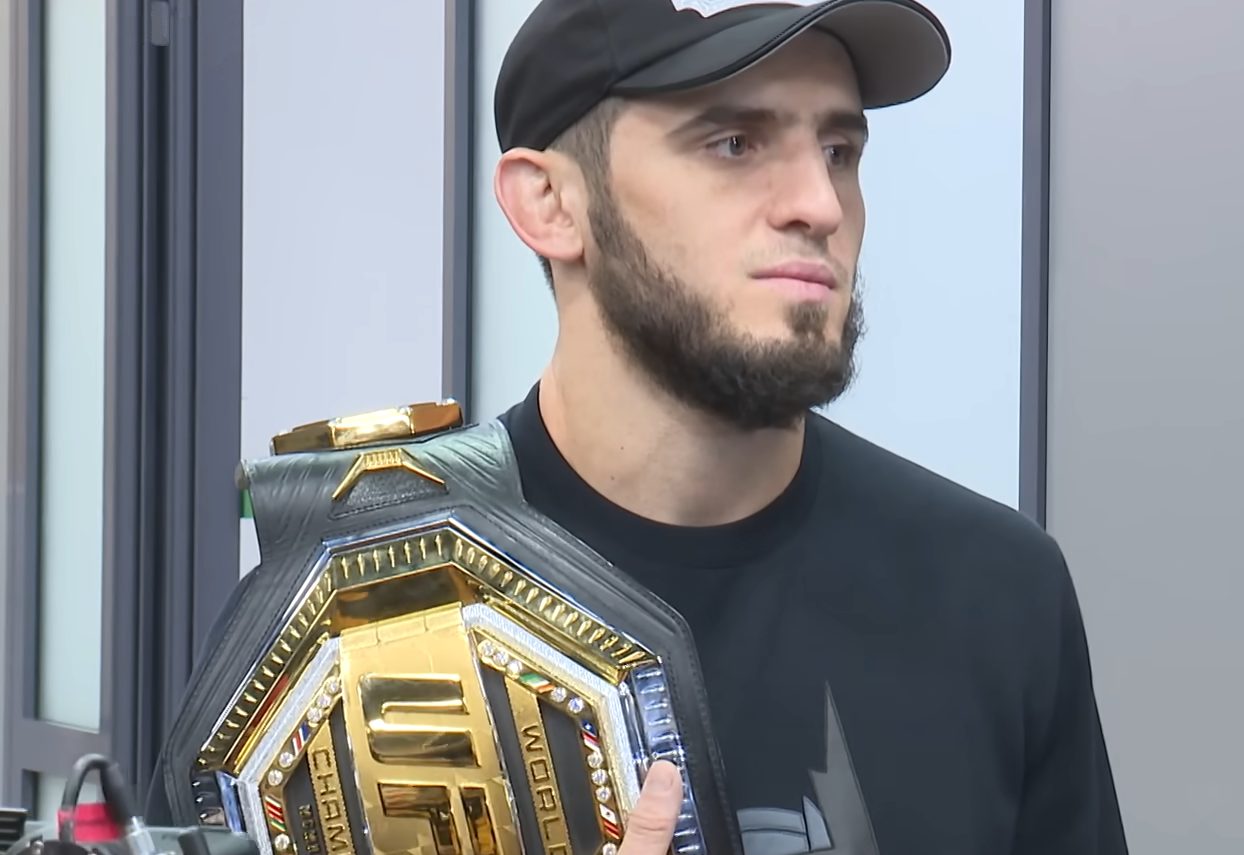
Photo: Новости ННТ, CC BY 3.0, via Wikimedia Commons