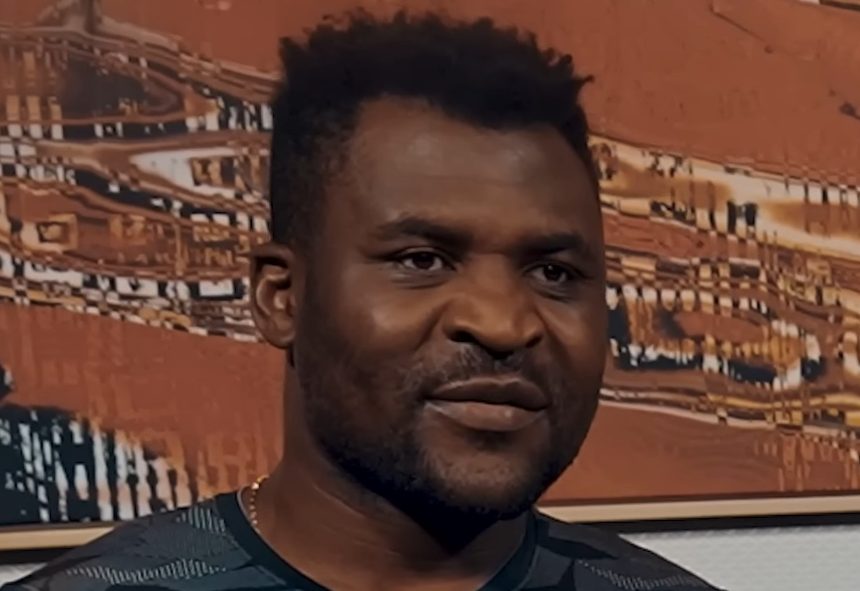
At 10 years old, Francis Ngannou was working in a sand quarry in Batié. Years later, he would walk into a cage as UFC heavyweight champion, then step through the ropes to box Tyson Fury. Few combat-sports careers have covered that much ground, in every sense.
Ngannou’s story is often told through the violence of his knockouts, and there is plenty of that in the record. But the shape of his career is broader than raw power. It starts in western Cameroon, runs through a long and dangerous journey to Europe, and turns into one of the more unusual heavyweight arcs of the modern era: regional MMA in France, a UFC title, a contract break with the sport’s biggest promotion, a move into boxing, and then another major belt in the PFL.
Early life in Cameroon
Francis Zavier Ngannou was born on September 5, 1986, in Batié, Cameroon. He has spoken openly about a hard childhood. His parents separated when he was young, and he worked from an early age in the local sand mines to help support himself.
Boxing was the first dream. Ngannou has said he was drawn to the sport by Mike Tyson and wanted to become a boxer long before mixed martial arts entered the picture. He began boxing training in Cameroon in his early twenties, but his path soon became less about a straight sporting progression and more about survival.
His trip from Cameroon to France took many months and included stretches of homelessness and time in detention during the journey, details Ngannou has discussed in interviews. Even after he reached Paris, life did not settle quickly. He was homeless for a period and, by his own account, often slept rough before finding help through the local fight community.
That was the setting in which MMA took hold. In Paris, he connected with Fernand Lopez at MMA Factory. Boxing had been the original aim, but mixed martial arts offered a faster route to earning money and building a career.
Learning fast on the French circuit
Ngannou turned professional in MMA in 2013. His debut came on November 30, 2013, when he stopped Rachid Benzina at 100% Fight: Contenders 20. The early years were busy and imperfect, which is often a good sign in a developing heavyweight. He won, lost, adjusted, and kept moving.
Before the UFC called, he fought mostly in French promotions and built a record of 5-1. The losses on that stretch mattered. He was submitted by Zoumana Cisse in his second pro fight and later dropped a decision to Karlly Brito. Those results are easy to skip over in a highlight-reel version of Francis Ngannou’s career, but they help explain what came later. He was not a finished destroyer from day one. He was a late starter learning on the job.
Even then, the outline was obvious: size, speed for a heavyweight, and unusual punching force. Once he began to connect cleanly, fights tended to end quickly.
The UFC run and the rise of a knockout threat
Ngannou made his UFC debut on December 19, 2015, against Luis Henrique at UFC on Fox 17. He lost the first round, then rallied and finished Henrique by knockout in the second. It was an untidy but revealing debut. He was dangerous, composed enough to recover, and instantly relevant in a division that always notices punchers.
The run that followed turned him into one of the most feared heavyweights in the sport. He beat Curtis Blaydes by TKO, submitted Anthony Hamilton, knocked out Bojan Mihajlovic, and then flattened Henrique’s countryman Anthony Hamilton? No, that is where many quick summaries get sloppy. The actual sequence matters because it shows the pace of his rise: Blaydes, Hamilton, Mihajlovic, then a first-round knockout of Andrei Arlovski in early 2017.
From there, the momentum became harder to ignore. In June 2017 he stopped Blaydes again, this time by doctor stoppage after the first round. In December came the knockout that still follows him everywhere: Alistair Overeem, rendered unconscious by a brutal left uppercut at UFC 218.
Around that same period, the UFC Performance Institute publicized a power-test result that it described as the hardest punch ever recorded in its system, and Ngannou’s name became attached to that claim for good. The exact science of such measurements can be debated. The effect of his punching power inside the cage could not.
Stipe Miocic, a hard lesson, and the rebuild
His first shot at the UFC heavyweight title came in January 2018 against Stipe Miocic at UFC 220. Ngannou entered as the dangerous challenger. Miocic spent five rounds exposing the gaps in his game, mixing wrestling, clinch work and pace to win a clear unanimous decision.
That loss changed the course of his career. It was followed by another difficult night, a listless decision defeat to Derrick Lewis in July 2018, one of the strangest high-level heavyweight fights in recent memory. For a moment, the surge had stalled.
Then came the reset.
Ngannou returned with a series of short, violent wins that put him back in the title picture: Curtis Blaydes in 45 seconds, Cain Velasquez in 26 seconds, Junior dos Santos in 71 seconds, and Jairzinho Rozenstruik in 20 seconds. Those finishes restored the aura, but they did not fully answer the questions raised by Miocic.
The deeper change happened in training. Ngannou eventually settled at Xtreme Couture in Las Vegas, working closely with coach Eric Nicksick and with Dewey Cooper among the key voices around his striking. The version of him that emerged there was still built around power, but he was calmer, more selective and harder to break positionally.
Winning the UFC heavyweight championship
The rematch with Miocic arrived at UFC 260 in March 2021. This time, Ngannou looked like a different heavyweight. He defended takedowns better, managed distance more carefully, and when the opening came, he finished the fight. A left hand and follow-up shots ended matters in the second round.
With that knockout, Francis Ngannou became UFC heavyweight champion and the first African-born fighter to win that title.
He defended the belt once, against Ciryl Gane at UFC 270 in January 2022. What made that fight notable was not drama at striking range but the opposite. Fighting with a damaged knee, Ngannou leaned on wrestling and top control to win a unanimous decision. For a man long reduced to a single idea, punch hard, finish early, it was a useful correction. He could adapt when he had to.
His official UFC record closed at 12-2, with the title win over Miocic and one successful defense.
Leaving the UFC while still champion
Heavyweight champions rarely leave the UFC on their own terms while still holding the belt. Ngannou did.
After the Gane fight, his contract situation became one of the sport’s biggest business stories. Ngannou publicly pushed for terms that included greater freedom to box, improved sponsorship rights, and better protections for fighters, including health-related concerns. In January 2023, the UFC announced that he had been released and stripped of the title after the sides failed to reach a new agreement.
That decision reshaped the second half of his career. It also led to a deal with the Professional Fighters League, where Ngannou was announced not only as a fighter but also as chairman of PFL Africa and a minority equity owner in the company.
Boxing Tyson Fury, then Anthony Joshua
The first major move after leaving the UFC was the one he had wanted for years: professional boxing.
Ngannou made his boxing debut against Tyson Fury in October 2023 in Riyadh. On paper, it looked like a crossover event tilted heavily toward the lineal heavyweight champion. In the ring, it was far more competitive than most expected. Ngannou dropped Fury in the third round and lost a split decision after 10 rounds.
He still lost, and his professional boxing record began at 0-1, but the performance changed the way he was viewed as a boxer. It was not a novelty appearance. He looked composed, physically credible, and dangerous enough to trouble one of the best heavyweights of his generation.
His second boxing match came in March 2024 against Anthony Joshua. That night went very differently. Joshua dropped him repeatedly and finished him by knockout in the second round. It was a sharp reminder that elite boxing punishes mistakes quickly, especially against a seasoned puncher.
So the boxing ledger stands at 0-2. Even so, those two fights became a central part of the Francis Ngannou record because they showed how far he was willing to push his career beyond the usual MMA lane.
Back to MMA and a PFL title
Ngannou returned to mixed martial arts in October 2024 against Renan Ferreira in the PFL Super Fights main event. He won by first-round TKO and claimed the PFL Super Fights heavyweight championship.
That result moved his MMA record to 18-3 at the time. It also gave him a second major title outside the UFC chapter and underlined the unusual split in his career: still a top-level heavyweight in MMA, while also pursuing high-profile boxing matches.
Fighting style: power first, but not only power
The nickname “The Predator” fits the obvious part of his game. Ngannou is an orthodox heavyweight with rare stopping power, and most of his best-known wins came from clean, sudden violence. In MMA, his record includes 13 wins by knockout or TKO, 4 by submission and 1 by decision.
But his style changed over time. Early in his rise, he could look impatient, loading up on every shot and trusting that one punch would solve the fight. After the first Miocic loss, and especially later in Las Vegas, he became more measured. He used feints better, conserved energy more intelligently, and showed he could wrestle when the matchup demanded it.
That is why the Gane fight matters in any honest profile. It was not his most exciting performance, but it rounded out the picture.
Life outside the ring
Away from competition, Ngannou’s public life has been shaped less by celebrity display than by business moves and work tied to Cameroon.
The Francis Ngannou Foundation, launched in 2018, supports projects in areas including education and sport. It has also been linked to the opening of an MMA gym in Cameroon, a meaningful detail given how little infrastructure existed there when he was growing up.
His post-UFC business role with PFL Africa also matters. It gave him influence beyond his own fight schedule and connected his name to the promotion’s expansion plans on the continent.
Some reports have also linked him to investments and endorsement deals outside fighting. Where those details are not confirmed directly by Ngannou or the companies involved, they are best treated cautiously. The same goes for widely circulated estimates of Francis Ngannou net worth, which vary from outlet to outlet and should be read as estimates rather than established fact.
He has lived and trained in Las Vegas for much of his later career. Reports about property purchases and other private-life details should likewise be treated as reported claims unless confirmed on the record.
What is firmly established is the broader shape of the man’s story: a heavyweight who came late to combat sports, learned in public, hit harder than almost anyone, and kept changing course when a simpler path was available.
FAQ
What is Francis Ngannou’s MMA record?
Francis Ngannou’s professional MMA record is 18-3, with 13 wins by knockout or TKO, 4 by submission and 1 by decision.
What is Francis Ngannou’s boxing record?
His professional boxing record is 0-2, with losses to Tyson Fury and Anthony Joshua.
Did Francis Ngannou win the UFC heavyweight title?
Yes. He won the UFC heavyweight championship by knocking out Stipe Miocic at UFC 260 in March 2021.
Where is Francis Ngannou from?
He was born in Batié, Cameroon, and later also became a French citizen.
Has Francis Ngannou fought in the PFL?
Yes. He signed with the PFL after leaving the UFC and won the PFL Super Fights heavyweight title by stopping Renan Ferreira in 2024.
Why did Francis Ngannou leave the UFC?
He left after a contract dispute centered on issues such as boxing freedom, sponsorship rights and broader fighter protections.
Photo: Mike Tyson, CC BY 3.0, via Wikimedia Commons