Less than a dollar for a first pro fight, a stowaway trip to Manila as a teenager, and world titles spread across eight divisions: Manny Pacquiao’s career never followed a normal boxing script.
Born Emmanuel Dapidran Pacquiao Sr. on December 17, 1978, in Kibawe, Bukidnon, he grew up in hardship and learned early that boxing could be more than a sport. It could be a way out. From the parks and small gyms of General Santos to pay-per-view main events watched around the world, the Filipino southpaw built one of the most unusual résumés the sport has seen.
Manny Pacquiao before the titles
Pacquiao’s early life has been told so often that some details now sit somewhere between family history and boxing folklore. The broad outline is clear. He spent part of his youth in Mindanao, was introduced to boxing by his uncle Sardo Mejia, and trained in improvised conditions before moving on to more serious work in General Santos City.
As a teenager, he left home and made his way to Manila to chase a boxing career. Accounts of that trip commonly describe him as a stowaway on a ship, a detail widely repeated in profiles of his life. The urgency behind the move was real enough either way: he was trying to escape poverty and find work through fighting.
Before turning professional, he reportedly compiled an amateur record of 60-4. He entered the paid ranks on January 22, 1995, as a junior flyweight. In another story that has long followed him, he was said to have claimed he was older than he really was and even put weights in his pockets to make the minimum. That anecdote has been widely reported, though like many tales from his earliest days, it belongs to the legend of the young Pacquiao as much as to official paperwork.
His first purse was tiny. Reports have long held that he earned less than a dollar and gave the money to his mother to buy rice. Whether remembered to the cent or not, it fits the reality of where he started.
A fast climb from flyweight to featherweight
The first major title arrived on December 4, 1998, when Pacquiao stopped Chatchai Sasakul to win the WBC flyweight championship. It was the kind of result that made people look twice. He was still a teenager, still raw in places, but the speed and left hand were already there.
The rise did not happen in a straight line. In September 1999, he lost that WBC flyweight title on the scales before his bout with Medgoen Singsurat, then was knocked out in the third round. It was an early setback, and an important one. His career would eventually be defined by the divisions he conquered, but there were hard lessons in those lower-weight years.
He resurfaced at super bantamweight and made a bigger statement on June 23, 2001, when he stopped Lehlohonolo Ledwaba to win the IBF title. That fight, taken on short notice, introduced him to a wider American audience. It also began a long partnership with trainer Freddie Roach, who helped sharpen the chaos in Pacquiao’s offense into something more repeatable and more dangerous.
At his best, he was not a tidy boxer. He was a southpaw attacker who came in bursts, changed rhythm quickly, and threw combinations from angles that unsettled opponents before they could set themselves. The hand speed was obvious. So was the pressure. He often won exchanges by making elite fighters work at a pace they did not want.
Barrera, Morales and Marquez
The breakthrough from titleholder to international star came on November 15, 2003. Pacquiao stopped Marco Antonio Barrera and took The Ring featherweight championship in a performance that changed how he was viewed. Barrera was not just another belt holder. He was an established elite name, and Pacquiao overwhelmed him.
Then came the rivalries that shaped the middle years of his career.
Erik Morales beat him by unanimous decision in March 2005, handing Pacquiao one of the most significant losses of his prime. Pacquiao answered by stopping Morales in January 2006 and again in November 2006, turning the rivalry his way.
Juan Manuel Marquez provided an even more complicated chapter. Their first fight, in May 2004, ended in a draw after Pacquiao scored three knockdowns in the opening round. Marquez won a split decision in 2012, but before that Pacquiao had edged him twice, by split decision in 2008 and majority decision in 2011. Across four fights, the official series finished 2-1-1 in Pacquiao’s favor, though debate over those scorecards never really disappeared.
Those rivalries mattered because they showed different sides of him. Against Barrera, he looked explosive. Against Morales, adaptable. Against Marquez, vulnerable and brilliant in the same rivalry, often within the same round.
The leap through the divisions
By 2008, Pacquiao was moving through weight classes at a pace that would have sounded unrealistic a few years earlier.
On March 15, 2008, he beat Marquez for the WBC super featherweight title. On June 28, 2008, he stopped David Diaz to win the WBC lightweight belt. Then, in December of that year, he battered Oscar De La Hoya into retirement after eight rounds. De La Hoya was the bigger man and the bigger commercial name, but the fight made clear that Pacquiao was no longer just a lower-weight champion daring to move up. He had become one of boxing’s main attractions.
The run continued in 2009. He knocked out Ricky Hatton in two rounds on May 2 to win The Ring light welterweight title, one of the most devastating single punches of his career. On November 14, he stopped Miguel Cotto and claimed the WBO welterweight title.
Then he added another division. On November 13, 2010, he beat Antonio Margarito by unanimous decision for the WBC light middleweight title.
That sequence is the heart of the Manny Pacquiao record and legacy. He won major world titles from flyweight to light middleweight, collecting championships in eight divisions overall. No other boxer has matched that eight-division mark.
Bradley, Marquez and the Mayweather event
Not every big night ended with his hand raised.
In June 2012, Timothy Bradley won a split decision over Pacquiao in a result that drew heavy criticism. Later that same year, on December 8, Juan Manuel Marquez knocked him out cold in the sixth round of their fourth fight, one of the most dramatic and damaging defeats of his career.
Pacquiao recovered again, as he so often did. He beat Bradley by unanimous decision in April 2014, then spent the next year heading toward the fight that had hovered over the sport for years.
Floyd Mayweather Jr. vs Manny Pacquiao finally happened in May 2015. The bout was a commercial giant, drawing 4.4 million pay-per-view buys in the United States. Mayweather won by unanimous decision in a tactical fight that never fully matched the anticipation around it, but the scale of the event made it unavoidable in any account of Pacquiao’s career. Reported purse figures vary by source, though estimates commonly placed Pacquiao’s earnings well into nine figures.
A senator still fighting
Pacquiao kept boxing at world level while stepping deeper into politics, a combination that would have sounded improbable if he had not actually done it. He served as a Senator of the Philippines from 2016 to 2022.
In the ring, he beat Timothy Bradley for a third time in April 2016, then outpointed Jessie Vargas in November 2016 to win the WBO welterweight title again. In July 2017, he lost a unanimous decision to Jeff Horn in Australia, another verdict that drew argument.
There was one more late-career surge. He stopped Lucas Matthysse in July 2018, beat Adrien Broner by unanimous decision in January 2019, and then defeated Keith Thurman by split decision on July 20, 2019, to win the WBA welterweight title. That made him the oldest welterweight world champion in boxing history at 40 years and 215 days.
Against Thurman, the old traits were still visible: the quick entries, the left hand, the willingness to attack first rather than wait.
Retirement, return and the late chapter
His last fight of that first long career came in August 2021, when Yordenis Ugas beat him by unanimous decision over 12 rounds. Pacquiao announced his retirement from professional boxing the following month.
He later ran for president of the Philippines and finished third in the 2022 election.
Retirement, though, did not prove permanent. Pacquiao returned to professional boxing on July 19, 2025, and fought Mario Barrios to a draw. That result moved his professional record to 62-8-3 with 39 knockouts.
He was also inducted into the International Boxing Hall of Fame in June 2025, recognition that would have come with or without the comeback. The numbers were already secure: 12 major world titles, championships in eight weight classes, and title-fight success spread across an extraordinary span of time.
What made Manny Pacquiao different
Statistics explain part of the story, but not all of it.
Pacquiao was small for some of the divisions he entered, especially later in his climb, yet he kept carrying his speed and power upward. He was a southpaw who attacked in combinations, often darting in and out before an opponent could answer cleanly. Early in his prime, the offense could look wild. Under Roach, it became more disciplined without losing its edge.
He also built a rare résumé against fellow elite fighters. Barrera, Morales, Marquez, De La Hoya, Hatton, Cotto, Bradley, Thurman: that list alone covers several eras and styles.
One story from the Margarito fight has lingered for years. Some observers said Pacquiao appeared to ease off late rather than pursue a stoppage against an already badly swollen opponent. That reading is interpretive rather than official fact, but it has remained part of how people discuss his temperament in the ring.
Life outside the ring
Away from boxing, Pacquiao’s public life became almost as broad as his fighting career.
He married Jinkee Jamora in 1999, and they have six children. His brother Bobby Pacquiao also fought professionally and later entered politics. Pacquiao’s own life outside sport has included business, entertainment and public office, with homes and properties linked in published reports to General Santos, Metro Manila and the United States.
Some claims about his business empire are harder to verify cleanly than his boxing results, so they are best treated with caution. He has been publicly linked to ventures including MP Promotions and other brand-based businesses, while various reports have also tied him to coffee, media and technology projects. Estimates of Manny Pacquiao net worth vary widely by outlet, and exact totals are difficult to confirm independently.
His charitable work, however, is well established in the public record. The Manny Pacquiao Foundation has supported housing, disaster relief, medical aid and community assistance. Reports about the scale of his giving often differ, so broad claims about exactly what share of his earnings he has donated should be treated as estimates rather than settled fact.
Then there is the cultural reach. In the Philippines, Pacquiao was never just a boxer. During his biggest fights, local media frequently reported unusually quiet streets and even temporary drops in crime, though the most dramatic versions of those stories are better read as widely repeated reports than hard statistical conclusions. His nickname, Ang Pambansang Kamao, the Nation’s Fist, captures that place in public life better than any endorsement figure could.
There have also been entertainment rumors around him. A possible Hollywood move has been mentioned in media reports, but nothing established has emerged from that talk. The same caution applies to online chatter about future opponents or rematches: unless a fight is officially announced, it remains rumor.
FAQ
How many world titles has Manny Pacquiao won?
He won 12 major world titles across eight weight divisions.
What is Manny Pacquiao’s boxing record?
His professional record stands at 62-8-3 with 39 knockouts after the draw with Mario Barrios.
When did Manny Pacquiao make his professional debut?
He debuted on January 22, 1995, as a junior flyweight.
Did Manny Pacquiao fight Floyd Mayweather Jr.?
Yes. They fought in May 2015, and Mayweather won by unanimous decision.
Was Manny Pacquiao a politician?
Yes. He served as a Senator of the Philippines from 2016 to 2022 and later ran for president.
Why is Manny Pacquiao historically unique?
He is the only boxer to win major world titles in eight different weight divisions.
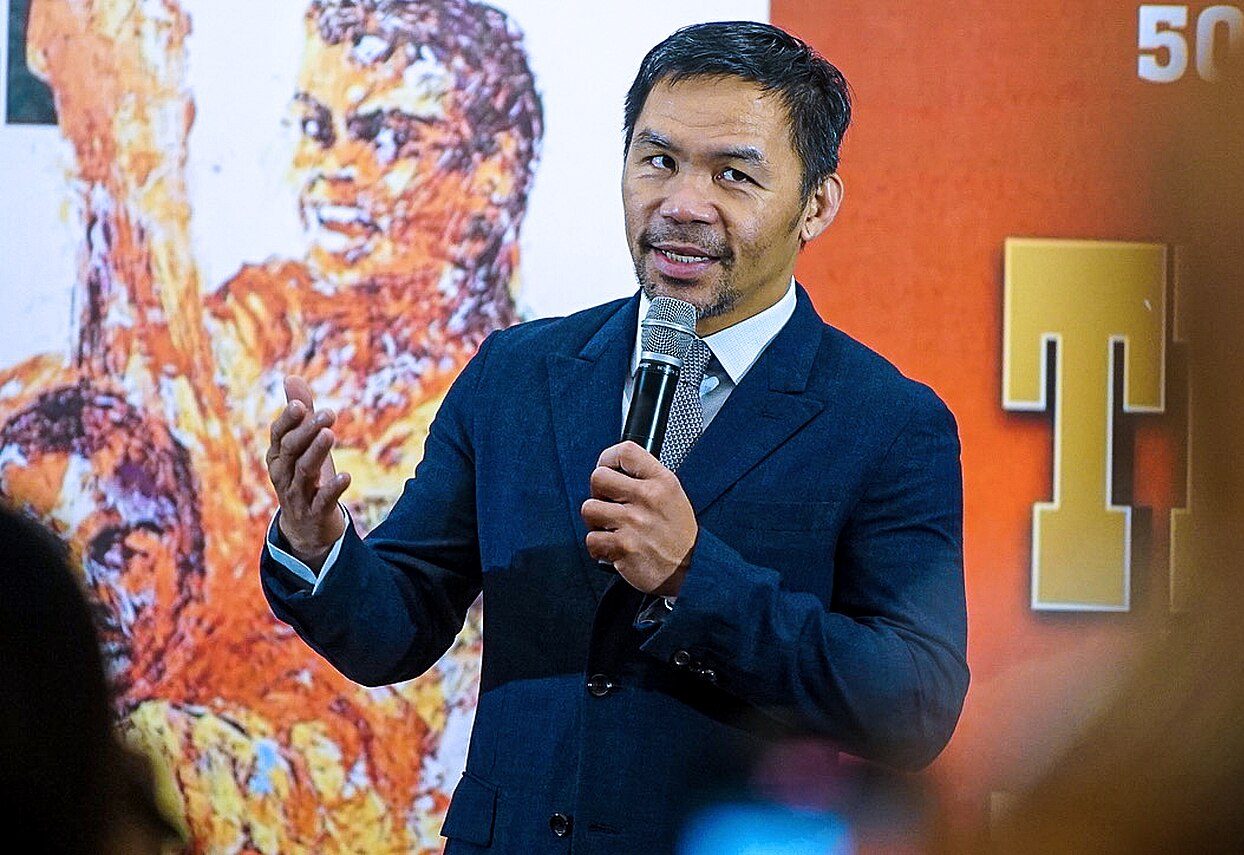
Photo: Robert Oswald P. Alfiler for the Philippine News Agency…, Public domain, via Wikimedia Commons