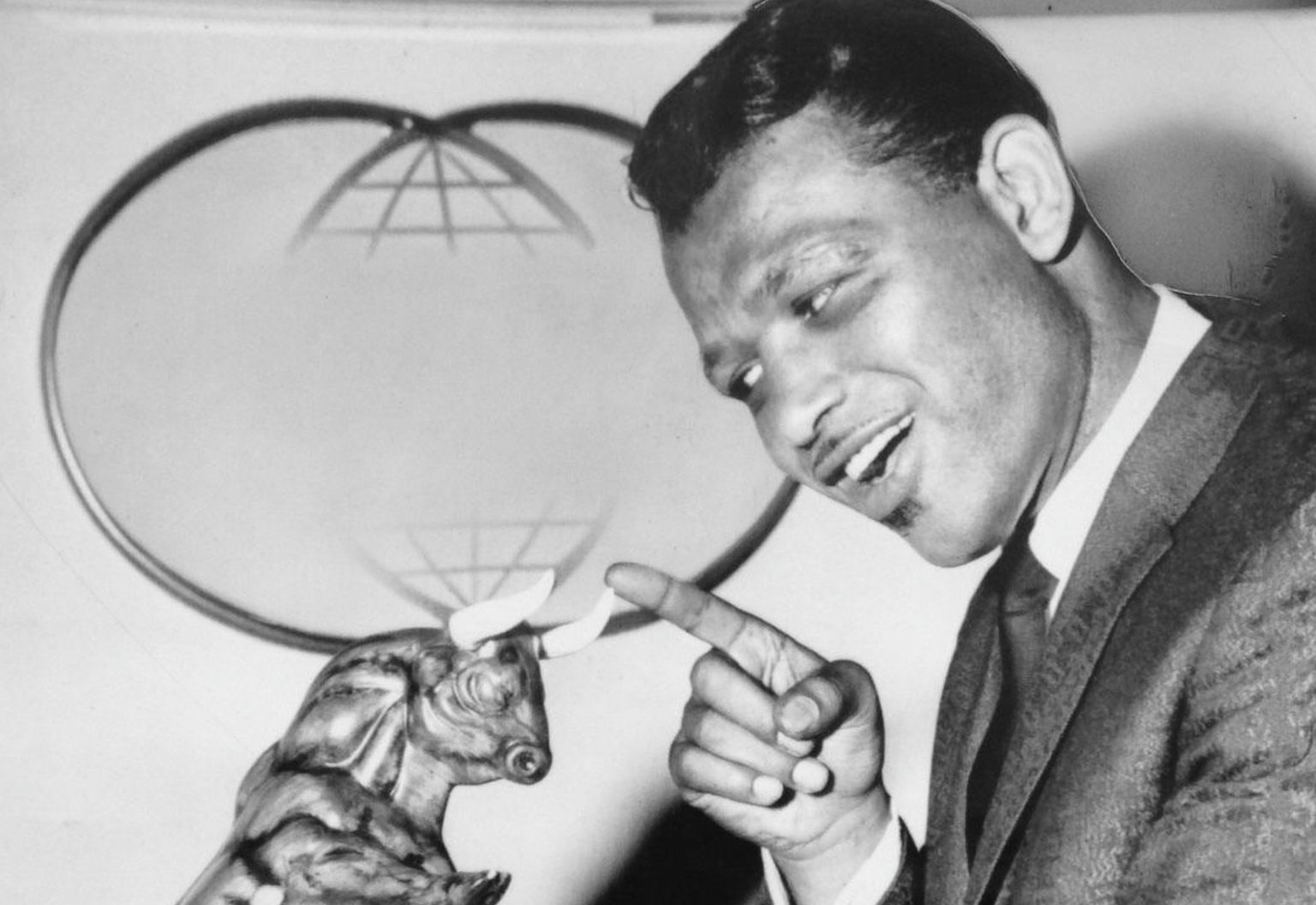
A borrowed amateur boxing card gave Walker Smith Jr. the name he would carry into championship fights. Too young to enter sanctioned competition under his own identity, he used the credentials of a boxer named Ray Robinson. The nickname “Sugar” followed, and the borrowed name became considerably more famous than the original.
Between his professional debut in 1940 and his last fight in 1965, Sugar Ray Robinson won the welterweight championship and held the middleweight crown five times. Those achievements tell only part of the story. There were punishing rivalries, a disastrous night in the heat at Yankee Stadium, a detour into show business and a fortune that largely disappeared.
Before the borrowed name
Born on May 3, 1921, Robinson is generally listed as a native of Ailey, Georgia, although accounts of his birthplace differ. He spent part of his childhood in Detroit before moving with his mother to Harlem.
In Detroit, Joe Louis provided an early glimpse of what boxing could offer. Robinson later recalled living near the future heavyweight champion and watching him at the Brewster Recreation Center. Henry Armstrong, whose relentless pressure carried him to championships in three divisions, became another important boxing influence.
Harlem supplied the setting for Robinson’s own development. Under trainer George Gainford, he began turning quick hands and natural coordination into a fighting method.
The familiar account of his nickname credits a spectator with describing him as “sweet as sugar.” Like many stories passed down through boxing, the details vary between tellings.
His amateur record is commonly given as 85 wins without defeat, including 69 knockouts. That figure should be treated cautiously: historical records include reported appearances under his birth name that complicate the unbeaten account. His major amateur achievements are firmer ground. He won New York Golden Gloves titles at featherweight in 1939 and lightweight in 1940.
Forty wins before the first defeat
Robinson made his professional debut at Madison Square Garden on October 4, 1940, stopping Joe Echevarria in the second round.
The matchmaking soon became serious. In 1941, he beat reigning lightweight champion Sammy Angott in a non-title contest, future welterweight champion Marty Servo and experienced welterweight Fritzie Zivic. He was still developing physically, but already beating men who understood the professional ring.
His first 40 bouts ended in victories. Jake LaMotta stopped that sequence in Detroit on February 5, 1943, winning a decision after knocking Robinson through the ropes.
The response came quickly: Robinson beat LaMotta in a rematch three weeks later. Their rivalry eventually covered six fights, with Robinson winning five. LaMotta’s strength and pressure made him a difficult opponent, but the smaller man repeatedly found ways to outbox him.
After that first defeat, Robinson went unbeaten in his next 91 contests. The run included draws and no-contests, not simply victories, and stretched into 1951.
A world championship opportunity nevertheless took years to arrive. Boxing’s promotional and managerial arrangements were tangled with organized crime, and Robinson later maintained that his refusal to accept underworld involvement had delayed his chance. That explanation belongs to his account of the period, rather than being treated as the only reason for the wait.
The welterweight championship, and its cost
On December 20, 1946, Robinson defeated Tommy Bell over 15 rounds at Madison Square Garden to win the vacant world welterweight title. Bell knocked him down in the second round, but Robinson recovered to take the decision.
He successfully defended the championship five times. The challengers included Bernard Docusen, Kid Gavilan and Charlie Fusari, yet the defense against Jimmy Doyle left the deepest personal mark.
Robinson stopped Doyle in the eighth round in Cleveland on June 24, 1947. Doyle died the following day from injuries sustained in the fight.
Robinson later described having dreamed beforehand that he would kill his opponent. The story became a lasting part of boxing lore, but it remains his reported personal experience, not an independently verifiable premonition. The death itself was devastating enough without embellishment.
He continued to defend his title while increasingly fighting above the welterweight limit. By the beginning of the next decade, middleweight offered the more practical challenge.
LaMotta, Turpin and a night of dangerous heat
The sixth and final LaMotta fight took place in Chicago on February 14, 1951. This time, the middleweight championship was at stake.
Robinson gradually took control, landing sustained combinations as LaMotta’s resistance weakened. The referee stopped the fight in the 13th round. Remembered as the “St. Valentine’s Day Massacre,” it gave Robinson his second divisional championship.
The reign lasted less than five months. On July 10, Randy Turpin outpointed him in London, disrupting his rhythm and taking the title. Robinson regained it in New York on September 12, stopping Turpin in the tenth round after a cut threatened his own chances of continuing.
Then came an attempt at a third division.
On June 25, 1952, he challenged light heavyweight champion Joey Maxim at Yankee Stadium. The oppressive heat overwhelmed even referee Ruby Goldstein, who had to be replaced during the contest.
Robinson was ahead on the scorecards but exhausted. He could not answer the bell for the 14th round, giving Maxim a technical-knockout victory. Some accounts describe the ending as a retirement after round 13; the official stoppage is generally recorded in the 14th.
It was the only stoppage defeat of Robinson’s professional career. He retired later that year and tried making his living as an entertainer.
A comeback measured in championships
The stage did not provide a lasting replacement for the ring. Robinson returned to boxing in January 1955 and, that December, knocked out Carl “Bobo” Olson in two rounds to regain the middleweight championship. He stopped Olson again in their 1956 rematch.
Gene Fullmer took the title from him by decision in January 1957. Four months later, Robinson reclaimed it with a fifth-round left hook that caught Fullmer moving forward. The punch became one of boxing’s most studied finishes: short, precisely timed and delivered while Robinson was giving ground.
Carmen Basilio then drew him into a different kind of struggle. The former welterweight champion won their bruising September 1957 fight by split decision. Robinson reversed the result over 15 rounds in March 1958, becoming the first boxer to win a divisional world championship five times.
Paul Pender ended that final reign in January 1960 and won their rematch. Robinson continued fighting, sometimes against opponents who had been children when he first became champion.
His last appearance came against Joey Archer in Pittsburgh on November 10, 1965. He lost a ten-round decision. His professional record is commonly listed as 174 wins, 19 losses, six draws and two no-contests, with 109 knockouts, although historical record compilations differ slightly.
What made his boxing different?
At approximately 5 ft 11 in, Robinson brought height and reach to welterweight, but his effectiveness went well beyond his dimensions.
An orthodox boxer-puncher, he could lead with fast combinations or draw an opponent forward and counter. His footwork helped him change the distance before an exchange and leave at an angle afterward. He could punch hard without first planting himself in an obvious attacking position.
The Fullmer knockout showed his timing. His longer championship fights showed his ability to adjust when a single punch would not settle matters. He was also willing to trade, which made his fights compelling but exposed him to considerable punishment across a long career.
He entered the International Boxing Hall of Fame with its inaugural class in 1990.
Harlem businesses, family and dwindling money
Outside the ropes, Robinson cultivated the appearance of a star. His pink Cadillac and Harlem business interests-including a nightclub and other neighborhood ventures-made him a conspicuous figure away from fight night.
Entertainment was more than a retirement distraction. He performed as a dancer and later took acting roles, including appearances in The Cincinnati Kid and A Rage to Live, both released in 1965.
He married three times. His first marriage, to Marjorie Joseph, ended in annulment; they had a son, Ronnie. He married dancer Edna Mae Holly in 1944, and their son, Ray Robinson Jr., was born in 1949. Following their divorce, he married Millie Wiggins Bruce in 1965.
The earnings did not provide lasting security. Biographical accounts describe substantial losses through spending, business difficulties and tax obligations. Precise online estimates of his eventual net worth are not reliable enough to establish what remained.
There were charitable commitments, too. For the 1950 Fusari defense, he donated all but one dollar of his purse to cancer research. After retirement, he established a youth foundation in Los Angeles.
Robinson developed Alzheimer’s disease in later life and died in Los Angeles on April 12, 1989.
FAQ
What was Sugar Ray Robinson’s real name?
Walker Smith Jr. He adopted Ray Robinson’s name after borrowing another boxer’s amateur identification.
How many world championships did he win?
He held the welterweight championship once and the middleweight championship five times: six reigns across two divisions.
What was his professional record?
It is commonly listed as 174-19-6, with two no-contests and 109 knockouts. Historical compilations vary slightly.
Who first defeated him professionally?
Jake LaMotta won a decision on February 5, 1943, in Robinson’s 41st professional fight.
Did he win a light heavyweight championship?
No. He challenged Joey Maxim in 1952 but could not continue because of heat exhaustion, despite leading on the scorecards.
Photo: UPI, Public domain, via Wikimedia Commons