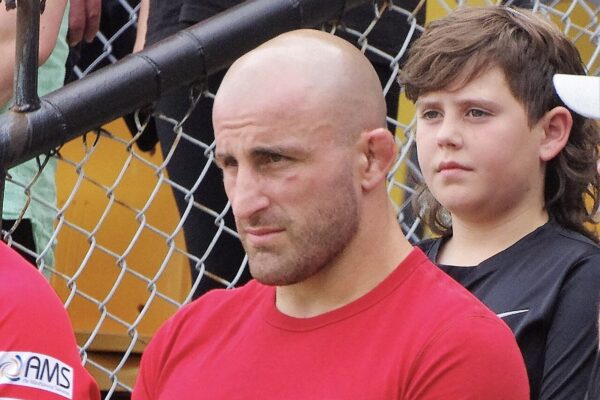

A left head kick landed with 56 seconds left, and suddenly years of patient work had a finish everyone could picture. Leon Edwards had spent most of his UFC career winning without much noise around him. Then, at UFC 278, he knocked out Kamaru Usman and turned a long, disciplined climb into one of the defining moments in the welterweight division.
From Kingston to Birmingham
Edwards was born in Kingston, Jamaica, on August 25, 1991. He has spoken often about growing up in poverty there, including living in a one-room shack before his family moved to England. At nine, he relocated to Aston in Birmingham, a move that changed his surroundings but did not immediately bring stability.
His childhood and teenage years were marked by violence and upheaval. When he was 13, his father was shot and killed in London. Edwards later described drifting into crime as a teenager in Birmingham, including street fighting and drug dealing. The nickname “Rocky” came from those school years, when fighting was already part of his identity.
MMA gave that energy a direction. He began training in his mid-teens, around 16 or 17, and the gym became the structure that had been missing. Before turning professional, he had a brief amateur run and went 2-0 with 1 no contest.
Building on the UK scene
Edwards made his professional debut in 2011 on the British regional circuit. In those early years he fought under the Fight UK and BAMMA banners, learning quickly and taking bouts in more than one weight class before settling at welterweight.
The key breakthrough came in BAMMA. On May 5, 2014, he submitted Wayne Murrie to win the BAMMA welterweight title, a result that helped push him toward the UFC. Even then, the outline of his game was clear: a composed southpaw, hard to rush, comfortable at range, and increasingly effective in the clinch.
He was not built as a brawler. He was building into a tactician.
A difficult UFC start, then steady progress
The UFC debut arrived on November 8, 2014, and it did not go his way. Edwards lost a split decision to Claudio Silva in a competitive fight, the kind of debut that can either stall a prospect or sharpen him. In his case, it did the latter.
The next year brought one of the quickest finishes of his career. In April 2015, he stopped Seth Baczynski in just eight seconds, one of the fastest knockouts in UFC welterweight history. Later that year, on December 19, he met Kamaru Usman for the first time and lost a unanimous decision. At the time it was simply a setback against a strong wrestler. Later, it would become the first chapter of the rivalry that defined his championship run.
From there, Edwards started to look like one of the division’s most reliable operators. He beat fighters such as Dominic Waters, Albert Tumenov, Vicente Luque, Bryan Barberena and Peter Sobotta, adding layers to his reputation as a measured, technical welterweight who rarely gave opponents the kind of fight they wanted.
The Sobotta finish stood out. Edwards knocked him out with one second left in the third round, tied for the latest knockout in UFC history. It was a reminder that his style, though often controlled, could still produce sharp endings.
The long unbeaten run
What followed was the stretch that made him impossible to ignore, even if title opportunities did not come quickly. Edwards beat Donald Cerrone in Singapore, then outpointed Gunnar Nelson and Rafael dos Anjos. He was not collecting viral moments every time out, but he was stacking wins against ranked opposition and doing it with consistency.
By the time he reached the early 2020s, he had built one of the strongest unbeaten runs in the division. The numbers are sometimes framed differently because of the no contest against Belal Muhammad, but the broader point holds: for years, he simply did not lose.
That Belal fight, on March 13, 2021, ended abruptly when an accidental eye poke left Muhammad unable to continue. Officially it went down as a no contest, an unsatisfying result for both men and one that would matter later.
Three months after that, Edwards fought Nate Diaz in a five-round main event and won by unanimous decision. Diaz had a late surge, but Edwards controlled most of the fight and stayed in the title picture. It was another professional performance in a career full of them.
Leon Edwards and the Usman rivalry
The defining turn came against the one man who had already beaten him cleanly.
On August 20, 2022, Edwards challenged Kamaru Usman for the UFC welterweight title at UFC 278. Through most of the fight, Usman was ahead and seemed on course to retain the belt. Then Edwards found the opening. With less than a minute left in round five, he whipped a left high kick around Usman’s guard and knocked him out.
It was one of the most dramatic title-fight finishes the UFC has seen. It also made Leon Edwards the first Jamaican-born UFC champion and the second British fighter to win a UFC title.
The victory mattered for more than the belt. It changed the way his whole run was viewed. Years of careful, sometimes underappreciated work now had a signature moment attached to them.
The trilogy took place on March 18, 2023, at UFC 286 in London. This time Edwards was the champion and won a majority decision over Usman to retain the title. It was his first successful defense, and it carried a different kind of weight from the knockout. The head kick had made history; the rematch showed he could manage a championship fight over five rounds against the same elite opponent and still come out ahead.
He followed that with another defense on December 16, 2023, beating Colby Covington by unanimous decision at UFC 296. It was not a wild fight, but it was a clear one. Edwards controlled the range, defended well, and looked every bit like an established champion rather than a man living off one famous finish.
Losing the belt
The next major chapter brought him back to Belal Muhammad, the opponent from the 2021 no contest.
Their rematch took place on July 27, 2024, with the UFC welterweight title on the line. This time there was no ambiguity. Muhammad won a unanimous decision and ended Edwards’ reign.
That loss closed a championship run that included two successful title defenses and wins over Usman twice and Covington once. It was not a long reign by historic standards, but it was substantial enough to move Edwards out of the category of one-night upset winner. He had defended the belt, handled different styles, and proved he belonged at the top.
His listed professional MMA record stands at 22-6 with 1 no contest.
How he fights
At his best, Edwards controls a fight without making it look frantic. He is a southpaw who works behind a sharp lead hand, clean body kicks and accurate straight shots. He prefers to set tempo rather than chase exchanges.
The clinch has long been one of his strongest areas. Knees, elbows and positional control make him difficult to smother, and opponents who try to crowd him often find themselves stuck in a slower, more technical fight than they wanted. He is also a capable grappler, with strong takedown defense and enough composure on the mat to avoid panic.
That is a big part of why his career developed the way it did. Edwards rarely looked reckless, rarely gave away position, and usually forced opponents to operate at his pace. For some viewers, that made him understated. For coaches and contenders, it made him a problem.
Life outside the cage
Birmingham runs through his story from start to finish. It is where he arrived as a child, where he got into trouble as a teenager, and where he rebuilt his life through training. Team Renegade became central to that transformation, and Edwards has remained closely tied to the gym and the city.
Fighting is also a family trade. His brother, Fabian Edwards, is a professional mixed martial artist who has competed at a high level himself. Leon is also a father to a son, a part of his private life he has acknowledged publicly without making it a constant feature of his profile.
Outside the cage, he has taken on sponsorship and media work, as many top fighters do. Reported brand partnerships have included Venum, Monster Energy, MyProtein and other sportswear or supplement companies. Exact endorsement terms are generally private, so broad earnings claims in that area should be treated as estimates rather than firm fact.
The charitable side of his public life is better documented. Edwards has been linked with youth work in the UK, including support for OnSide Youth Zones, and he has also been associated with the Bob & Rita Marley Foundation. In 2023, he took part in Soccer Aid, the charity event that raises money for UNICEF. Those appearances fit the public version of Edwards that emerged after he became champion: not loud, not especially theatrical, but willing to use his platform.
Leon Edwards net worth and career earnings
Any Leon Edwards net worth figure should be treated cautiously. Different outlets have published very different estimates, ranging from a few million dollars to much higher numbers, and fighters’ real finances are rarely public in full. Reported purses for his title-fight period were clearly the biggest of his career, especially around the Usman rematch, the Covington defense and the Belal Muhammad title fight, but exact totals vary by source.
The firmer point is simpler. Becoming champion changed his earning level, his visibility and his place in British MMA history.
FAQ
Where is Leon Edwards from?
He was born in Kingston, Jamaica, and moved to Birmingham, England, as a child.
What is Leon Edwards’ nickname?
His nickname is “Rocky.”
Did Leon Edwards become UFC champion?
Yes. He won the UFC welterweight title by knocking out Kamaru Usman at UFC 278.
Did Leon Edwards lose the UFC welterweight title?
Yes. He lost the belt to Belal Muhammad by unanimous decision on July 27, 2024.
Who is Leon Edwards’ brother?
His brother is Fabian Edwards, also a professional MMA fighter.
What gym does Leon Edwards train with?
He has long been associated with Team Renegade in Birmingham.
Photo: James English, CC BY 3.0, via Wikimedia Commons