Twenty-nine fights, twenty-nine wins, no comeback tour. In mixed martial arts, that kind of ending is almost unheard of, which is one reason Khabib Nurmagomedov still sits in a rare place in the sport.
His record is the clean headline, but the career story is richer than a line of numbers. Nurmagomedov arrived from Dagestan with a style that felt old-world and modern at the same time: chain wrestling, trips from the clinch, smothering top control, and a calm, almost clinical sense of pace. By the time he retired after submitting Justin Gaethje in October 2020, he had become UFC lightweight champion, defended the belt three times, and left without a loss.
From Sildi to the mats
Khabib Abdulmanapovich Nurmagomedov was born on September 20, 1988, in Sildi, in what was then the Dagestan ASSR of the Soviet Union. He grew up in a fighting culture, and more specifically in his father’s system. Abdulmanap Nurmagomedov was not just a parent with an interest in sports; he was a coach, organizer and central figure in Dagestani combat training. That mattered.
The foundation came early. Nurmagomedov started wrestling as a child, later added judo, and then moved into combat sambo as a teenager. Those disciplines did not stay separate for long. They blended into the style that would define him in MMA: pressure against the fence, balance in scrambles, quick transitions from takedown to control, and a steady ability to wear opponents down.
One image has followed him for years: the childhood video of him grappling with a bear. It is real, and it became part of the public mythology around his upbringing, though it explains less about his success than the harder, less cinematic truth, years of structured training under a demanding coach.
Amateur success before the UFC
Before the UFC ever signed him, Nurmagomedov had already built a serious résumé in combat sports. He won titles in army hand-to-hand combat and pankration, then established himself in combat sambo, one of the strongest feeder systems for his kind of MMA.
He won the World Combat Sambo Championship in 2009 and again in 2010, achievements that gave context to what would come later in the cage. This was not a raw wrestler learning on the fly. He was already a polished grappler with high-level competitive experience, and that showed in how quickly he controlled professional fights.
A fast regional climb
Nurmagomedov turned professional in 2008 and was busy from the start. He fought across the regional circuit in Russia and Ukraine, often more than once in a month, and piled up wins before most international fans had heard his name.
By the time the UFC called, he was 16-0. That unbeaten run was built outside the spotlight, but it was not empty. He had already become the kind of fighter opponents struggled to solve. He did not need much room to work, he rarely wasted position, and once he got on top, rounds could disappear quickly for the man underneath him.
The UFC years begin
His UFC debut came on January 20, 2012, against Kamal Shalorus. Nurmagomedov won by third-round submission, a controlled introduction to the lightweight division. Later that year he beat Gleison Tibau by unanimous decision in a fight that remains one of the more debated scorecards of his career, but it still went into the books as another win.
The next stretch established his place in the division. He beat Thiago Tavares in January 2013, then Abel Trujillo in May. The Trujillo fight produced one of the promotion’s more remarkable stat lines: 21 takedowns, still a UFC single-fight record. It was less a curiosity than a perfect snapshot of what he did to people. He kept asking the same question until opponents ran out of answers.
Wins over Pat Healy and Rafael dos Anjos followed in 2013 and 2014, and by then he looked like a future title challenger. Injuries slowed the climb. He spent long stretches out of action and lost momentum at a time when the lightweight title picture kept moving without him.
When he returned, he picked up where he had left off. He beat Darrell Horcher in April 2016, outclassed Michael Johnson later that year, and then dominated Edson Barboza in December 2017. The Barboza performance, in particular, felt like a final argument for a title shot. Barboza was one of the division’s most dangerous strikers; Nurmagomedov turned the fight into a prolonged lesson in control.
Winning the UFC lightweight title
The championship finally came in April 2018 at UFC 223. Nurmagomedov faced Al Iaquinta for the vacant UFC lightweight title and won by unanimous decision over five rounds.
That win made him the UFC lightweight champion and the first Muslim fighter to win a UFC title. It also arrived after a chaotic week in Brooklyn, where the original title plans had fallen apart and the event itself had become tangled in the fallout from Conor McGregor’s attack on a bus carrying fighters. Nurmagomedov still had to do the hard part in the cage, and he did it with the same measured pressure that had carried him there.
McGregor, Poirier and Gaethje
His reign is easy to trace because the biggest fights came one after another.
First came Conor McGregor at UFC 229 in October 2018. It was the most heated rivalry of Nurmagomedov’s career and one of the UFC’s biggest commercial events. Inside the cage, he won by fourth-round submission. The fight mixed everything he did well: takedowns, control, patience, and enough striking threat to keep McGregor guessing.
The night did not end cleanly. After the submission, Nurmagomedov jumped the cage and moved toward McGregor’s team, triggering a post-fight brawl. The Nevada State Athletic Commission later suspended him and fined him $500,000. That episode remains one of the defining controversies of his career because it cut against the control he usually showed while fighting.
The second defense came against Dustin Poirier at UFC 242 in September 2019 in Abu Dhabi. Nurmagomedov won by third-round submission, gradually breaking Poirier’s resistance with pressure and grappling exchanges that became harder to survive as the fight went on.
The third and final defense was against Justin Gaethje at UFC 254 in October 2020. Gaethje entered as interim champion and one of the division’s hardest hitters. Nurmagomedov submitted him in the second round with a triangle choke, finishing his career at 29-0.
That was the last time he fought.
Why his style worked
Some champions are remembered for speed, others for power. Nurmagomedov’s game was about control.
Officially, he retired with 8 wins by knockout, 11 by submission and 10 by decision. Those numbers show balance, but they can undersell the feel of his fights. He was not usually chasing a quick finish at all costs. He was building a fight that became harder and harder to escape.
He fought from an orthodox stance, mostly at lightweight, though some early bouts came at welterweight. On the feet, he was functional rather than flashy. The real danger began once he closed distance. From there came the clinch, the trip, the chain takedown, the wrist control, the fence work, the leg ride, the slow drain of time and energy.
That style made even elite lightweights look stuck. It also translated into a 13-0 UFC record, one of the best unbeaten runs the division has seen.
Retirement after Gaethje
Nurmagomedov announced his retirement in the cage after beating Gaethje on October 24, 2020. The decision carried extra weight because his father, Abdulmanap, had died earlier that year. Nurmagomedov said he had promised his mother he would not continue without his father.
The UFC later recognized the retirement as official in March 2021. He never returned.
There have been later claims and rumors about whether family reasons were the only factor. For example, lightweight Dan Hooker publicly suggested there may have been more behind the decision. That remains outside speculation rather than an established fact.
Nurmagomedov was inducted into the UFC Hall of Fame, Modern Wing, in 2022.
Life outside the cage
Away from fighting, his life has remained closely tied to family, faith, business and the Dagestani coaching culture that shaped him. He is married, and multiple outlets have reported that he and his wife have three children. He generally keeps his family life private, and that privacy has been a consistent part of his public image.
He has also stayed active in the sport as a mentor and coach, helping guide fighters from Dagestan and beyond. For a period he was heavily involved in Eagle FC, the promotion that emerged from his acquisition of Gorilla Fighting Championship.
Business has become a major part of the post-fighting chapter. Reported ventures linked to him have included gyms, nutrition and fitness brands, technology projects and real estate interests in Russia and the UAE. As with many athlete business portfolios, exact ownership structures and valuations are not always fully public.
That is also true of Khabib Nurmagomedov net worth estimates. Different celebrity-finance sites and sports business reports have placed the figure in a broad range, often between roughly $25 million and $40 million, but those numbers are estimates, not verified disclosures.
His public life has not been free of criticism. His association with Chechen leader Ramzan Kadyrov has been widely documented and scrutinized. He has also faced backlash for public comments on cultural and social issues. Where sponsorships and business consequences are concerned, exact cause-and-effect claims are often reported loosely, so it is safer to say that some of his statements have drawn public criticism and commercial scrutiny rather than present every reported consequence as settled fact.
FAQ
What is Khabib Nurmagomedov’s MMA record?
He retired with a professional MMA record of 29-0.
When did Khabib Nurmagomedov retire?
He announced his retirement on October 24, 2020, after defeating Justin Gaethje. The UFC later made it official in March 2021.
Who did Khabib win the UFC lightweight title against?
He won the vacant UFC lightweight title by unanimous decision against Al Iaquinta at UFC 223 in April 2018.
How many times did he defend the UFC lightweight championship?
He defended the belt three times: against Conor McGregor, Dustin Poirier and Justin Gaethje.
What was Khabib Nurmagomedov’s fighting style?
He was known for pressure wrestling, clinch work, chain takedowns, top control and submissions, built on wrestling, judo and combat sambo.
What is known about Khabib Nurmagomedov net worth?
Public estimates vary, commonly landing between about $25 million and $40 million, but no definitive verified figure is publicly confirmed.
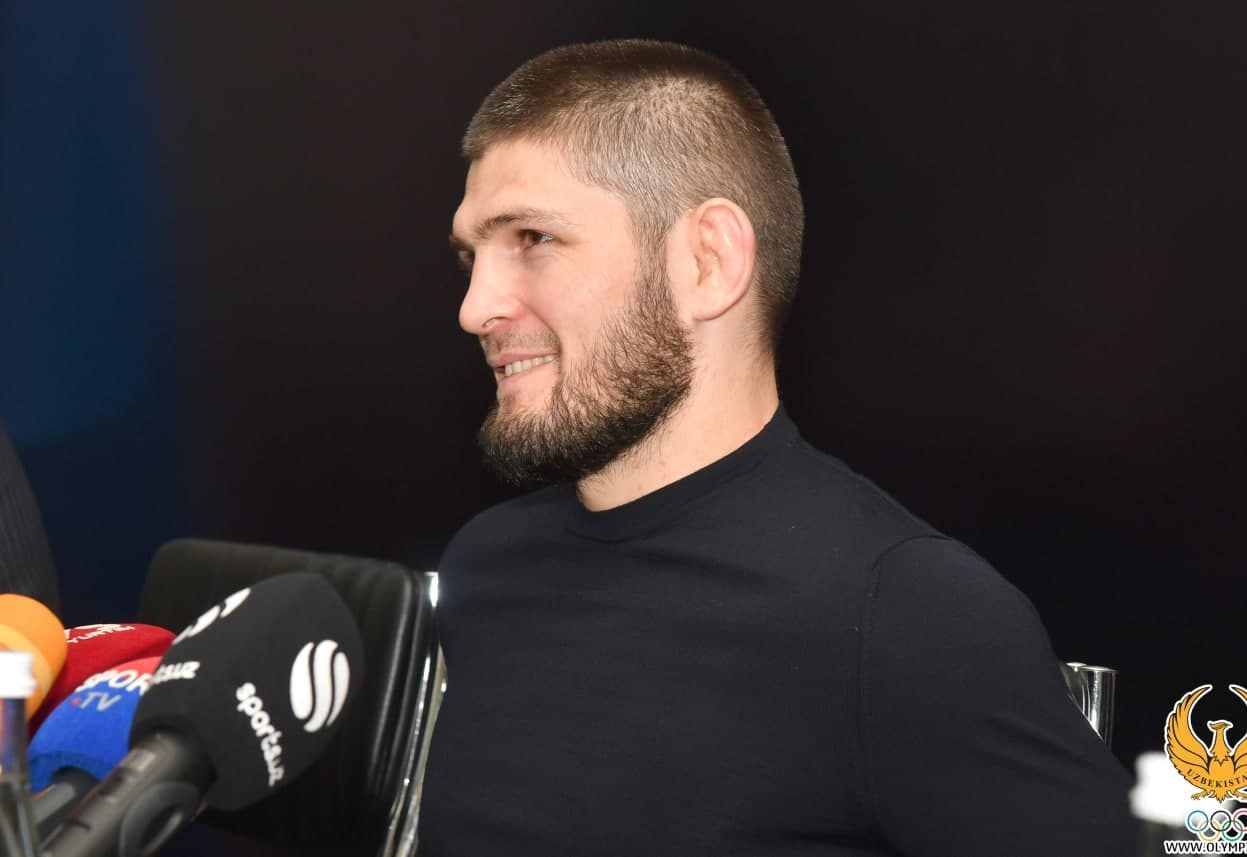
Photo: Национальный олимпийский комитет Республики Узбекистан, CC BY 4.0, via Wikimedia Commons