David Haye could make Nikolai Valuev miss, but he could not put him down. Their 12-round fight in November 2009 ended with the WBA heavyweight title changing hands on a majority decision. It also closed the Russian’s professional career: 50 victories, two defeats, one no contest, and no knockdowns suffered.
At 2.13 metres, or seven feet, Valuev was the tallest heavyweight world champion boxing had seen, and the heaviest to win a world title. Those dimensions made him a curiosity long before he became a champion. His career, however, was more complicated than the spectacle: two title reigns, disputed scorecards and physical problems that eventually made continuing impossible.
From Leningrad to a boxing ring
Nikolai Sergeyevich Valuev was born on August 21, 1973, in Leningrad, the Soviet city now called Saint Petersburg. His exceptional height was not a family characteristic; neither parent approached his eventual size.
Before boxing, he tried sports in which that height offered a more obvious advantage. Basketball was one, while athletics introduced him to the discus. Boxing became his profession, but it was not the childhood pursuit around which everything else had been arranged.
His amateur apprenticeship was brief. He made his professional debut in Berlin on October 15, 1993, stopping John Morton in the second round. There was no immediate rush toward a world championship. Under trainer Oleg Shalaev, he spent the following years learning how to turn an unusual physique into a workable heavyweight style.
That meant developing more than punching power. Balance, conditioning and the ability to keep opponents at the end of his jab would matter increasingly as the opposition improved.
A long climb to John Ruiz
The Russian heavyweight championship came in 1999, followed by the regional PABA title in 2000. Manvel Gabrielyan took over as trainer that year, beginning another stage in a gradual climb through the rankings.
Not every result remained straightforward. A 1999 victory over Andreas Sidon was subsequently changed to a no contest. That distinction matters when reading his record: the extra result was not a draw.
By 2004, Valuev had added the WBA Inter-Continental belt. His size attracted attention, particularly in Germany, where he became a familiar attraction, but a world-title opportunity still required him to prove he could beat established contenders.
On December 17, 2005, he challenged John Ruiz for the WBA heavyweight championship in Berlin. Ruiz was an experienced, awkward champion, accustomed to close-range fights that rarely rewarded an opponent’s patience.
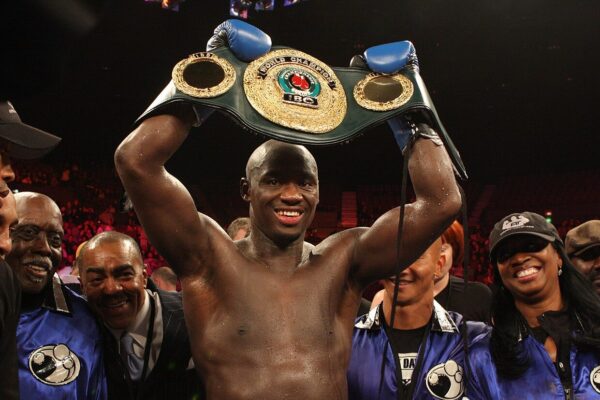
After 12 rounds, Valuev received a majority decision. Two judges favoured him; the third scored a draw. The scoring was disputed, but the result stood, making him the first Russian to win a major professional world heavyweight title.
He weighed well over 300 pounds for the contest. Boxing had never crowned a heavyweight champion so tall or so heavy.
Three defenses, then a first defeat
The first reign produced three successful defenses, each ending inside the distance.
Owen Beck lasted three rounds in June 2006. Monte Barrett offered more resistance that October before being stopped in the 11th. In January 2007, Jameel McCline’s challenge ended in the third round when a knee injury left him unable to continue.
The circumstances differed, but the sequence established that Valuev could do more than occupy space and wait for the scorecards. His record ultimately included 34 knockout victories.
Ruslan Chagaev presented a different problem on April 14, 2007, in Stuttgart. The shorter southpaw used movement, changes of angle and quick entries to get past the champion’s reach. Valuev could not consistently make the fight happen at his preferred distance.
Chagaev won a majority decision over 12 rounds, handing him his first professional defeat. The size advantage had not disappeared; an opponent had found a way to work around it.
Alexander Zimin became Valuev’s trainer in 2007 and guided the final phase of his career.
Back to the belt and into controversy
A clear points victory over former titleholder Siarhei Liakhovich in February 2008 helped restore his position. The WBA title situation, meanwhile, became tangled when illness prevented Chagaev from making a scheduled defense against him.
With Chagaev designated “champion in recess,” Valuev faced Ruiz again on August 30, 2008. This time he won a unanimous decision, beginning his second WBA reign. The administrative circumstances meant it was not a clean resolution of his rivalry with Chagaev, but he had a championship belt again.
His next challenger was Evander Holyfield.
At 46, the former undisputed champion was far removed from his best years. On December 20, 2008, in Zurich, he nevertheless used movement and selective combinations to make the much larger titleholder look hesitant.
Valuev retained the belt by majority decision. Many ringside observers and television viewers believed Holyfield had done enough to win, and the WBA subsequently reviewed the scoring. The official result remained unchanged.
It was his fourth successful defense across two reigns, but hardly a reassuring one. The argument afterward concerned the judges rather than an emphatic performance by the champion.
Haye, the final bell and failing health
David Haye followed a similar tactical principle when they met in Nuremberg on November 7, 2009: avoid prolonged exchanges, move and score before the bigger man could set himself.
The British challenger won a majority decision. One judge scored it level; the other two gave Haye the fight. Valuev lost his championship for the second and final time.
He never boxed professionally again. Bone and joint problems were central to his withdrawal from the sport, and his health history also included acromegaly, a condition involving excessive growth-hormone production.
His completed record was 50 wins, two losses and one no contest, with 34 knockouts. Both defeats came over the full 12 rounds. He was never stopped or knocked down in a professional contest.
The notation sometimes given as “50-2-1” can be misleading: that final result represents a no contest, not a draw. The clearer version is 50-2, 1 NC.
How he fought: making size useful
An orthodox boxer with a listed reach of 216 centimetres, Valuev did his best work behind a long jab. He advanced steadily, forcing opponents to spend energy moving around him or trying to cross the considerable distance to his body and head.
He was not especially quick, and agile opponents could leave him turning rather than punching. Chagaev and Haye exposed those limitations without needing to overpower him.
Still, remaining effective across 12 rounds at his size required conditioning. His durability also held up against championship opposition. The spectacle of a seven-foot heavyweight sometimes obscured the practical qualities that kept him competitive: patience, a persistent jab and the ability to absorb punches without losing his footing.
Family, poetry and a political second career
Away from the ring, published profiles have described a less intimidating personality than his “Beast from the East” billing suggested. He has said he prefers “The Russian Giant,” and accounts of his courtship with his wife, Galina, include an unexpected detail: poetry.
The couple have three children, two sons and a daughter. That family portrait offers a different view of a man whose public image was so often reduced to measurements.
Writing became part of his professional story, too. With Konstantin Osipov, he co-wrote My 12 Rounds, an account of his life and boxing career.
His involvement in sport continued through the Nikolai Valuev Boxing School, established in 2009, and youth-sports initiatives. In 2011, he also became general manager of Russia’s national bandy team.
That same year brought a more substantial change of arena: election to Russia’s State Duma as a representative of United Russia. Politics became a continuing public career, rather than a brief retirement appearance. The former heavyweight champion had exchanged title defenses for parliamentary work.
FAQ
How tall is Nikolai Valuev?
He is 2.13 metres tall, or seven feet. He became the tallest world heavyweight boxing champion.
What was his professional boxing record?
He finished with 50 wins, two losses and one no contest, including 34 knockout victories.
Was Valuev ever knocked down?
No. He completed his professional career without being knocked down or stopped.
Which world title did he hold?
He held the WBA heavyweight championship twice, from 2005 to 2007 and from 2008 to 2009, making four successful defenses in total.
Why did he stop boxing?
Health problems, particularly involving his bones and joints, prevented his return after the November 2009 defeat by David Haye.
Did he become a politician?
Yes. He was elected to Russia’s State Duma in 2011, representing United Russia.